
Are urology residents losing autonomy? What the case-log role score measures
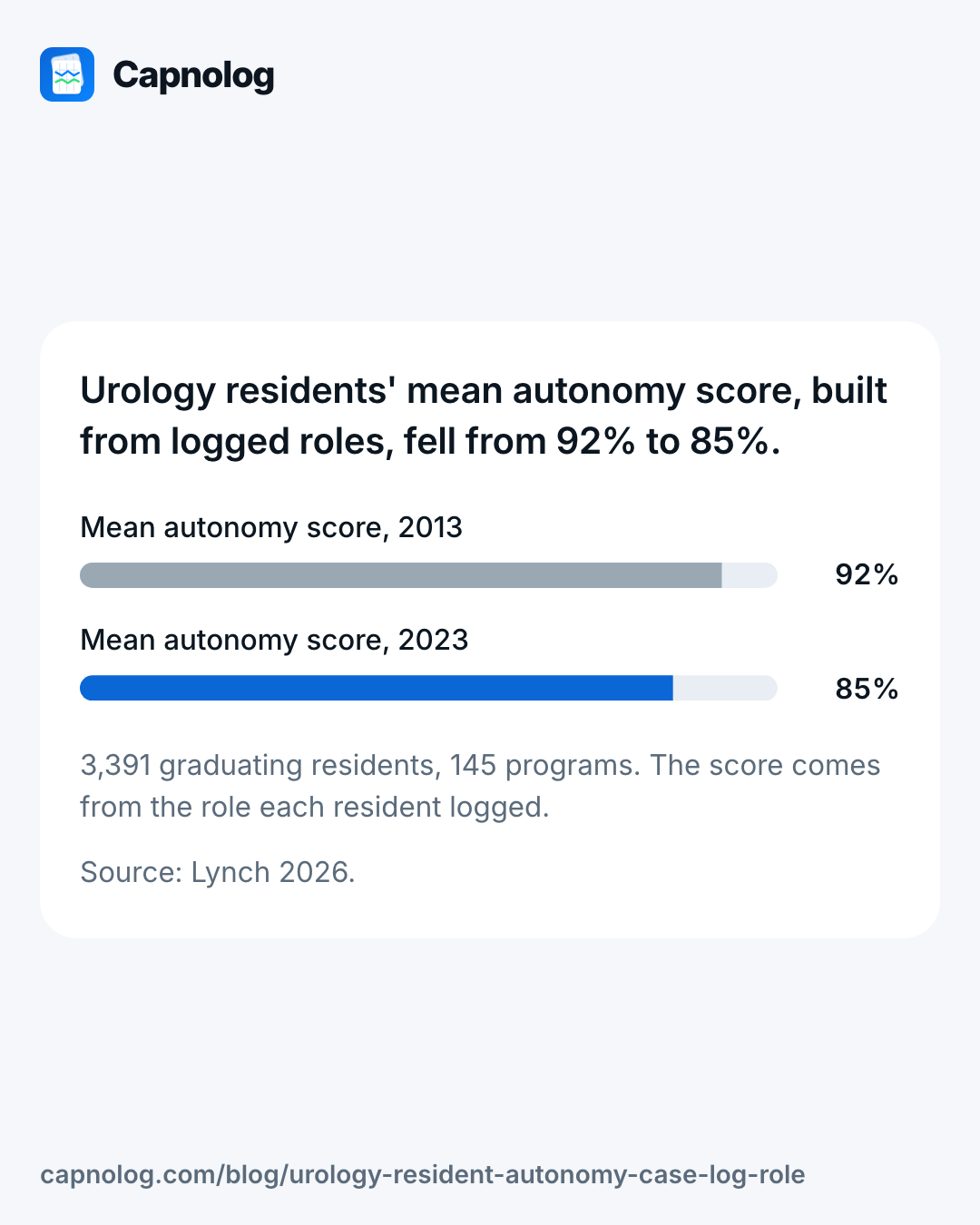
A national analysis of ACGME case logs from 3,391 graduating urology residents in 145 programs reports that the mean autonomy score fell from 92% in 2013 to 85% in 2023. The score comes from the operative role each resident chose when logging a case. How residents choose that role therefore shapes the number.
A resident who builds Capnolog ·
The finding matters to program leaders and to residents. This post explains what the score measures, what research shows about how residents pick a role, and what a program can do.
What the 2026 study reports
Lynch and colleagues analyzed ACGME case-log data for 3,391 graduating urology residents across 145 programs (Lynch 2026). The mean autonomy score fell from 92% in 2013 to 85% in 2023, a statistically significant decline (p < 0.001) (Lynch 2026).
3,391 graduating residents, 145 programs. The score comes from the role each resident logged.
Source: Lynch 2026.
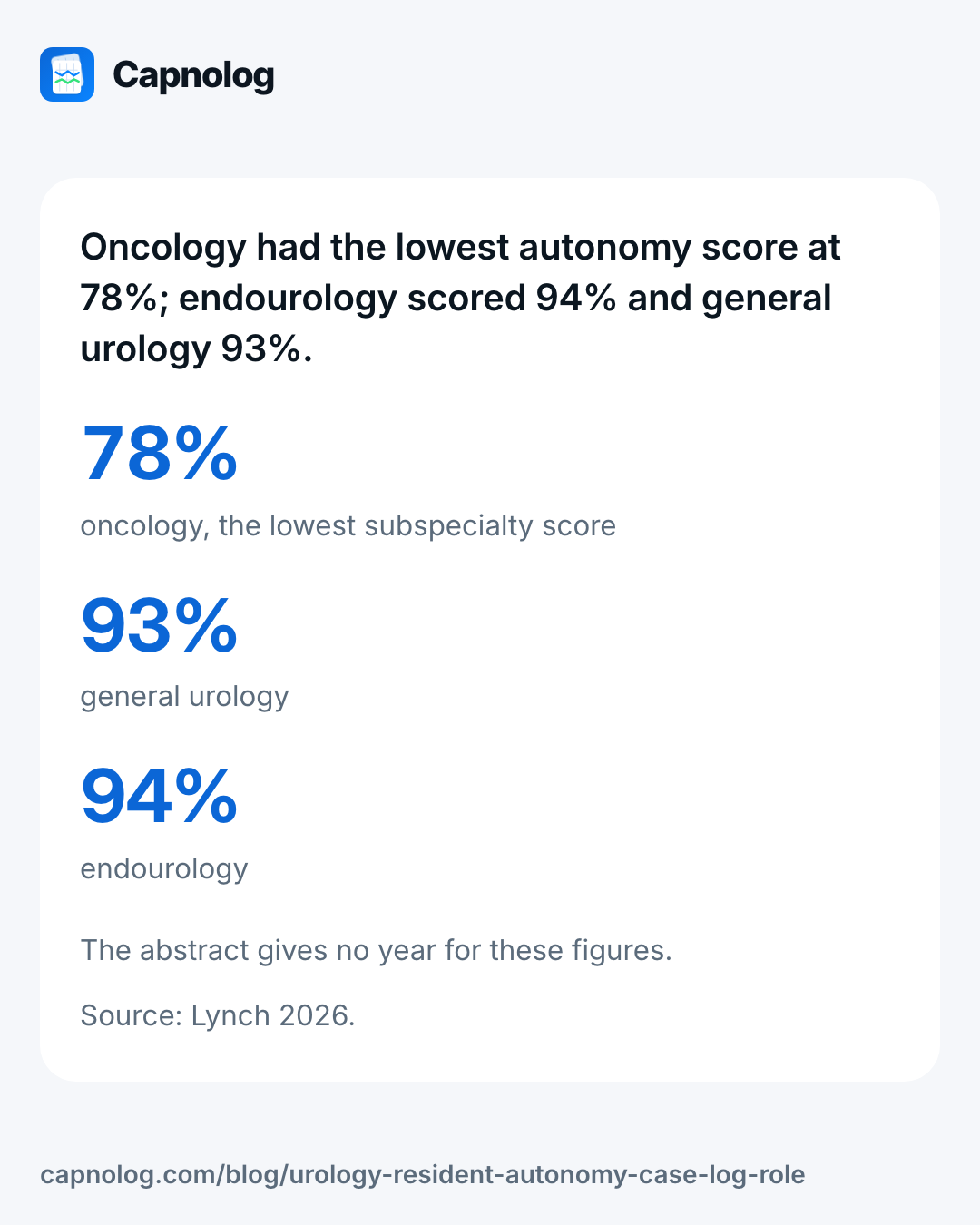
Scores also differed by subspecialty. Oncology had the lowest autonomy at 78%, while endourology scored 94% and general urology 93% (Lynch 2026). The abstract does not say which years those subspecialty figures cover.
The abstract gives no year for these figures.
Source: Lynch 2026.
An earlier study from the same lead author reviewed 364 chief residents' case logs from 11 institutions, from 2010 to 2021 (Lynch 2025). Chief resident autonomy scores fell significantly over that period, and the authors called for validation in a larger national cohort (Lynch 2025).
What goes into the score
The 2026 study used each resident's self-reported operative role as a proxy for autonomy, and computed an autonomy score for each resident (Lynch 2026). The 2025 chief-resident study inferred autonomy from 3 roles: assistant, surgeon, and teaching surgeon (Lynch 2025).
A role in a case log records the resident's own call about their part in the case. The score therefore reflects how residents labeled their role. A faculty rating of autonomy is a different measure.
That distinction matters for reading the trend. A mean built from labels can move when residents do less, and also when residents label the same work differently. The abstracts alone cannot separate those 2 explanations.
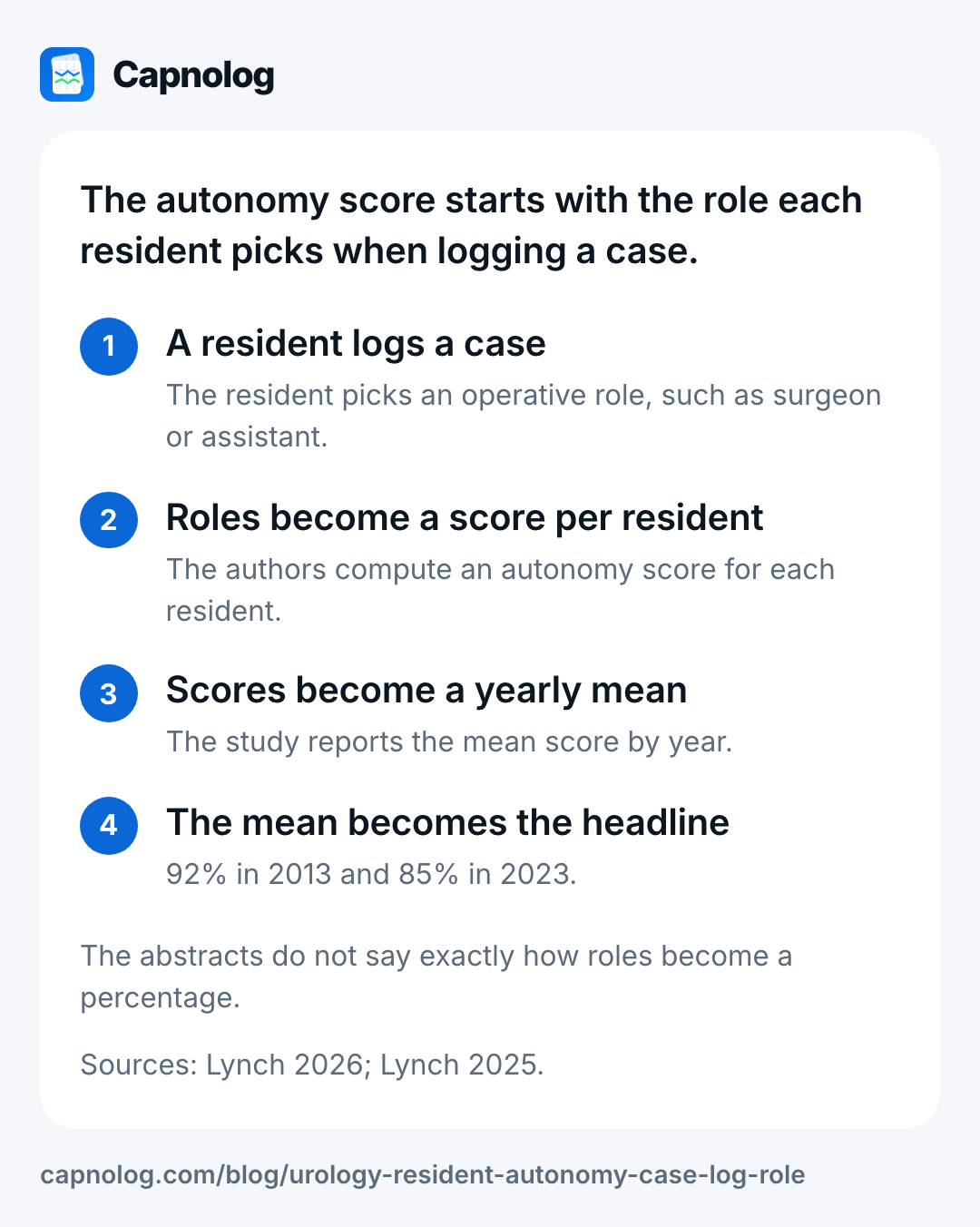
- A resident logs a caseThe resident picks an operative role, such as surgeon or assistant.
- Roles become a score per residentThe authors compute an autonomy score for each resident.
- Scores become a yearly meanThe study reports the mean score by year.
- The mean becomes the headline92% in 2013 and 85% in 2023.
The abstracts do not say exactly how roles become a percentage.
Sources: Lynch 2026; Lynch 2025.
A logged role is not a faculty rating
Faculty ratings measure autonomy another way. In a study at 14 general surgery programs, attendings rated residents' autonomy on the Zwisch scale (George 2017). The share of ratings showing meaningful autonomy rose from 15.1% in the first year of training to 65.7% in the final year (George 2017).
For core procedures, ratings of Practice Ready or above rose from 12.3% to 77.1% (George 2017). In the last 6 months of training, only 33.3% of core-procedure ratings reached Supervision Only (George 2017).
Those numbers come from a different instrument, a different specialty, and a different period. They neither confirm nor contradict the urology trend, so do not set them side by side as one trend.
How consistently residents pick a role
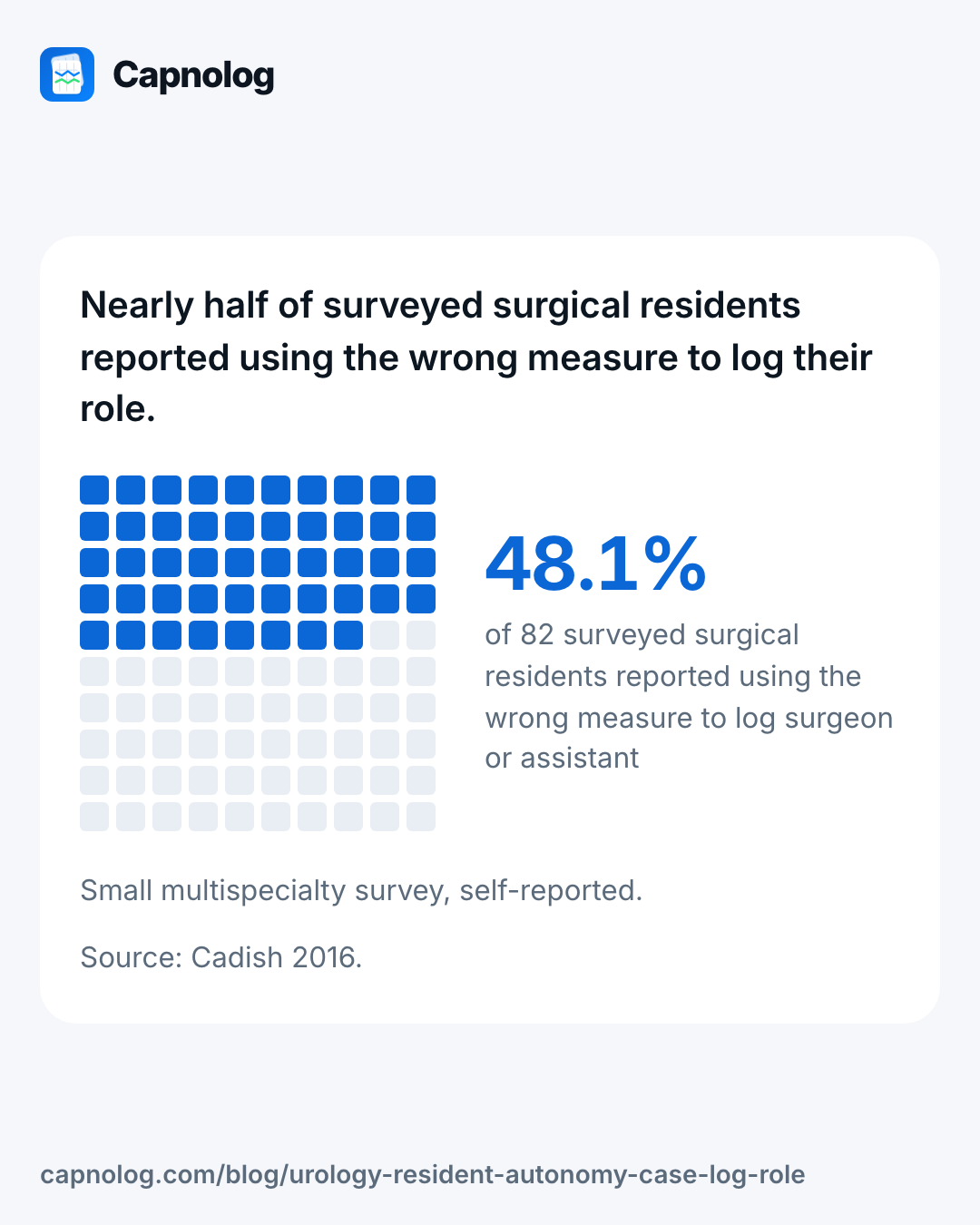
Some evidence suggests role logging varies. Cadish and colleagues surveyed residents in 7 surgical specialties, including urology and neurosurgery, and 82 of 126 eligible residents answered (Cadish 2016). Of those, 48.1% reported using the wrong measure to log their role as surgeon or assistant (Cadish 2016). That survey is small and self-reported, and covers several specialties.
Small multispecialty survey, self-reported.
Source: Cadish 2016.
Other evidence suggests residents can judge their part in a case well. In a small orthopaedic study of 65 knee and hip replacements, 17 residents and 17 staff surgeons rated each resident's involvement (Trajkovski 2012). Residents' ratings showed substantial agreement with the staff surgeons' ratings (ICC 0.80) (Trajkovski 2012).
Put together, residents may judge their involvement well while applying different rules to the role field. Teaching one rule is the part a program controls.
What the ACGME asks urology residents
The ACGME's urology resident survey includes a specialty item on logging. The item asks residents to rate how important accurate logging is after they meet the minimums (ACGME urology update 2026). A second urology item asks residents whether their operative exposure feels equitable next to their peers' (ACGME urology update 2026).
Both items treat the log as a record that should stay complete. For the 2024 and 2026 urology minimum changes, see the 2026 case-log changes. For why a minimum is not a target, see how to judge residency case volume.
What a program director can do
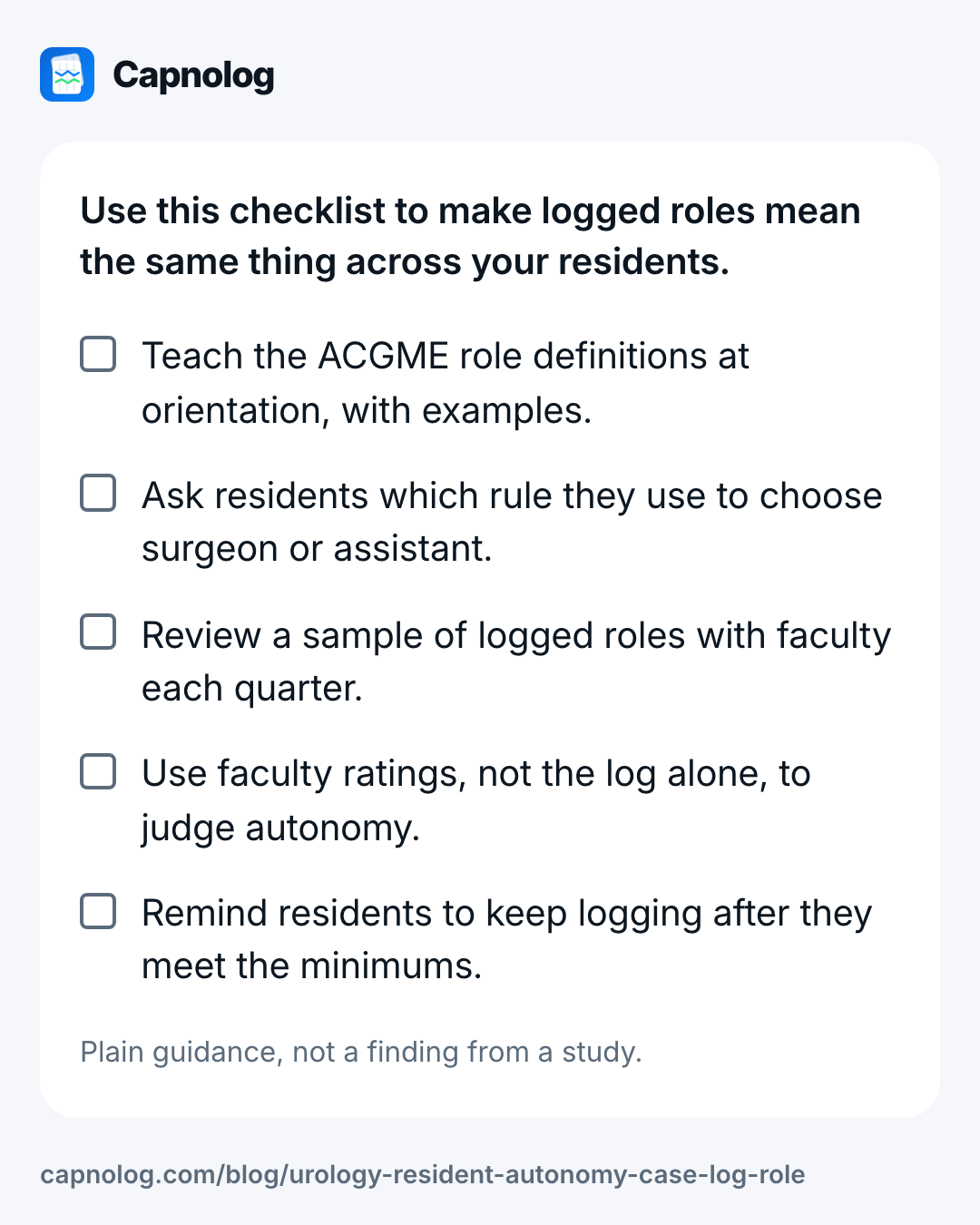
The steps below are plain guidance, not findings from the studies above. Each step aims at the same result: residents who label the same part in a case the same way.
- Teach the ACGME role definitions at orientation, with examples.
- Ask residents which rule they use to choose surgeon or assistant.
- Review a sample of logged roles with faculty each quarter.
- Use faculty ratings, not the log alone, to judge autonomy.
- Remind residents to keep logging after they meet the minimums.
Plain guidance, not a finding from a study.
If you are a resident, ask your program director which definition of surgeon and assistant the program uses. Then apply that one rule to every case, including cases you log late. A consistent label makes your own record easier to read at review time.
For logging habits more broadly, see what improves case-log completion. The urology case minimums page lists the current numbers. Capnolog for urology is coming, and you can join the list on the urology page.
Hear when urology logging opens.
The urology resident module is not generally available yet.
Tell me when urology opensWhat the evidence does not show
- This post uses the abstracts of the 2 urology studies. The abstracts do not say exactly how the score turns roles into a percentage (Lynch 2026; Lynch 2025).
- A self-reported role is a proxy. No study here checked urology residents' logged roles against faculty ratings.
- The faculty-rating study covered general surgery, and the self-assessment study covered 65 orthopaedic cases. Neither result applies to urology directly (George 2017; Trajkovski 2012).
- The role-logging survey is small, covers 7 specialties, and relies on what residents said (Cadish 2016).
- None of this shows that the 2026 finding is wrong. The evidence here describes what the score rests on.
Sources
- Lynch NB, Giannaris ES, Kinley A, et al. Are Urology Residents Losing Autonomy? A National Analysis of ACGME Case Log Data from 2013 to 2023. J Surg Educ. 2026;83(10):104130.
- Lynch NB, Samuel J, Corey Z, et al. Trends in Urology Resident Surgical Autonomy: What Do ACGME Chief Resident Case Logs Indicate? Urology. 2025;204:314-319.
- George BC, Bohnen JD, Williams RG, et al. Readiness of US General Surgery Residents for Independent Practice. Ann Surg. 2017;266(4):582-594.
- Cadish LA, Fung V, Lane FL, Campbell EG. Surgical Case Logging Habits and Attitudes. J Surg Educ. 2016;73(3):474-481.
- Trajkovski T, Veillette C, Backstein D, Wadey VM, Kraemer B. Resident self-assessment of operative experience in primary total knee and total hip arthroplasty: Is it accurate? Can J Surg. 2012;55(4):S153-S157.
- Kielb S, et al. Specialty Update: Urology. ACGME 2026 Annual Educational Conference.