
ACGME case log changes in 2026: what's different by specialty
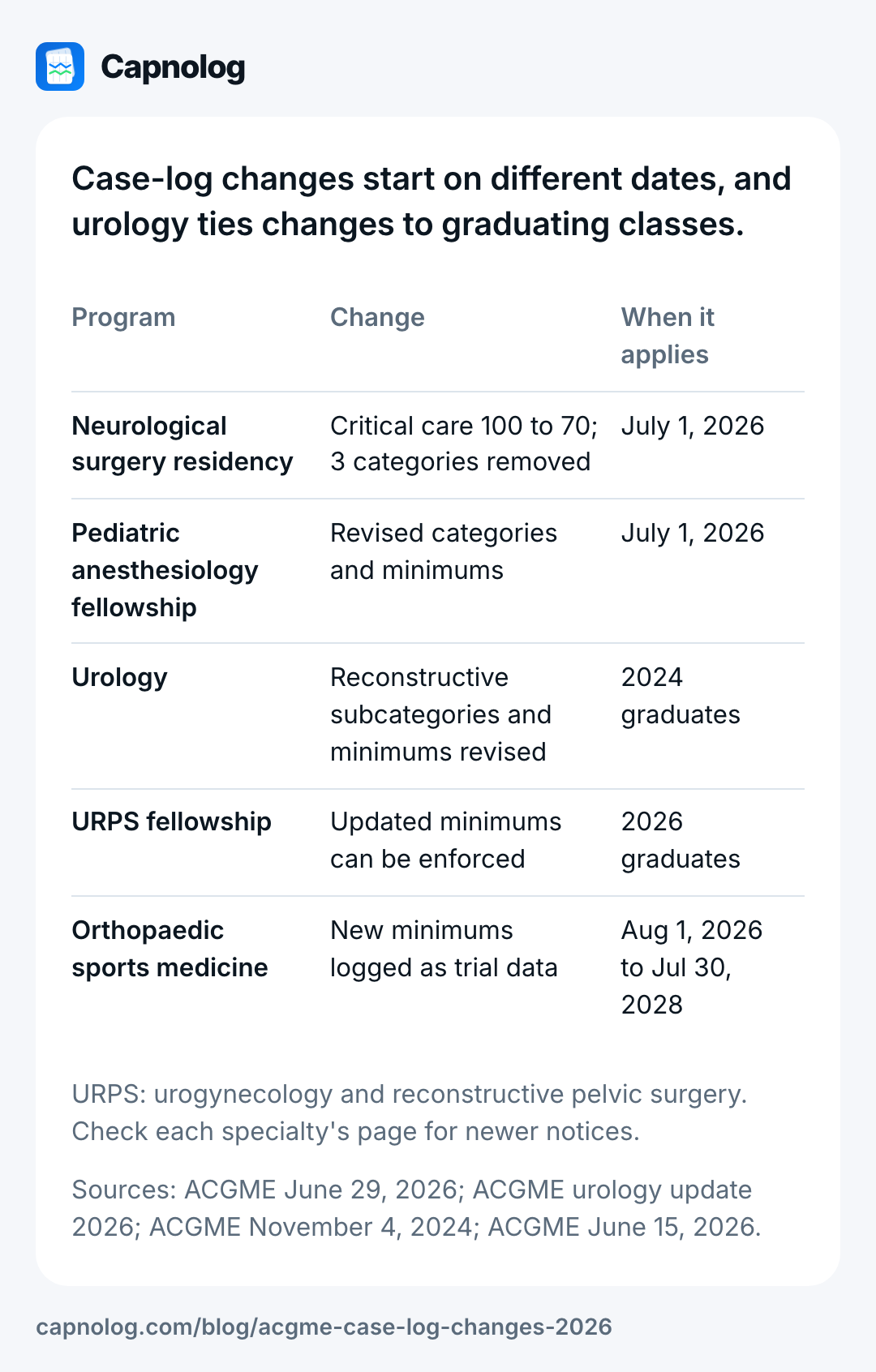
Two changes took effect July 1, 2026: neurosurgery's critical care minimum dropped from 100 to 70, and pediatric anesthesiology fellowship logs were revised. Urology's newer minimums apply by graduating class. The dates for logging, system updates, and enforcement are not always the same.
A resident who builds Capnolog ·
A change to a minimum does not always reach the reporting software on the same day. Some specialties also separate a trial logging period from the point when a shortfall can lead to a citation.
The table below is a starting point. Read the section for your specialty before you apply a number to a resident's or fellow's record.
The dates worth knowing
| Program | Change | When it applies |
|---|---|---|
| Neurological surgery residency | Critical care 100 to 70; 3 categories removed | July 1, 2026 |
| Pediatric anesthesiology fellowship | Revised categories and minimums | July 1, 2026 |
| Urology | Reconstructive subcategories and minimums revised | 2024 graduates |
| URPS fellowship | Updated minimums can be enforced | 2026 graduates |
| Orthopaedic sports medicine | New minimums logged as trial data | Aug 1, 2026 to Jul 30, 2028 |
URPS: urogynecology and reconstructive pelvic surgery. Check each specialty's page for newer notices.
Sources: ACGME June 29, 2026; ACGME urology update 2026; ACGME November 4, 2024; ACGME June 15, 2026.
The older urology changes are here for context, since they did not first take effect in 2026. Major revisions to several anesthesiology fellowship requirements also began in July 2025 (ACGME anesthesiology update 2026). Those revisions are not new core residency minimums for 2026.
Neurological surgery: 100 critical care cases became 70
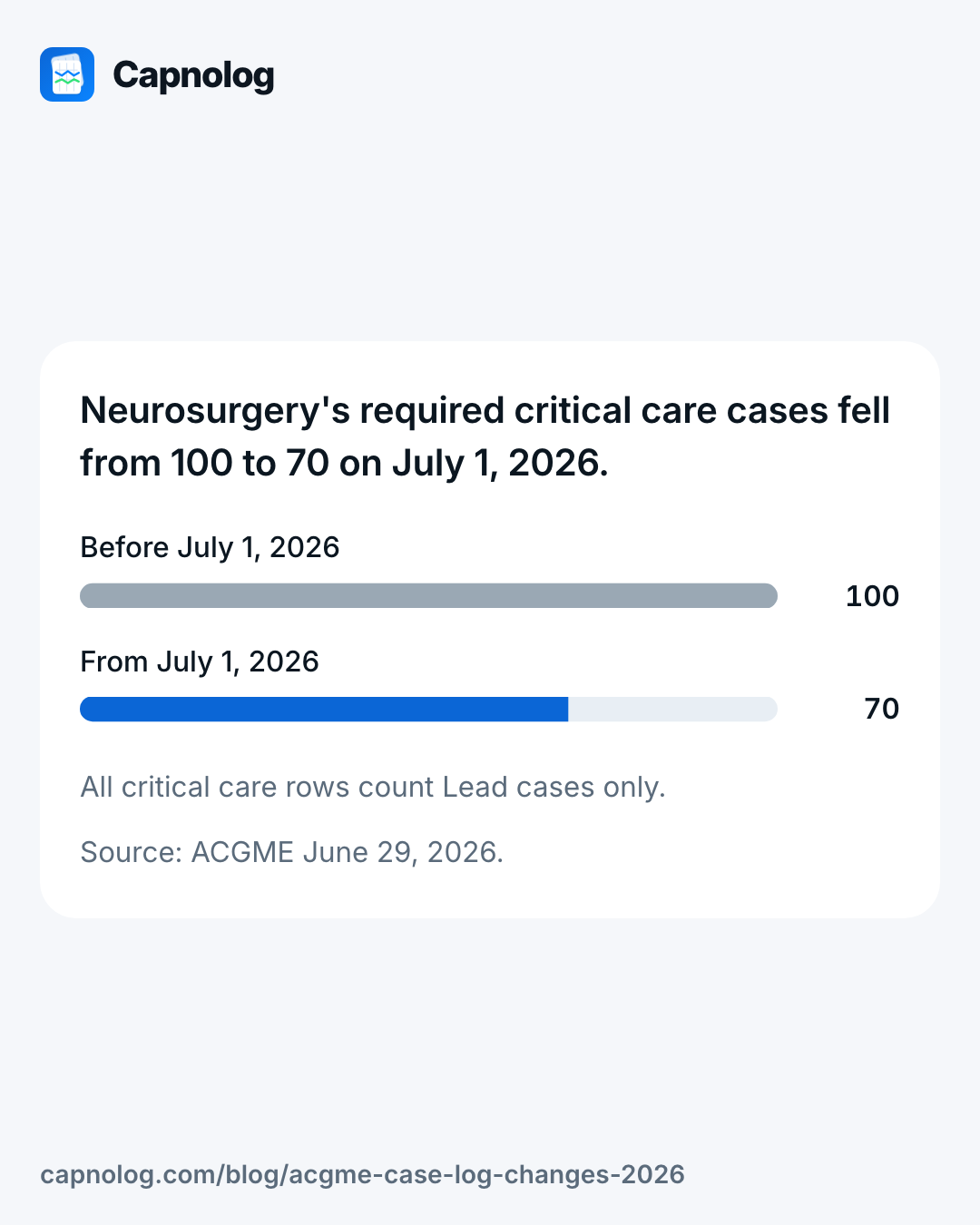
Effective July 1, 2026, the ACGME removed 3 neurological surgery critical care minimums: airway management, arterial line placement, and central venous pressure (CVP) line placement (ACGME June 29, 2026). Each had required 10 cases, and removing all 3 lowered the critical care total from 100 to 70 (ACGME June 29, 2026).
All critical care rows count Lead cases only.
Source: ACGME June 29, 2026.
The updated defined-category document, dated June 2026, groups the 70 cases into 4 categories (ACGME Neurological Surgery 2026). Angiography needs 20 cases, and external ventricular drain (EVD) or transdural monitor placement needs 30 (ACGME Neurological Surgery 2026). Lumbar or other puncture or drain needs 10, and percutaneous cerebrospinal fluid (CSF) reservoir tap needs 10 (ACGME Neurological Surgery 2026).
| Critical care category | Lead cases |
|---|---|
| Angiography | 20 |
| EVD or transdural monitor | 30 |
| Lumbar/other puncture or drain | 10 |
| Percutaneous CSF reservoir tap | 10 |
| Airway management | Removed |
| Arterial line placement | Removed |
| CVP line placement | Removed |
Lead cases only. The Lead + Senior column shows no number for critical care.
Sources: ACGME Neurological Surgery 2026; ACGME June 29, 2026.
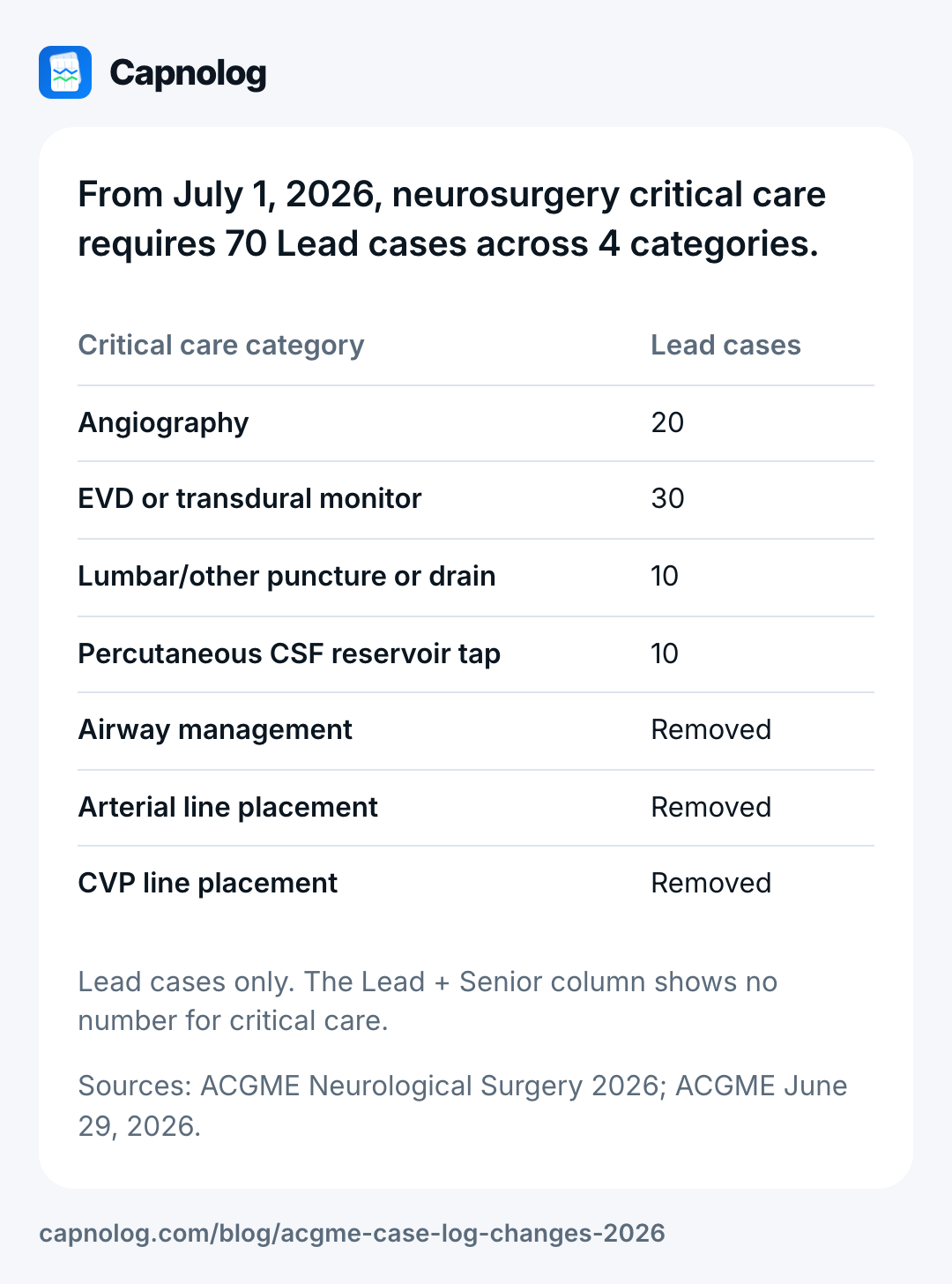
These are Lead case counts. The table's Lead + Senior column gives no separate critical care number (ACGME Neurological Surgery 2026). Keep recording the procedures you actually perform. The removal of a separate minimum is no reason to erase work already logged.
The ACGME said the change would appear in the Case Log System in late August or early September 2026 (ACGME June 29, 2026). That expected software date differs from the July 1 effective date. If your program's reports still show a 100-case total, compare them with the current minimums document.
See the neurological surgery case minimums for every category.
Pediatric anesthesiology: updated fellowship case logs
The pediatric anesthesiology fellowship's revised case-log requirements also began July 1, 2026 (ACGME June 29, 2026). The ACGME asked programs to review the updated document and to inform fellows, faculty, and staff (ACGME June 29, 2026).
The 2026 table sets a total of 240 patients, including 10 difficult airways (ACGME pediatric anesthesiology 2026). The table also sets minimums by ASA class, patient age, case type, and procedure (ACGME pediatric anesthesiology 2026). The pediatric anesthesiology case minimums page lists the full table.
This update belongs to the fellowship and sets no new target for core anesthesiology residents. Use the pediatric anesthesiology table for a fellow's progress, and the core anesthesiology requirements for residency (ACGME Anesthesiology 2026).
Urology: graduating class matters
Urology changes run on a different clock. The Review Committee revised the reconstructive surgery subcategories and established new minimums, effective with 2024 graduates (ACGME urology update 2026). Under the updated rules, pediatric reconstructive cases count toward both the pediatric and the reconstructive minimums (ACGME urology update 2026).
For urogynecology and reconstructive pelvic surgery (URPS) fellowships, the updated minimums took effect July 1, 2024 (ACGME November 4, 2024). The 2025 graduating class was subject to an area for improvement (ACGME urology update 2026). Starting with 2026 graduates, failure to reach a minimum may be subject to citation (ACGME November 4, 2024).
A program's handout needs both the minimum and the graduating class the minimum applies to. A revised table may not take effect for every resident in the same year. The urology case minimums page lists the current numbers.
How an ACGME minimum can be phased in
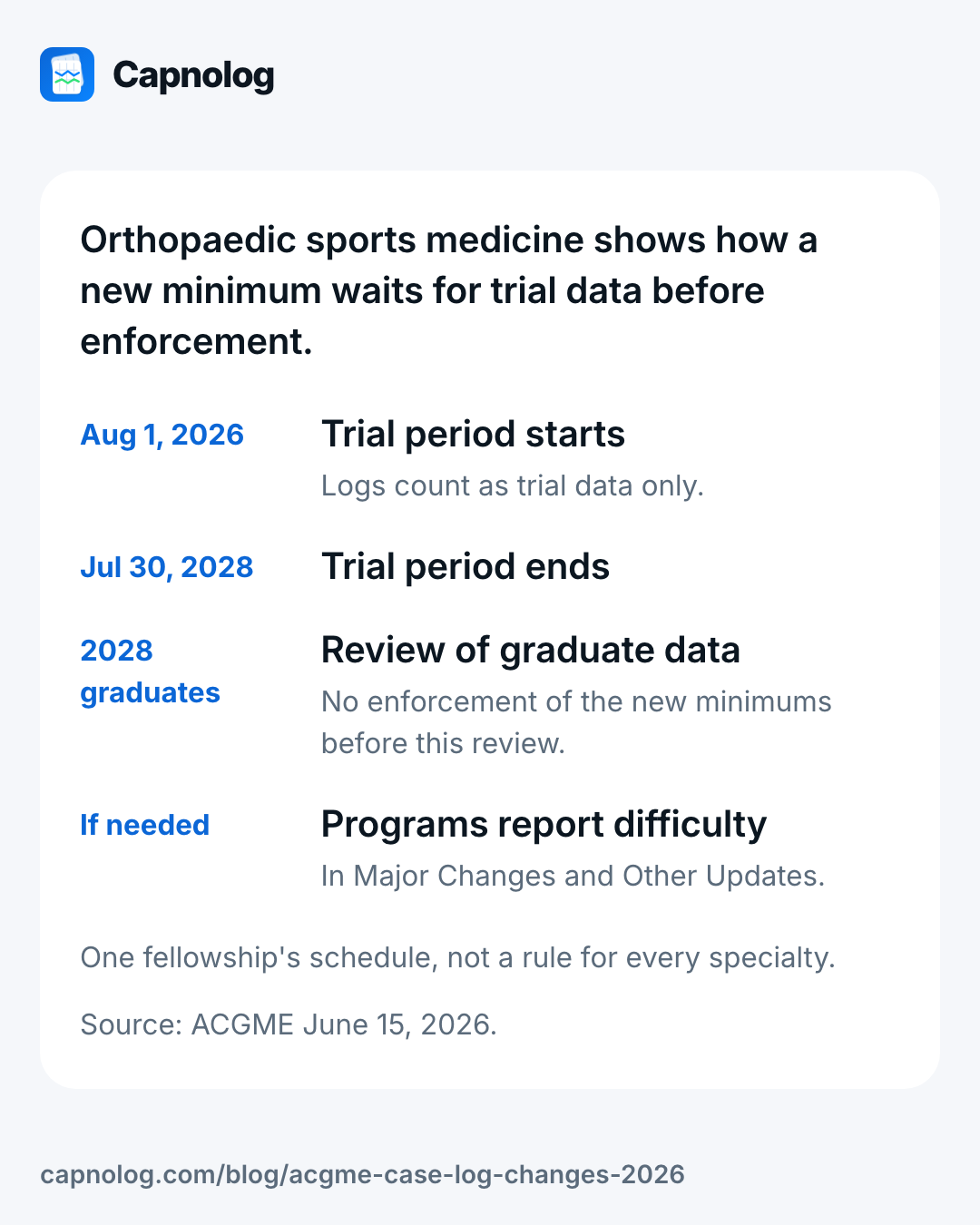
Orthopaedic sports medicine gives a useful example, although its dates do not apply to neurosurgery, anesthesiology, or urology. Logs entered from August 1, 2026 through July 30, 2028 count as trial period data only (ACGME June 15, 2026). The Review Committee will not enforce the new minimums until a review of 2028 graduate data (ACGME June 15, 2026).
The software had a schedule of its own. The Case Log System was expected to update in September 2026, with cases entered from July 1 to September 22 mapped to the new minimums (ACGME June 15, 2026).
- Aug 1, 2026Trial period startsLogs count as trial data only.
- Jul 30, 2028Trial period ends
- 2028 graduatesReview of graduate dataNo enforcement of the new minimums before this review.
- If neededPrograms report difficultyIn Major Changes and Other Updates.
One fellowship's schedule, not a rule for every specialty.
Source: ACGME June 15, 2026.
For any case-log announcement, ask 3 questions.
- When does the requirement apply? The answer is the effective date or the affected graduating class.
- When does the software show the requirement? Reporting updates may arrive later.
- When can a program face consequences for a shortfall? Some new minimums have trial periods or delayed enforcement.
A program can log the new categories well before the Review Committee enforces the new numbers.
What to check before updating a program's tracking sheet
- Read the current minimums document on your specialty's ACGME page.
- Record the effective date, graduating class, and any trial or enforcement period.
- Compare the document with what the ACGME Case Log System shows.
- Tell affected residents, fellows, faculty, and coordinators what changed.
- Date any spreadsheet, handout, or report that repeats a minimum.
- Check newer ACGME notices before citing a number in a graduation review.
Practical review steps, not an ACGME checklist.
Source: ACGME June 29, 2026.
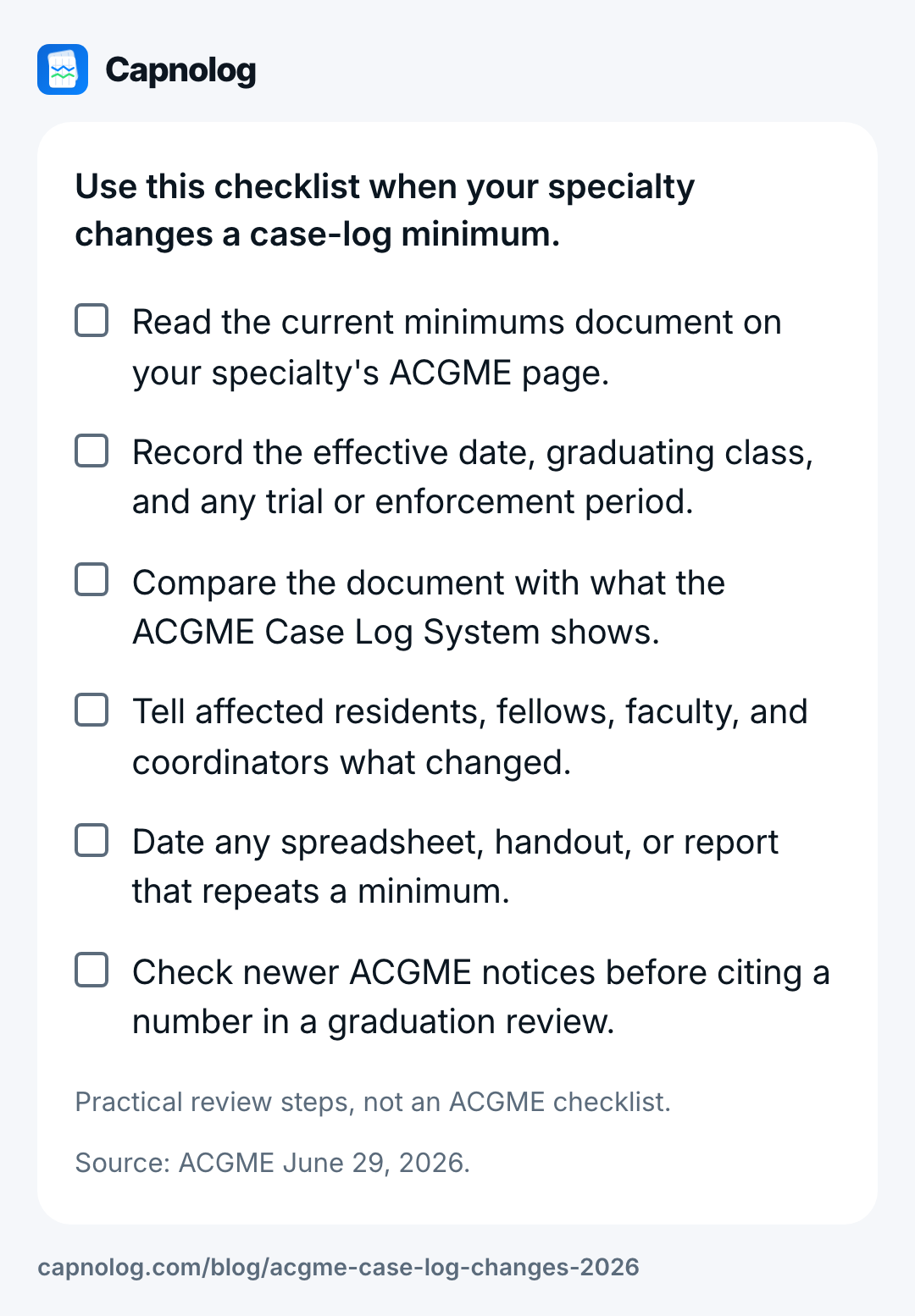
These are practical review steps, not an ACGME checklist. The briefing step matches what the ACGME asked of pediatric anesthesiology programs (ACGME June 29, 2026).
The ACGME case minimums reference helps you find each specialty's table. The ACGME's current documents and your program decide which requirements apply.
How Capnolog fits
Capnolog counts the cases a resident logs against the categories of that resident's specialty, and keeps Lead and Lead + Senior apart in neurosurgery. The count is not the official ACGME record, so confirm your official entries.
ACGME case minimumsWhat these notices do not establish
- A date for any future change to core anesthesiology residency minimums. The Delphi study published in October 2026 makes recommendations, not adopted ACGME rules (Saddawi-Konefka 2026).
- Whether a specific case counts for credit. The current official minimums tables and your program decide that.
- Notices after October 12, 2026. This post checked the ACGME e-Communication through October 12, 2026, and found no newer case-log notice for these specialties. Check for newer notices before you act.
- Capnolog has no affiliation with the ACGME.
Sources
- ACGME. e-Communication, June 29, 2026.
- ACGME Review Committee for Neurological Surgery. Neurological Surgery Case Log Defined Case Categories and Required Minimum Numbers, effective July 1, 2026 (6/2026).
- ACGME Review Committee for Anesthesiology. Pediatric Anesthesiology Fellowship Minimum Case Numbers. Effective July 1, 2026
- ACGME. Program Requirements for Graduate Medical Education in Anesthesiology including FAQs (2026).
- ACGME. Anesthesiology Review Committee Update, 2026 Annual Educational Conference.
- Kielb S, et al. Specialty Update: Urology. ACGME 2026 Annual Educational Conference, Case Logs slide.
- ACGME. e-Communication, November 4, 2024: Urogynecology and Reconstructive Pelvic Surgery Case Log update.
- ACGME. e-Communication, June 15, 2026.
- Saddawi-Konefka D, Kacmar RM, Long TR, Mitchell JD, Ang L, Ambardekar AP. A National Delphi Study to Inform Modernization of Anesthesiology Residency Case Log Requirements. Anesthesiology. 2026.