
How to improve resident case-log completion: what actually worked
A reminder alone did not improve case logging in one anesthesiology residency. Logging was more timely after a different surgical program introduced protected administrative time, but that study was observational. EHR extraction found more procedures than manual logs in other small studies. Before changing policy, measure entry delays and missing cases within your own program.
A resident who builds Capnolog ·
A reminder is easy to send. Finding out whether the reminder improved the case log is harder.
In one anesthesiology residency, an intraoperative reminder did not improve case logging (Pregnall 2021). A surgical residency reported better logging after creating a protected weekly administrative hour (Kelly-Schuette 2020). Studies of electronic records also found cases or procedures that residents had not entered (Douglas 2022; Kwan 2024).
These studies come from different institutions and designs, so none proves that one intervention will work at every program. For program directors and coordinators, the practical start is to measure what is missing and how long entries take. Then make one change and measure again.
Start with a one-month baseline
Before you change a reminder policy, compare a recent month of clinical activity with the same month's case-log entries. Use an authorized department record, such as the OR schedule, for the starting count. Use the official ACGME Case Log reports to see what was submitted.
- Select one recent monthRecord the month, the rotations included, and how the program counted expected cases.
- Find entries submitted within 7 daysMeasure when cases reached the official log, not when residents opened an app.
- Repeat the check at 30 daysThe second count separates prompt logging from late entries.
- Ask why entries are missingRule out leave, off-service rotations, excluded categories, and duplicates first.
- Choose one change and repeatUse the same definitions in a comparable period.
A local quality-improvement suggestion, not a tested method.
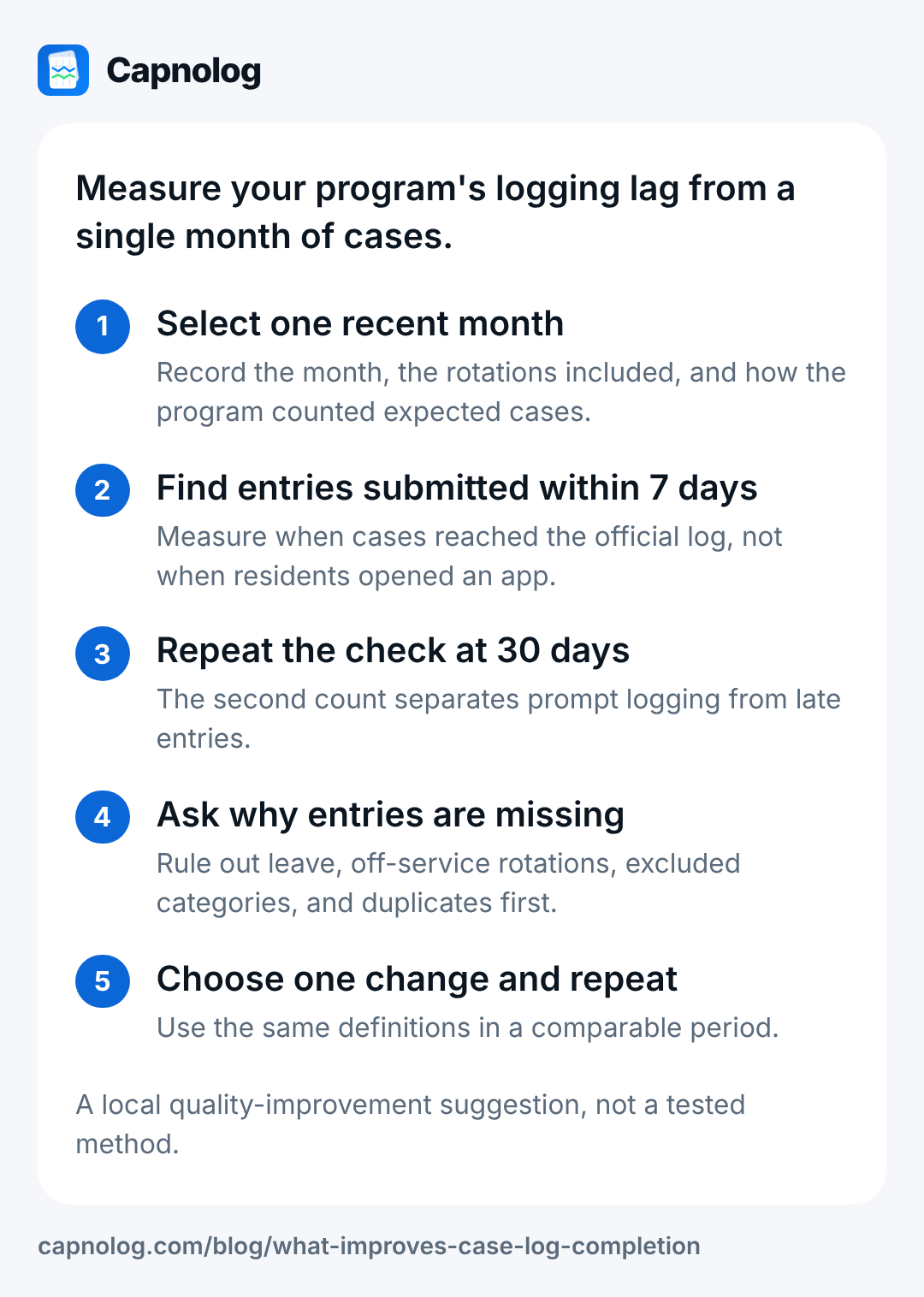
This plan is a local quality-improvement suggestion. No source here validates a 7-day threshold as an ACGME requirement. The OR board and the case log may not count the same things, so the comparison may need manual review.
A program can report 3 separate measures: cases entered promptly, cases present by 30 days, and cases with correct roles and categories. A faster entry is not always a correct entry. A higher total does not prove that every relevant experience was captured.
What happened when one program added a reminder
Pregnall and colleagues studied resident entries at one anesthesiology program. On March 13, 2019, the program added an intraoperative reminder to log the case (Pregnall 2021). Overall logging rates did not improve, and the delay between case and log entry grew longer (Pregnall 2021). Logging rates fell for PGY-3 and PGY-4 residents, while the PGY-2 rate did not change (Pregnall 2021).
The authors offered possible reasons and did not test them. Residents may be unable to log during a case, or may not feel they took part enough to log the case (Pregnall 2021). The study was not a randomized comparison of reminder systems or a multicenter trial.
The finding does not mean reminders can never help. The finding does mean that sending more reminders without measuring the results is not an evidence-based fix.
What electronic records revealed
Two studies show how much can be missing from manually entered logs. Their denominators and specialties differ, so their percentages should not be combined.
At one institution, PGY-2 to PGY-4 anesthesiology residents logged 11,713 cases in a study year when the institution performed 16,342 anesthetics (Pregnall 2021). Dividing one count by the other gives 71.7%. Not every departmental anesthetic belongs to the studied residents, so 71.7% is not an accuracy rate.
In emergency medicine at one center, electronic records yielded 7,617 procedures, compared with 4,291 recorded manually (Kwan 2024). By the same simple division, manual logging captured 56.3%. The study counted procedures, not anesthesia cases, for 47 residents in a silent assessment (Kwan 2024).
Simple division of published counts. Different specialties, years, and measures.
Sources: Pregnall 2021; Kwan 2024.
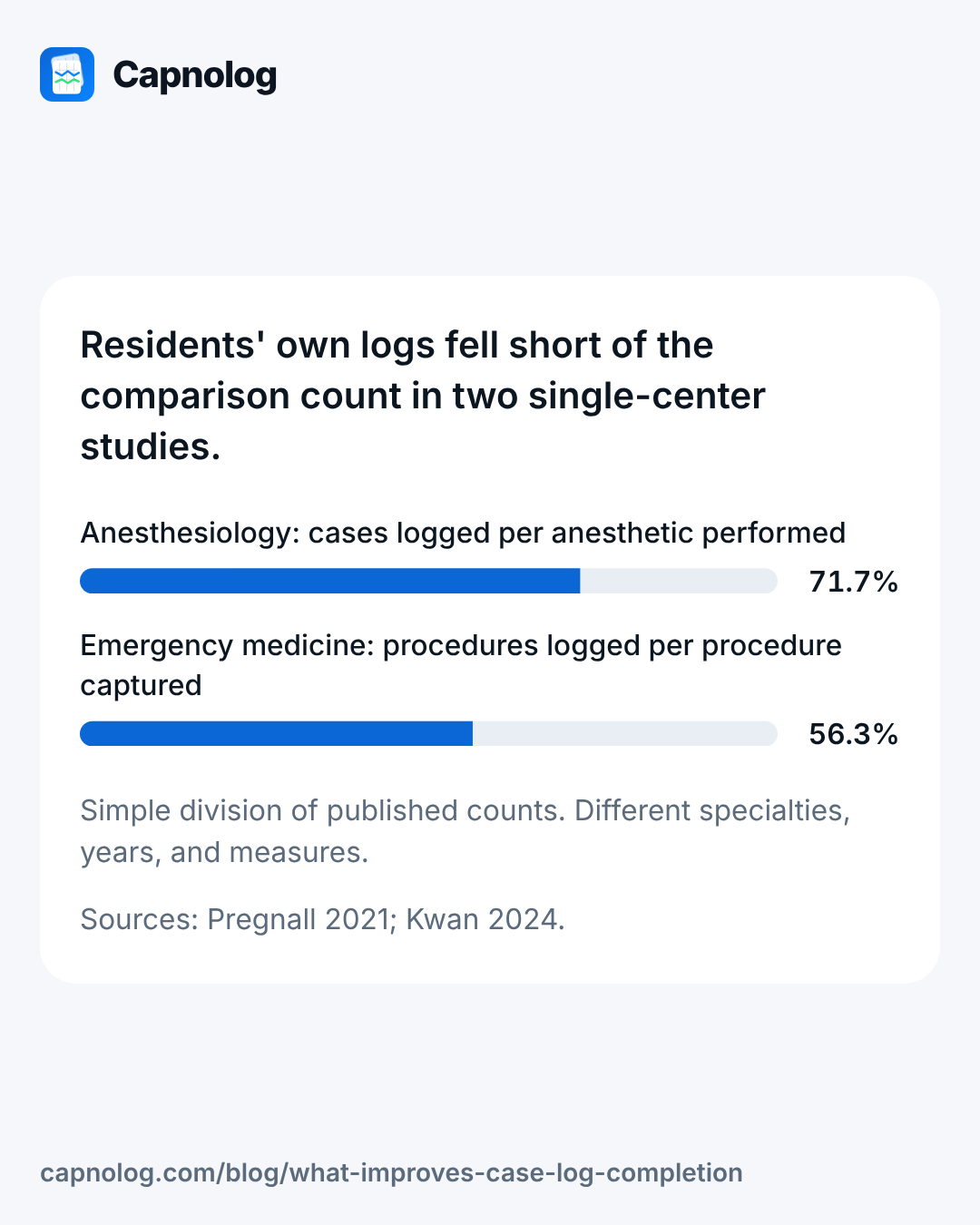
These studies do not establish the share missing at another institution. The studies show why a department should check existing records rather than assume that a full-looking log holds every experience.
Did electronic extraction solve the problem?
Douglas and colleagues compared automated capture with anesthesiology resident-entered case logs. Automated logs captured a median of 1,226.5 total anesthetic cases (Douglas 2022), against a median of 1,134.5 that residents reported to the ACGME (Douglas 2022). The findings come from one program and one system, not every EHR installation.
A 2026 narrative review found 8 semiautomated case-logging systems and no fully automated end-to-end system (Bain 2026). The review covered literature through February 2025, so the review cannot rule out newer products or local workflows (Bain 2026).
Narrative review; literature through February 2025.
Source: Bain 2026.
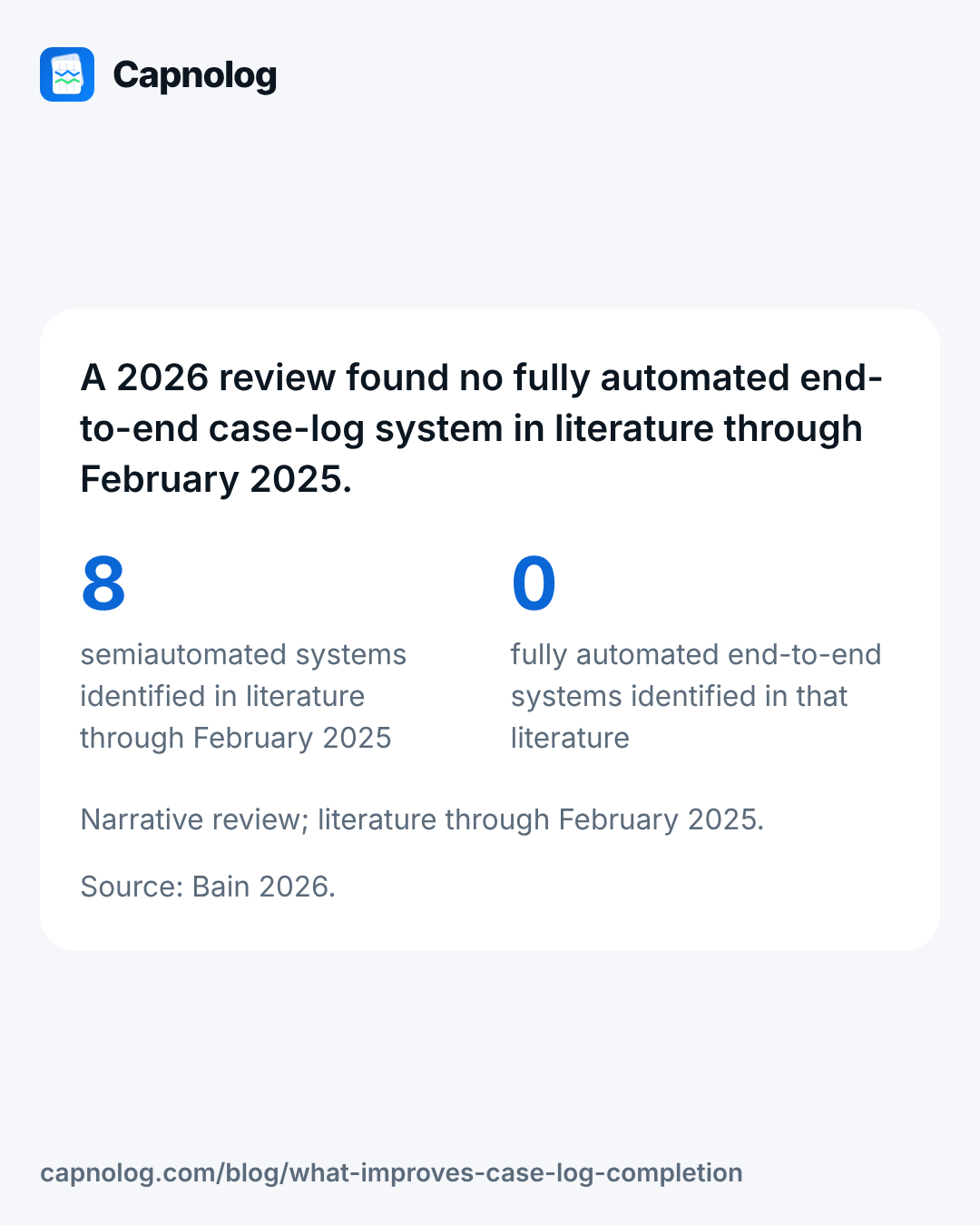
More complete extraction does not by itself confirm an ACGME submission. Some tools identify or prepare records, while the resident still verifies the operation, the role, and the final entry.
What happened when a surgical program protected time
A 2020 study compared 3 years before and 3 years after one surgical residency introduced a protected administrative hour each week. The study covered 79 residents at one community-based, university-affiliated hospital (Kelly-Schuette 2020).
The share logged within 7 days was 28.7% before and 37.2% after. Within 30 days, the values were 52.7% before and 69.9% after (Kelly-Schuette 2020).
These are before-and-after observations, not a randomized estimate of cause. The study had no control group, and other program changes might explain some of the difference. The authors also reported duty-hour findings, which this post does not treat as proof that the hour caused fewer violations.
The limited lesson is still useful. A program can give residents time for an administrative task, then measure what happened. The paper does not show that exactly 1 hour is the right amount.
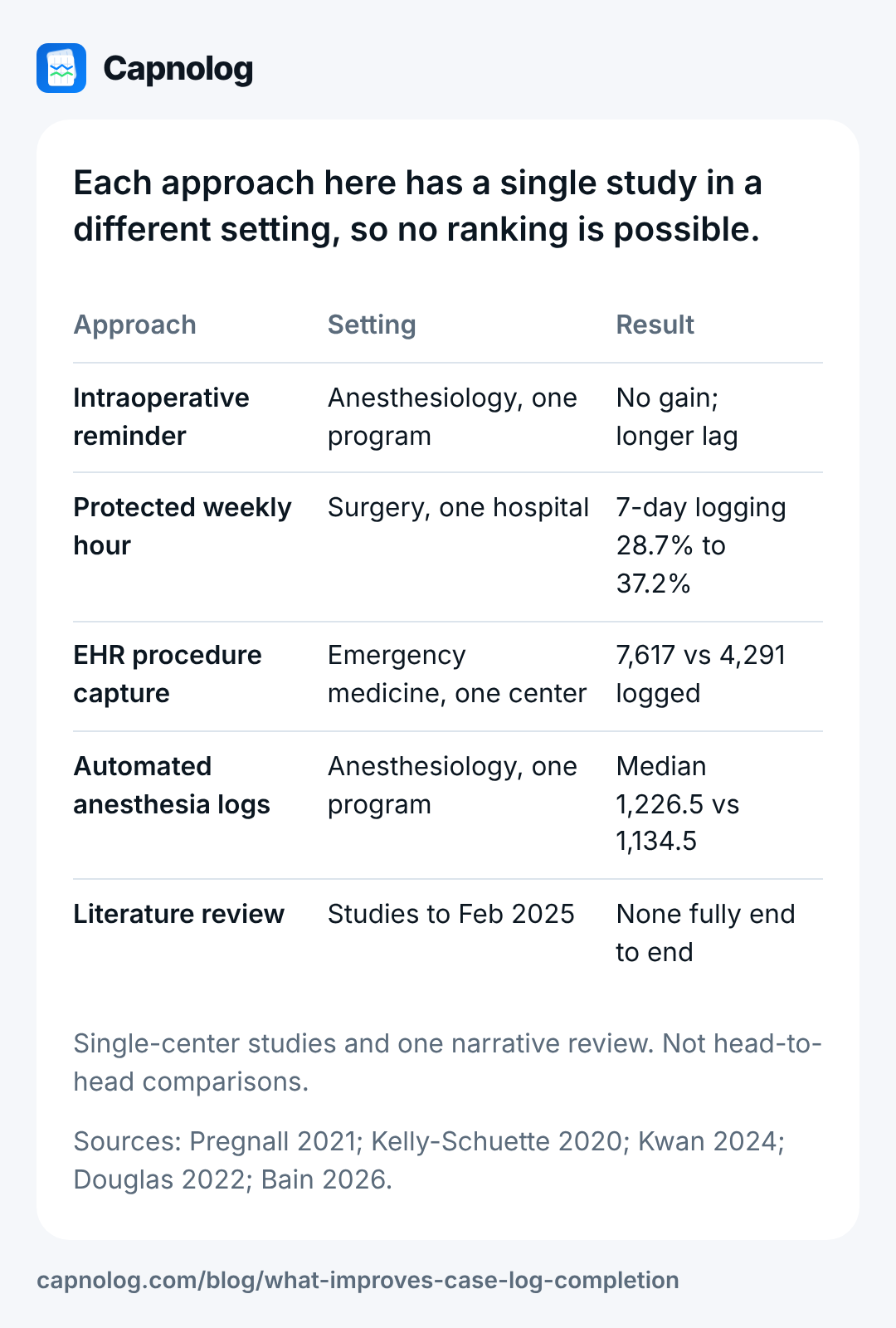
Which intervention should a program test first?
| Approach | Setting | Result |
|---|---|---|
| Intraoperative reminder | Anesthesiology, one program | No gain; longer lag |
| Protected weekly hour | Surgery, one hospital | 7-day logging 28.7% to 37.2% |
| EHR procedure capture | Emergency medicine, one center | 7,617 vs 4,291 logged |
| Automated anesthesia logs | Anesthesiology, one program | Median 1,226.5 vs 1,134.5 |
| Literature review | Studies to Feb 2025 | None fully end to end |
Single-center studies and one narrative review. Not head-to-head comparisons.
Sources: Pregnall 2021; Kelly-Schuette 2020; Kwan 2024; Douglas 2022; Bain 2026.
A reasonable local sequence has 5 steps.
- Ask residents how long they wait to enter cases and what prevents same-day entry.
- Make the details residents need, such as date, attending, procedure, and role, easier to find through approved institutional workflows.
- Offer a regular catch-up period or a simpler entry method before adding another reminder.
- Measure promptness, eventual completeness, and category correctness separately.
- Review the results with residents, and revise any step that adds administrative work.
A repeated problem might reflect long forms, a difficult sign-in, unclear operative credit, or an inaccessible case list. Different causes need different changes.
Do not require residents to export patient-identifiable information into personal spreadsheets or outside systems to build a dashboard. Use institutionally authorized, minimum-necessary records, and follow your program's data-handling policies.
How to tell whether the change helped
Choose an outcome before the pilot begins. For example, a program might aim to shorten the delay between an operation and entry into the official system.
Then compare the same measures before and after. Report how many expected records were reviewed, how many were entered by each checkpoint, and how many needed corrections. Describe any changes to residents' clinical schedules or case types.
If 7-day logging rises but 30-day completeness does not, the program has improved speed without finding more cases. If both rise, audit a sample for roles and category accuracy. Neither result establishes cause without a stronger study design.
What Capnolog does for residents and for programs
Capnolog helps individual residents keep a case log and see their specialty minimums. The official record stays in the ACGME Case Log System.
The Capnolog program console has a different role: the console lets a program publish OR assignments to residents. The console never opens a resident's private Capnolog case log, and offers no program-wide completion dashboard.
Discuss the OR-week workflow for your program.
The Program Console publishes resident assignments. It does not audit residents' private case logs.
What the Program Console doesUse the findings to ask better local questions, not to assign blame or to infer competence from a tally.
What the evidence does not establish
- The reminder, protected-time, and electronic capture studies use different methods, and each comes from one center.
- The 71.7% and 56.3% figures are simple division of published counts. Neither is a resident accuracy rate the authors reported.
- The protected-hour study cannot isolate the effect of the hour, since the study had no control group.
- The 2026 narrative review stops at February 2025.
- The one-month measurement plan is an editorial quality-improvement suggestion, not a validated ACGME procedure.
Sources
- Pregnall AM, Gruss CL, Ramanujan KS, Gelfand BJ, McEvoy MD, Wanderer JP. ACGME Case Log Reminder Does Not Improve Resident Accuracy in Logging Cases. J Med Syst. 2021;46(1):1 (PMID 34786618).
- Kelly-Schuette K, Osantowski B, Chung MH, Wright GP. Implementation of a Weekly Administrative Hour and the Impact on Case Logging and Duty Hour Reporting in Surgical Residents. J Surg Educ. 2020;77(4):765-771 (PMID 32147467).
- Kwan B, Engel J, Steele B, Oyama L, Longhurst CA, El-Kareh R, Daniel M, Goldberg C, Clay B. An Automated System for Physician Trainee Procedure Logging via Electronic Health Records. JAMA Netw Open. 2024;7(1):e2352370 (PMID 38265802).
- Douglas MS, Leeper L, Peng J, Lien D, Lauer R, Stier G, Gatling JW, McCabe MD. Automating Anesthesiology Resident Case Logs Reduces Reporting Variability. J Educ Perioper Med. 2022;24(4):E694 (PMID 36545371).
- Bain AP, Low A, Zhang AY, Abdelfattah KR, Clark AT, Ji H. Automating Resident Case Logs: Narrative Review and Challenges Ahead. J Grad Med Educ. 2026;18(2):141-150 (PMID 42005891).