
How to judge residency case volume before you rank programs
In a national survey of 82 neurosurgery programs, a program's total case volume showed no correlation with how many cases residents logged. Only the number of cases per faculty member was linked to resident volume. Ask how many cases each attending does, how often the program reviews each resident's log, and how graduates compare with the national report.
A resident who builds Capnolog ·
Applicants care about operating experience. In a survey of 2016 Urology Match applicants at participating institutions, 346 of 468 registered applicants answered (Lebastchi 2018). They named 3 criteria as most important for judging a program: operative experience, interactions with current residents, and relationships between faculty and residents (Lebastchi 2018).
Case volume is hard to judge from the outside. This post sets out what the research shows, what a program must tell you, what you can look up, and what to ask.
What predicts a resident's case volume
One national survey asked this question directly. Burkhardt and colleagues surveyed neurosurgery program directors and coordinators, and 97 of 115 programs responded, or 84.3% (Burkhardt 2024). The authors excluded 15 programs for missing data and analyzed 82 (Burkhardt 2024).
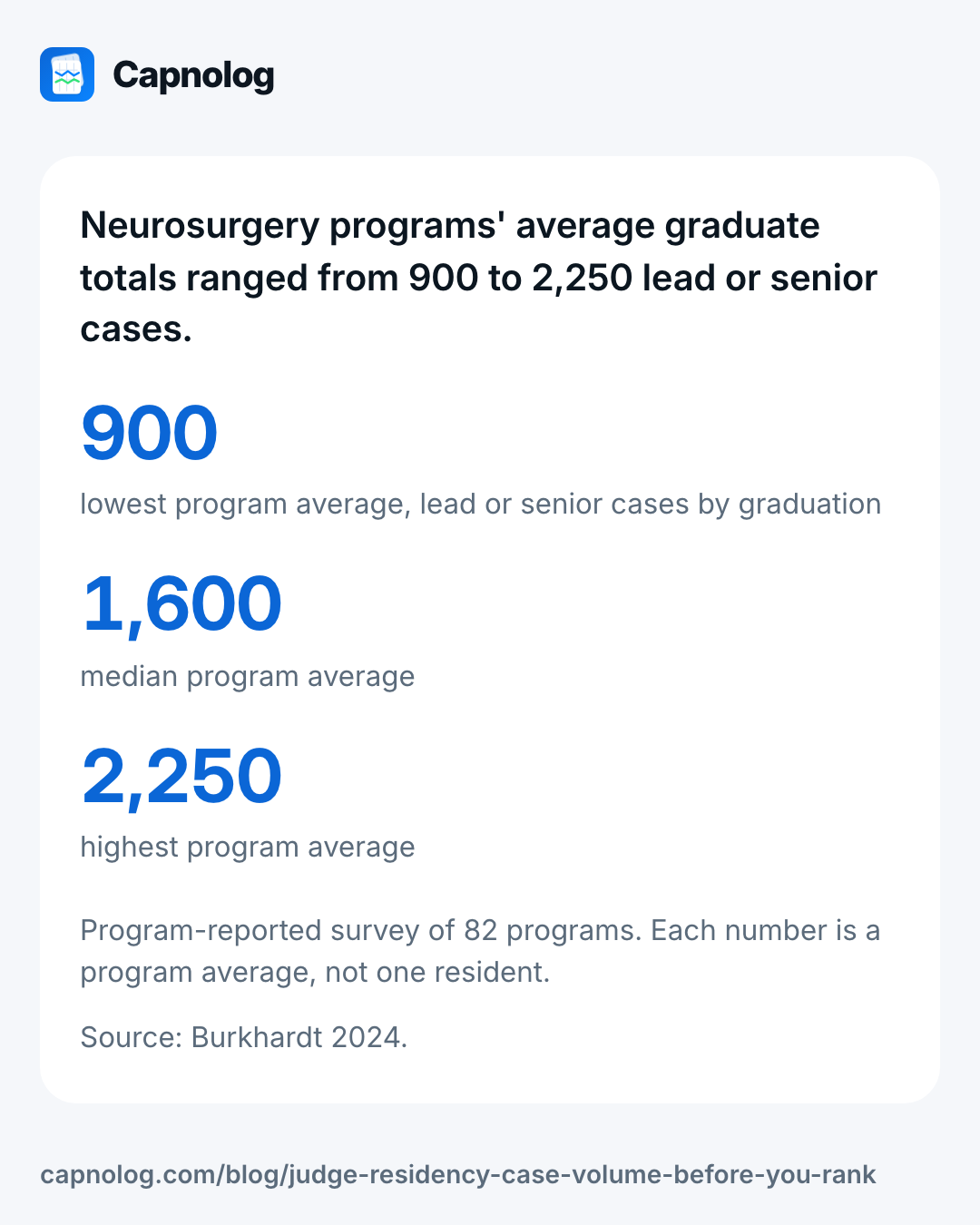
Across those programs, the average number of cases residents did as lead or senior surgeon by graduation ranged from 900 to 2,250 (Burkhardt 2024). The median program average was 1,600 cases. The range compares program averages, not individual residents.
Program-reported survey of 82 programs. Each number is a program average, not one resident.
Source: Burkhardt 2024.
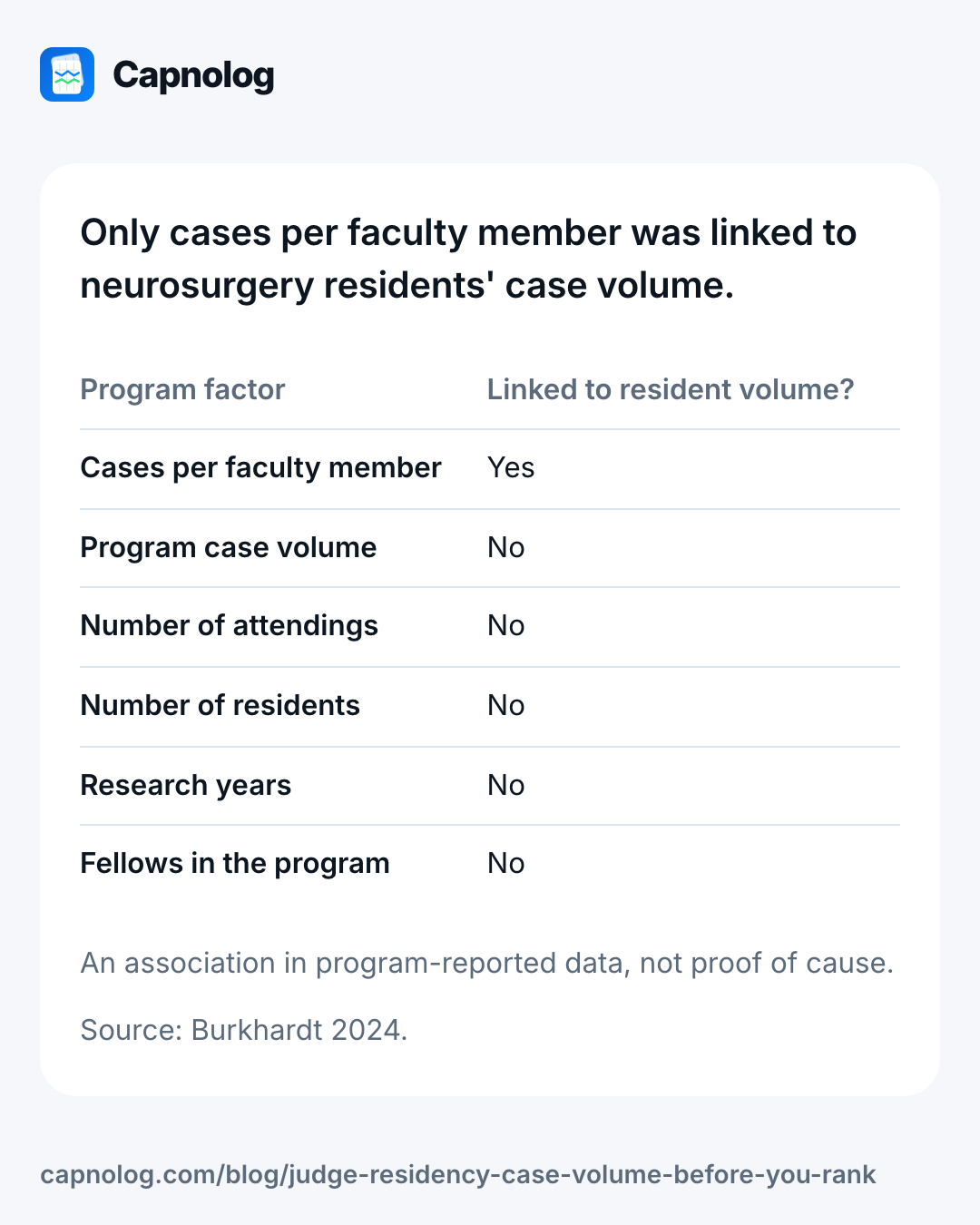
Resident volume showed no correlation with total program volume, the number of attendings, the number of residents, research years, or fellows (Burkhardt 2024). The only factor linked to resident volume was the number of cases performed per faculty member (Burkhardt 2024).
| Program factor | Linked to resident volume? |
|---|---|
| Cases per faculty member | Yes |
| Program case volume | No |
| Number of attendings | No |
| Number of residents | No |
| Research years | No |
| Fellows in the program | No |
An association in program-reported data, not proof of cause.
Source: Burkhardt 2024.
Read that result as an association. Program staff reported the numbers, and a survey cannot show that more cases per faculty member would raise resident totals. For an applicant, the result still points to one question: how many cases does each attending do?
What a program must tell you
The ACGME requirements say what a program must tell interviewees about the boards. A program director must give applicants offered an interview information about their eligibility for the specialty's board examinations (ACGME Anesthesiology 2026; ACGME Neurological Surgery 2026). The rule, numbered 2.6.l, uses the same text in the 2026 anesthesiology, neurological surgery, and urology requirements (ACGME Anesthesiology 2026; ACGME Neurological Surgery 2026).
That rule covers board eligibility, not case volume. Case numbers are a question you have to ask.
Programs do review case logs, and you can ask how. In neurosurgery, the program director must review each resident's ACGME Case Log data at least twice a year (ACGME Neurological Surgery 2026). The requirement aims at balanced progress toward a variety and complexity of procedures (ACGME Neurological Surgery 2026).
Review Committees also use program-level case-log data to judge whether a program has enough patient volume for its approved number of residents (ACGME 2024). Ask the program what recent graduates logged, since that number speaks to your own training.
What you can look up in public
The ACGME makes some national case-log reports public and keeps others private. Certain Case Log Graduate Statistics National Reports are on the ADS public site for each academic year, while others are not shared publicly (ACGME 2024).
The public report form lists 14 top-level specialties, including neurological surgery, surgery, and urology (ACGME ADS). Anesthesiology is not on that list, so anesthesiology applicants have no public national report to compare against (ACGME ADS).
A national report covers graduating residents across the country, not one program. In the 2018-19 urology report, each row gives the average, standard deviation, lowest count, median, highest count, and requirement (ACGME Urology 2018-19). The lowest-count column, Natl Res MIN, is the lowest procedure count among residents nationally (ACGME Urology 2018-19).
Take one row as a worked example. In that report, graduating urology residents logged an average of 171.4 reconstructive cases (ACGME Urology 2018-19). The median was 167, the lowest resident logged 68, and the highest logged 398, against a requirement of 60 (ACGME Urology 2018-19). Counting only the Surgeon role, the average was 139.3 (ACGME Urology 2018-19).
Subcategories revised January 2024, so today's 170 may not count the same cases as 2018-19.
Sources: ACGME Urology 2018-19; ACGME Urology 2024.
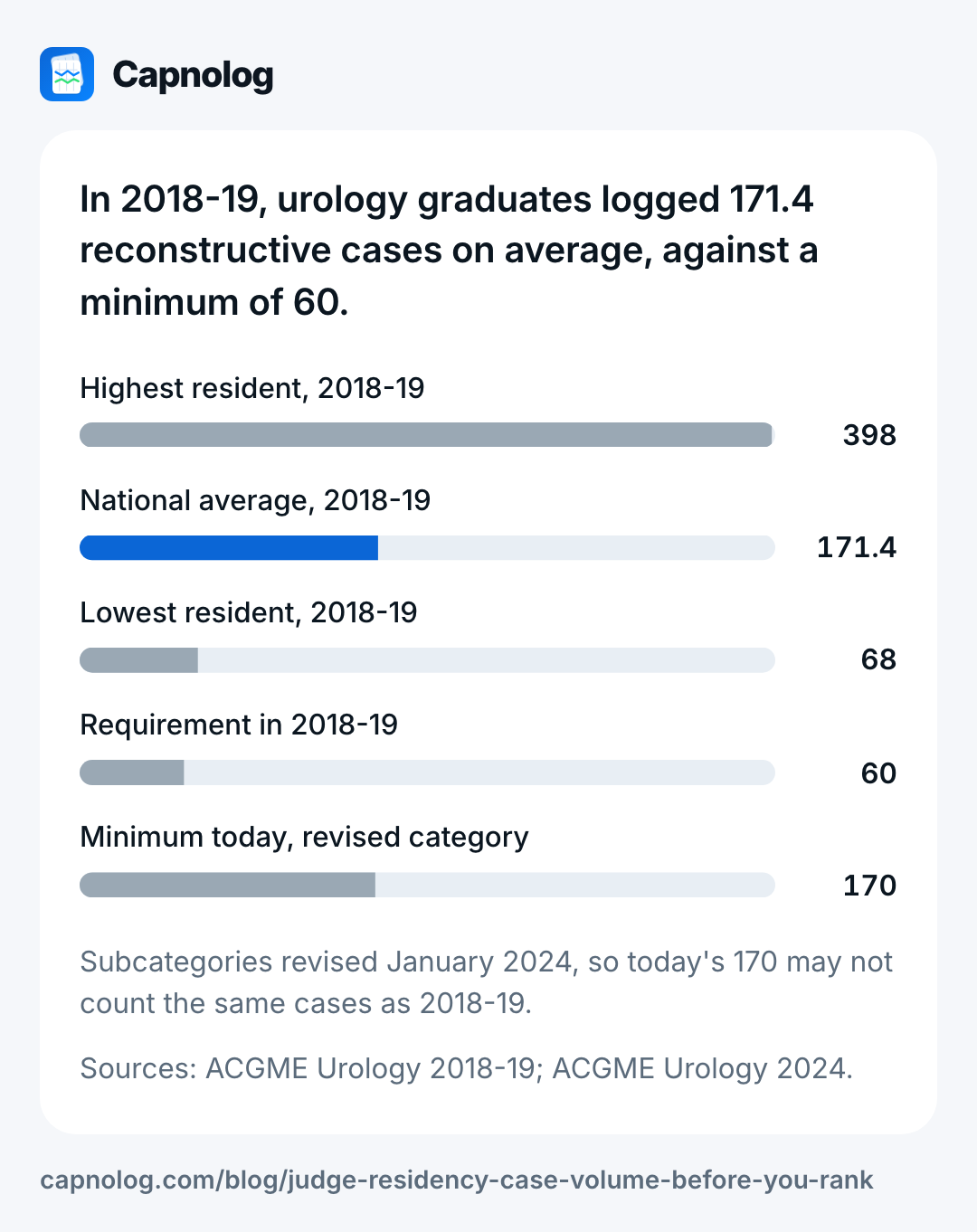
Today's urology reconstructive minimum is 170, and the ACGME revised the reconstructive subcategories in January 2024, effective for 2024 graduates (ACGME Urology 2024). Because the subcategories changed, the 2018-19 row and today's minimum may not count the same cases.
The reports carry 2 warnings. Do not compare them across specialties, because category definitions vary among specialties, and take care comparing years, because definitions can change (ACGME Urology 2018-19).
Questions to ask on interview day
No study has tested which questions predict the case volume you will log. The questions below come from the research above, so treat them as a starting point, not a proven tool.
The most useful answers came from residents, not from the program. As an applicant, the author asked residents how many of one kind of case they logged before graduation. With junior residents, the question became how many cases they had logged so far.
Pick a case type that matters to you, such as cardiac cases or a procedure with a hard minimum. A count from a resident is a number you can compare across programs.
- To residents: how many of one case type did you log by graduation, or have you logged so far?
- How many cases does each attending do in a year? Cases per faculty member was the one factor linked to resident volume in neurosurgery (Burkhardt 2024).
- How often does the program review each resident's case log, and what happens after a review?
- Did every graduate in the last few years meet every minimum?
- Who decides a resident's role on a case, and how do residents log that role?
- Do fellows take cases that residents need?
- In neurosurgery, surgery, or urology, how do graduates' totals compare with the national report?
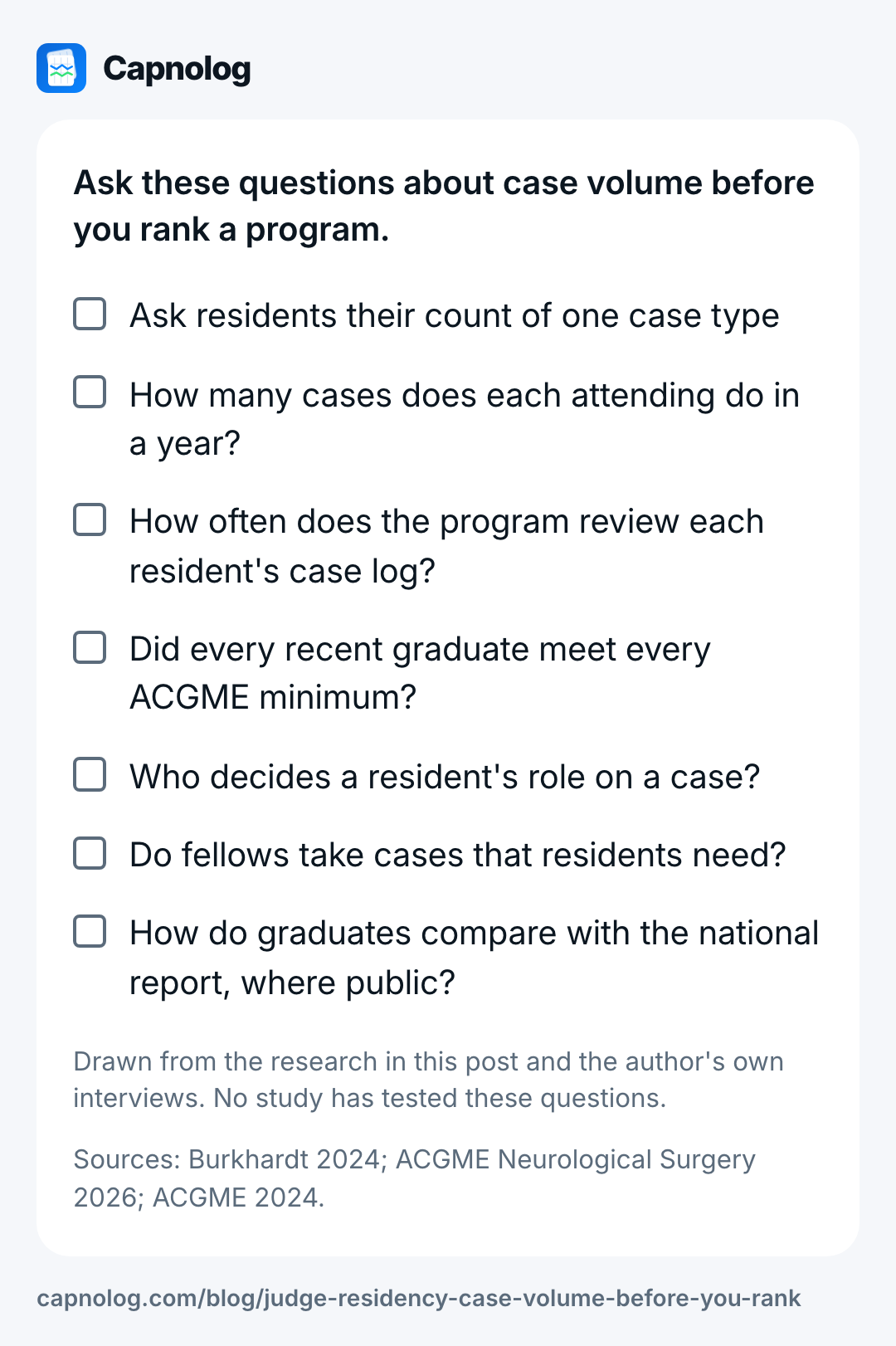
- Ask residents their count of one case type
- How many cases does each attending do in a year?
- How often does the program review each resident's case log?
- Did every recent graduate meet every ACGME minimum?
- Who decides a resident's role on a case?
- Do fellows take cases that residents need?
- How do graduates compare with the national report, where public?
Drawn from the research in this post and the author's own interviews. No study has tested these questions.
Sources: Burkhardt 2024; ACGME Neurological Surgery 2026; ACGME 2024.
Bring the minimums with you. The neurological surgery minimums and the urology minimums list the current numbers. In anesthesiology, with no public national report, ask how recent graduates compare with the anesthesiology minimums.
What a case count cannot tell you
A high count is not proof of skill. The ACGME's urology case-log guide says minimum numbers are not a final target, and reaching them does not signify competence (ACGME Urology 2024).
The same guide says program directors must make sure residents keep logging after they reach the minimums (ACGME Urology 2024). Where residents stop logging early, their totals undercount the cases they did. A count also does not show how much of each case the resident did.
After you match, the same questions apply to your own log. Run the case-log checks before the mid-year CCC, and keep surgical case notes so each case teaches you something.
Keep every interview in one notebook.
The free student notebook keeps program impressions and interview notes together.
What the student app doesWhat the evidence does not show
- No study has linked the questions an applicant asks, or the program an applicant ranks, to the case volume that applicant later logs. The question list above is reasoning, not a tested tool. The question to residents comes from the author's own interviews.
- The neurosurgery survey used figures that programs reported about themselves, and the authors excluded 15 of 97 responding programs for missing data (Burkhardt 2024). The link with cases per faculty member is an association, not proof of cause.
- The public report form read for this post listed no anesthesiology report. The list may vary with the academic year selected (ACGME ADS).
- The urology figures come from the 2018-19 report. The ADS public site carries a report for each academic year, and newer figures may differ (ACGME 2024).
Sources
- Lebastchi AH, Khouri RK, McLaren ID, et al. The Urology Applicant: An Analysis of Contemporary Urology Residency Candidates. Urology. 2018;115:51-58.
- Burkhardt E, Adeeb N, Terrell D, et al. Factors impacting neurosurgery residents' operative case volume: a nationwide survey. J Neurosurg. 2024;140(2):570-575.
- ACGME. Program Requirements for Graduate Medical Education in Anesthesiology including FAQs, 2026, section 2.6.l.
- ACGME. Program Requirements for Graduate Medical Education in Neurological Surgery including FAQs, effective July 1, 2026, sections 2.6.l and 5.1.f.1.
- ACGME. ACGME Answers: A Look at Case Log Minimums. ACGME blog, September 26, 2024.
- ACGME. ADS Public Reports: Case Log Graduate Statistics National Report form.
- ACGME. Urology Case Logs National Data Report, residents completing programs in 2018-2019.
- ACGME Review Committee for Urology. Case Log Information: Urology (1/2024).