
What to check in residents' case logs before the mid-year CCC
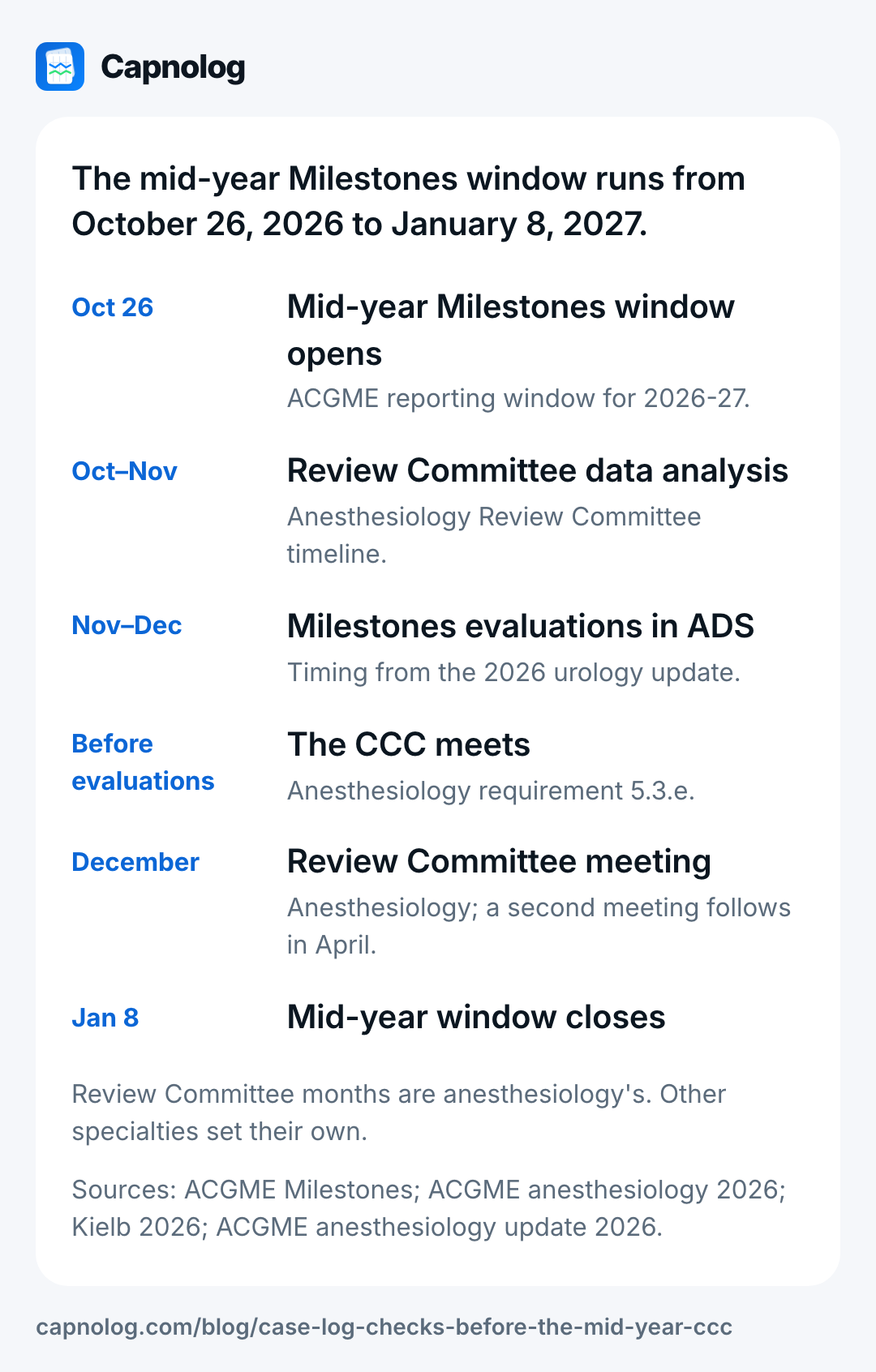
Run the Case Log reports again in the week the clinical competency committee meets, and read each resident's recent activity before the totals. The 2026-27 mid-year Milestones reporting window runs from October 26, 2026 to January 8, 2027. In anesthesiology, the committee must meet before the residents' semi-annual evaluations.
A resident who builds Capnolog ·
This post is for program directors, associate program directors, and coordinators who prepare case logs for the clinical competency committee (CCC). Each of the 5 checks below cites a date or the requirement text. Requirement numbers are from the 2026 anesthesiology program requirements, with neurosurgery and urology noted where they differ.
The dates for 2026-27
The ACGME lists the 2026-27 mid-year Milestones reporting window as October 26, 2026 to January 8, 2027 (ACGME Milestones). In anesthesiology, requirement 5.3.e says the CCC must meet before the residents' semi-annual evaluations and advise the program director on each resident's progress (ACGME anesthesiology 2026).
Specialty slides add their own months inside that window. The 2026 urology update lists November and December as the ADS period for Milestones evaluations of residents and fellows (Kielb 2026). Those months are the deck's timing, not a second window.
The anesthesiology Review Committee keeps a separate annual cycle for program review. The Committee's 2026 timeline shows ADS data input in August and September, then data analysis in October and November (ACGME anesthesiology update 2026). The Committee meets in December, and meets again in April for review and follow-up (ACGME anesthesiology update 2026).
- Oct 26Mid-year Milestones window opensACGME reporting window for 2026-27.
- Oct–NovReview Committee data analysisAnesthesiology Review Committee timeline.
- Nov–DecMilestones evaluations in ADSTiming from the 2026 urology update.
- Before evaluationsThe CCC meetsAnesthesiology requirement 5.3.e.
- DecemberReview Committee meetingAnesthesiology; a second meeting follows in April.
- Jan 8Mid-year window closes
Review Committee months are anesthesiology's. Other specialties set their own.
Sources: ACGME Milestones; ACGME anesthesiology 2026; Kielb 2026; ACGME anesthesiology update 2026.
What the requirements ask of the program director
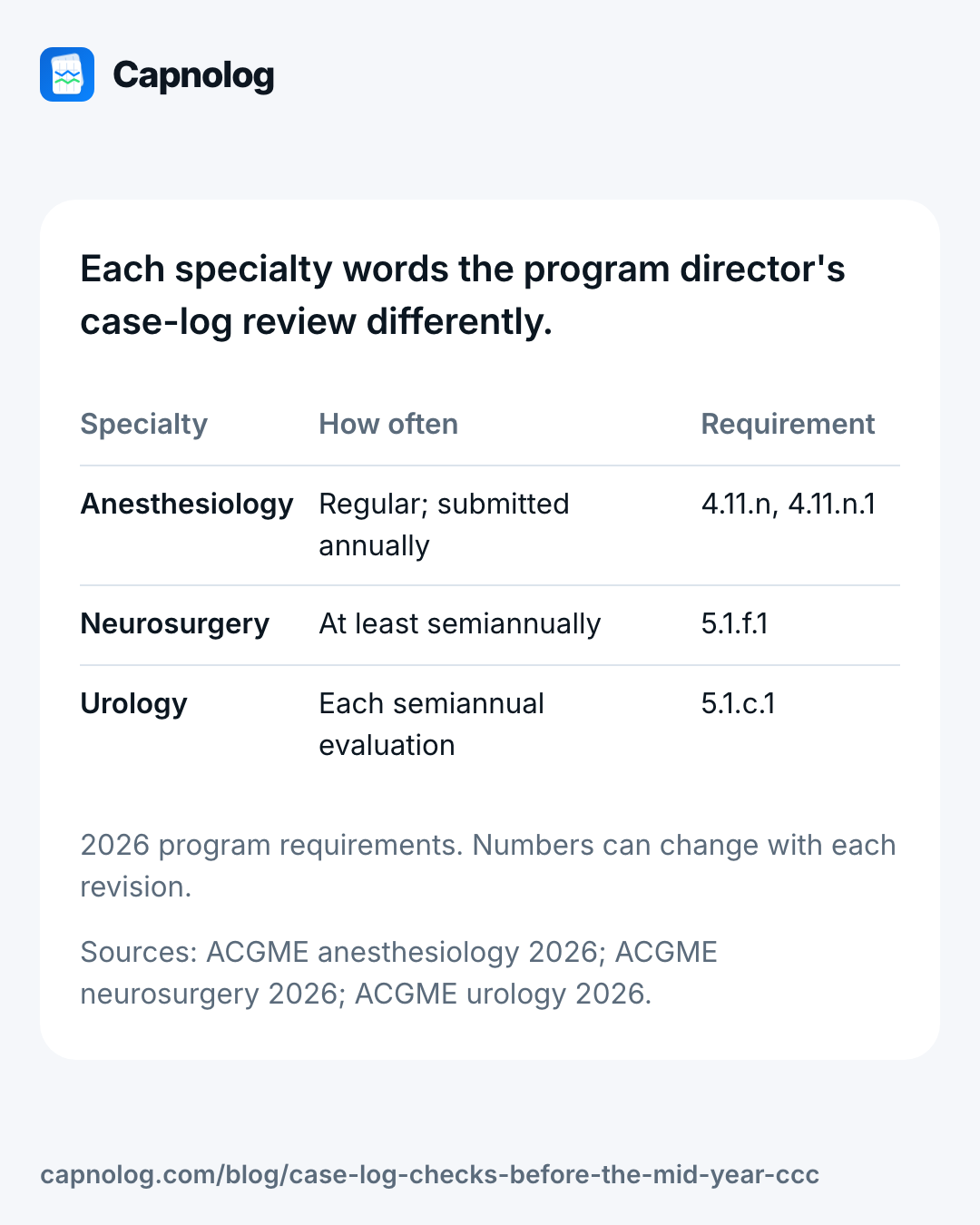
In anesthesiology, requirement 4.11.n makes the program director responsible for regular review of residents' clinical experience logs (ACGME anesthesiology 2026). The director must also verify the logs' accuracy and completeness when the program transmits the logs to the Review Committee (ACGME anesthesiology 2026).
Requirement 4.11.n.1 requires annual submission of the logs to the Review Committee, in the format and by the due date the Committee sets (ACGME anesthesiology 2026). Requirement 4.11.p requires monitoring of the distribution of cases among residents (ACGME anesthesiology 2026).
Two other specialties name a frequency. Neurosurgery requirement 5.1.f.1 says the program director must review the Case Log data with each resident at least semiannually (ACGME neurosurgery 2026). Urology requirement 5.1.c.1 makes the semiannual evaluation include a review of each resident's procedural experience, including the number of cases recorded (ACGME urology 2026).
| Specialty | How often | Requirement |
|---|---|---|
| Anesthesiology | Regular; submitted annually | 4.11.n, 4.11.n.1 |
| Neurosurgery | At least semiannually | 5.1.f.1 |
| Urology | Each semiannual evaluation | 5.1.c.1 |
2026 program requirements. Numbers can change with each revision.
Sources: ACGME anesthesiology 2026; ACGME neurosurgery 2026; ACGME urology 2026.
Anesthesiology requirement 5.2.a calls the Milestones, and when applicable the Case Logs, tools to ensure residents can practice autonomously at completion (ACGME anesthesiology 2026). The checks below treat a case log as evidence for the committee to read, not as a verdict.
Check 1: run the reports again
A report pulled weeks before the meeting shows counts as they stood on that day. On June 9, 2025, the ACGME announced updated Case Log category calculations for adult cardiothoracic anesthesiology (ACGME June 2025). The notice advised programs to run end-of-year Case Log reports again before any Clinical Competency Committee meeting (ACGME June 2025).
That notice covered the adult cardiothoracic anesthesiology fellowship categories, not the core residency. For any program, the practical step is to pull fresh reports in the week of the meeting. Write the run date on each report, so the committee knows which day the counts reflect.
Check 2: read activity before totals
A total shows how many cases a resident has logged, not whether the resident is logging now. The ACGME radiology Case Log FAQ says program directors and coordinators can run reports to oversee residents' data entry (ACGME radiology FAQ). The FAQ names two detailed reports for ongoing oversight, Log Activity and Case Detail (ACGME radiology FAQ).
The anesthesiology Case Logs page in ADS uses the same 2 names, beside Experience by Year and a specialty report, Anesthesiology Minimum. Check the menu for your own specialty before the meeting.
Activity matters because a resident can be behind on entry without being short on cases. In a 2016 survey of 82 residents in surgical specialties at one center, half logged monthly or less often (Cadish 2016). About half (51.4%) reported backlogs of 3 months or longer (Cadish 2016).
A resident with a steady total and no entries in the last 2 months may have a backlog rather than a shortfall. Ask before the committee reads the count.
Check 3: list residents who took leave
Before the meeting, list every resident who took a leave of absence this year. The anesthesiology FAQ on leave allows flexibility at the program level, provided that all clinical experience requirements are met, including case and procedure logs (ACGME anesthesiology 2026). The CCC must also consider the resident fully prepared for autonomous practice (ACGME anesthesiology 2026).
The same FAQ encourages the program director to seek guidance from the American Board of Anesthesiology's Absence from Training policy (ACGME anesthesiology 2026). At mid-year, there is still time to schedule cases in a category where a resident back from leave is short.
Check 4: treat a low count as a question
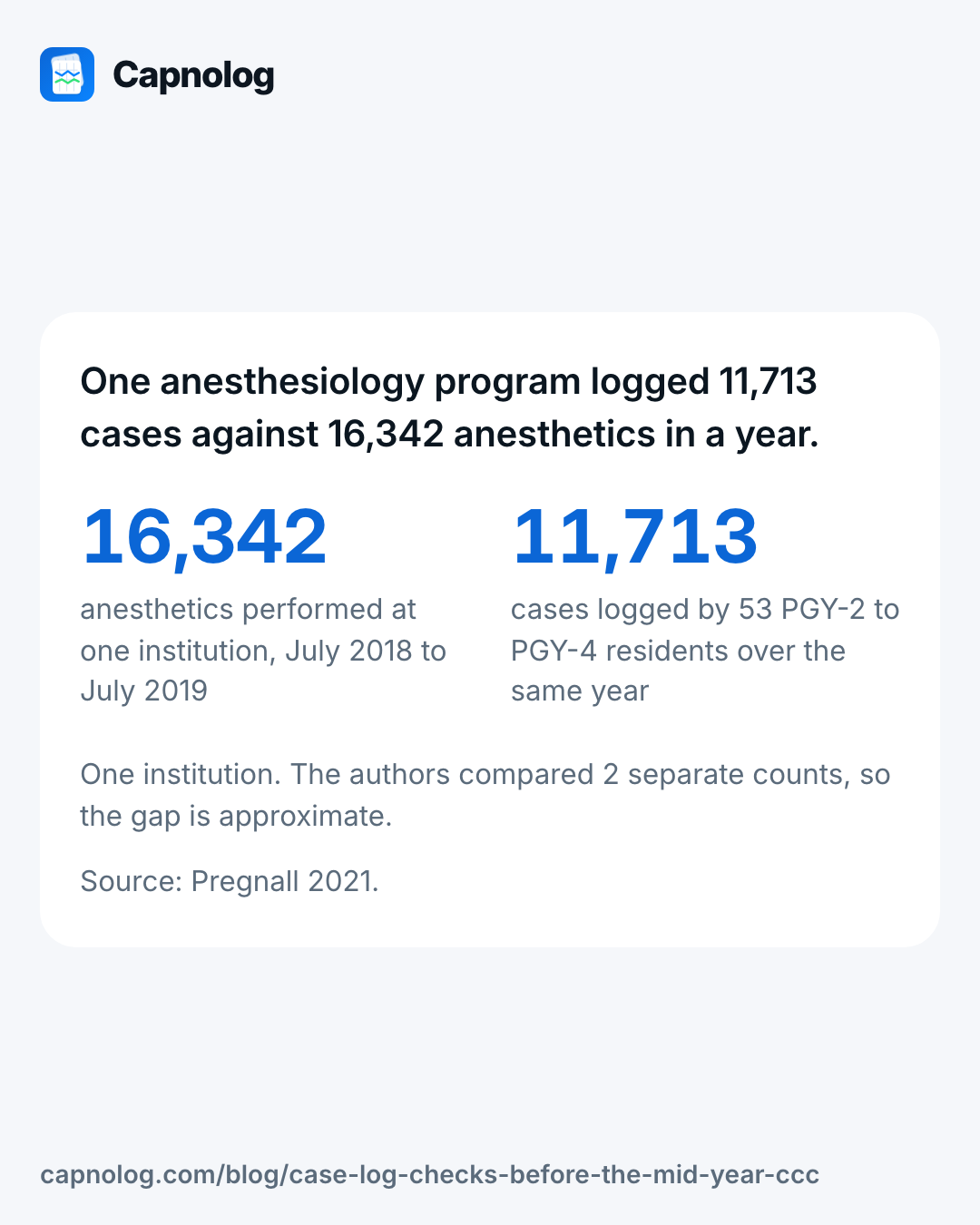
A low count can mean too few cases, or cases done and not logged. At one institution, 53 anesthesiology residents in PGY-2 to PGY-4 logged 11,713 cases against 16,342 anesthetics performed over one year (Pregnall 2021). The authors compared 2 separate counts, so read the gap as approximate.
One institution. The authors compared 2 separate counts, so the gap is approximate.
Source: Pregnall 2021.
Nudges have a mixed record. An intraoperative reminder in that study did not improve logging rates (Pregnall 2021). The 2016 survey found departmental training and reminders associated with better logging habits (Cadish 2016). The findings do not agree, and neither study set out to show what works at another program.
Ask the resident before the committee reads a low count as a gap in training. A short conversation separates a logging backlog from a true shortfall in cases.
Check 5: read counts beside the other evidence
The ACGME describes the Case Log as playing a significant role in assessing a resident's readiness for independent practice (ACGME 2024). Minimums, in the same account, ensure experience in critical areas (ACGME 2024).
A count still sits beside other assessment, not above other assessment. The anesthesiology Milestones say Milestones cannot be the sole assessment in high-stakes decisions (ACGME Milestones 2.0). The same document calls Level 4 a graduation goal, not a requirement (ACGME Milestones 2.0).
The ACGME guidebook for clinical competency committees describes sub-committees that review procedural competence and Case Logs (Andolsek 2020). The guidebook lists a procedure log with an assessment of competency as one assessment method (Andolsek 2020). Read the count with the assessment, not in place of the assessment.
For the research on how many cases go unlogged, see the case-log gap page. The anesthesiology minimums page lists the categories and their minimums. For residents, a separate post covers how to keep surgical case notes.
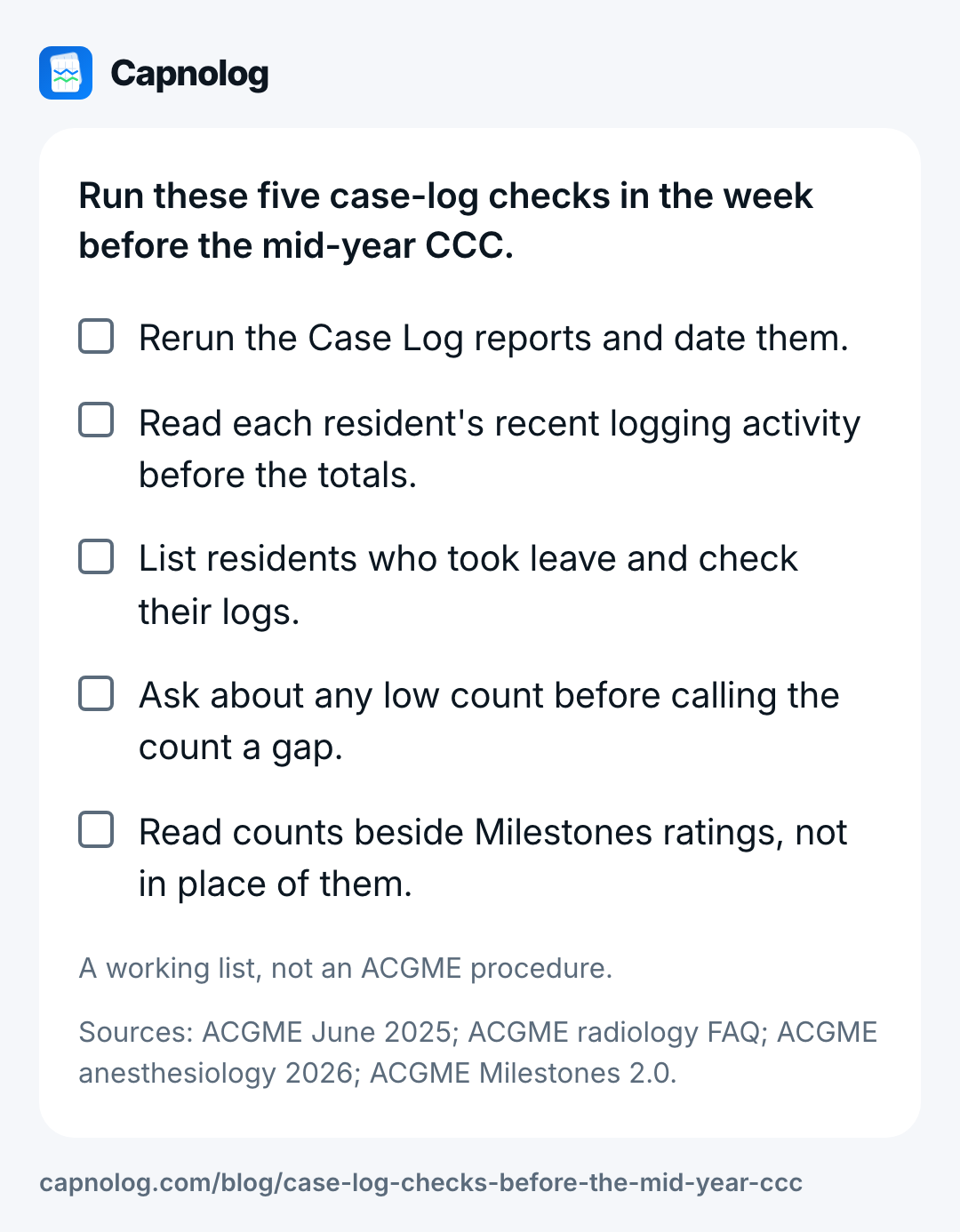
- Rerun the Case Log reports and date them.
- Read each resident's recent logging activity before the totals.
- List residents who took leave and check their logs.
- Ask about any low count before calling the count a gap.
- Read counts beside Milestones ratings, not in place of them.
A working list, not an ACGME procedure.
Sources: ACGME June 2025; ACGME radiology FAQ; ACGME anesthesiology 2026; ACGME Milestones 2.0.
Make the next OR schedule easier to share.
Capnolog's Program Console publishes the OR week to residents. It does not open their personal case logs.
What the Program Console doesWhat this post does not cover
- The report names come from the radiology FAQ and the author's own anesthesiology view in ADS, checked in October 2026. The neurosurgery and urology menus were not checked.
- The June 2025 rerun notice applied to the adult cardiothoracic anesthesiology fellowship categories. This post does not claim a similar recalculation in other categories.
- The logging evidence is single-center: one anesthesiology program in 2018-19 and one 2016 survey of 82 residents.
- The CCC guidebook cited is the third edition, current as of January 2020, read on a copy hosted outside acgme.org.
- Whether a resident is ready for autonomous practice is the judgment of the CCC and the program director. These checks inform that judgment and do not replace the judgment.
Program staff: see how programs use Capnolog.
Sources
- ACGME. Milestones overview: reporting windows for 2026-27. acgme.org.
- ACGME. Program Requirements for Graduate Medical Education in Anesthesiology, including FAQs. 2026 (requirements 4.11.n, 4.11.n.1, 4.11.p, 5.2.a, 5.3.e; FAQ on leave).
- ACGME. Program Requirements for Graduate Medical Education in Neurological Surgery, including FAQs. 2026 (requirement 5.1.f.1).
- ACGME. Program Requirements for Graduate Medical Education in Urology, including FAQs. 2026 (requirement 5.1.c.1).
- ACGME. e-Communication, June 9, 2025: updated Case Log category calculations for adult cardiothoracic anesthesiology.
- ACGME. Anesthesiology Milestones 2.0 (second revision November 2020; implemented July 1, 2021).
- ACGME Review Committee for Radiology. Case Log FAQs: Diagnostic and Interventional Radiology. July 2026.
- Andolsek K, Padmore J, Hauer KE, Ekpenyong A, Edgar L, Holmboe E. Clinical Competency Committees: A Guidebook for Programs, 3rd edition. ACGME, current as of January 2020 (copy hosted by Kaiser Permanente Northern California).
- ACGME. Anesthesiology Review Committee Update, 2026 Annual Educational Conference ('Annual Timeline' slide).
- Kielb S, Huth L, Bardgett S. Specialty Update: Urology. ACGME 2026 Annual Educational Conference.
- ACGME. ACGME Answers: A Look at Case Log Minimums. ACGME blog, September 26, 2024.
- Pregnall AM, Gruss CL, Ramanujan KS, Gelfand BJ, McEvoy MD, Wanderer JP. ACGME Case Log Reminder Does Not Improve Resident Accuracy in Logging Cases. J Med Syst. 2021;46(1):1 (PMID 34786618).
- Cadish LA, Fung V, Lane FL, Campbell EG. Surgical Case Logging Habits and Attitudes: A Multispecialty Survey of Residents. J Surg Educ. 2016;73(3):474-481 (PMID 27049679).