
How the ACGME Review Committee uses your program's case logs
The anesthesiology Review Committee reads graduate case logs once a year, beside board pass rates, surveys, and other data. For a permanent complement increase, the Committee reviews 2 to 3 years of Case Log reports. Under-logging could make a program's volume look lower, though that step is an inference, not an ACGME statement.
A resident who builds Capnolog ·
This post is for program directors, associate program directors, and coordinators. It pulls the case-log lines out of the 2026 Review Committee updates for anesthesiology, neurosurgery, and urology. Months and rules differ by specialty, so check your own Committee's deck before you plan around them.
When the anesthesiology Committee reads the data
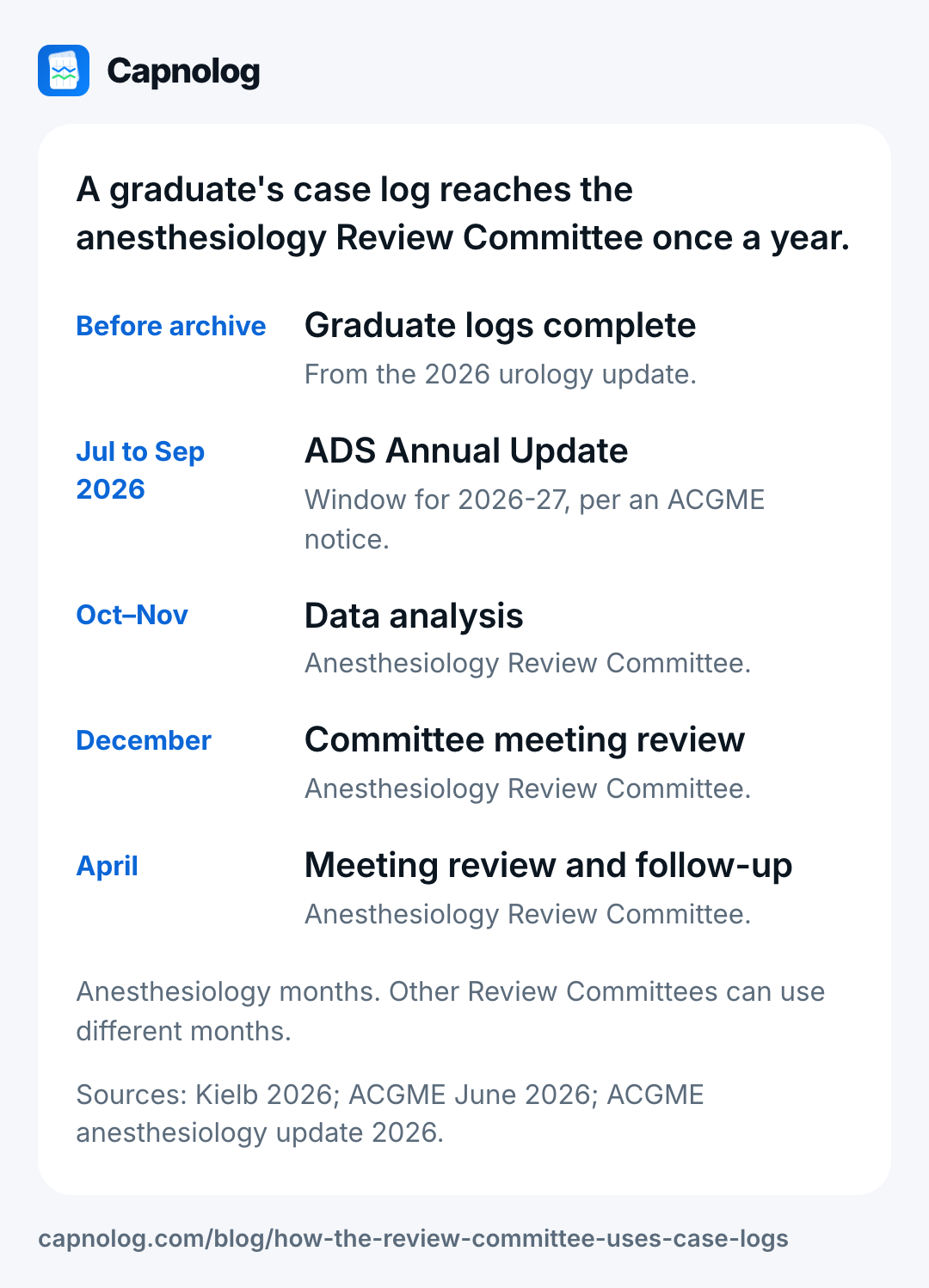
The anesthesiology Review Committee works on an annual timeline. Programs enter data in ADS in August and September, and the Committee analyzes the data in October and November (ACGME anesthesiology update 2026). The Committee reviews programs at a December meeting, then holds an April meeting for review and follow-up (ACGME anesthesiology update 2026).
For 2026-27, an ACGME notice set the ADS Annual Update window as July to September 2026 (ACGME June 2026). The notice went out in June, before the window opened. Check ADS for the dates of the next cycle.
The months above come from the anesthesiology deck. Other Review Committees can use different months, so read the timeline slide for your specialty.
- Before archiveGraduate logs completeFrom the 2026 urology update.
- Jul to Sep 2026ADS Annual UpdateWindow for 2026-27, per an ACGME notice.
- Oct–NovData analysisAnesthesiology Review Committee.
- DecemberCommittee meeting reviewAnesthesiology Review Committee.
- AprilMeeting review and follow-upAnesthesiology Review Committee.
Anesthesiology months. Other Review Committees can use different months.
Sources: Kielb 2026; ACGME June 2026; ACGME anesthesiology update 2026.
What the Committee reads beside the case logs
The anesthesiology deck lists graduate case logs among its annual review elements (ACGME anesthesiology update 2026). The other elements include board pass rates, attrition and omission rates, program changes, scholarly activity, and major changes (ACGME anesthesiology update 2026). The faculty survey and the resident survey sit in the same diagram (ACGME anesthesiology update 2026).
The neurosurgery deck lists procedural logs, meaning graduate case log data, among its annual program review data elements (ACGME neurosurgery update 2026). Its list also names the ADS Annual Update, board passage rate, surveys, and omission of data (ACGME neurosurgery update 2026). The data come from the most recently completed academic year, except major changes and responses to citations (ACGME neurosurgery update 2026).
In both decks, the case log sits among several inputs. The Committee reads that input every year, for every class that graduates.
Missed minimums in neurosurgery and urology
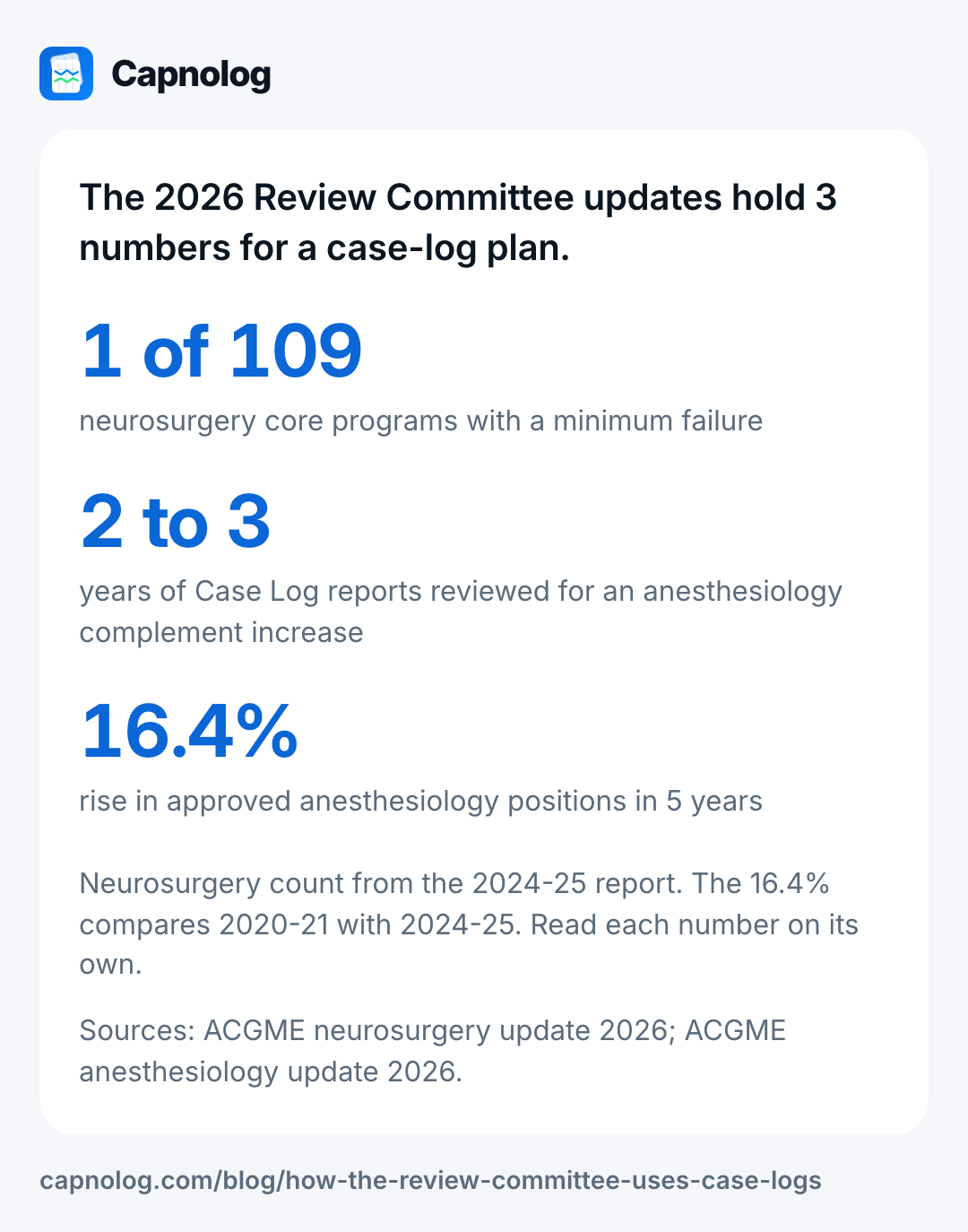
In the neurosurgery 2024-25 Case Log report, 1 of 109 core programs had a minimum failure (ACGME neurosurgery update 2026). The other 108 core programs had none on that report.
The neurosurgery deck advises program directors and coordinators to enter missed Case Log minimums before graduation (ACGME neurosurgery update 2026). The slide lists missed minimums among items to report to the Committee with an action plan and initial results (ACGME neurosurgery update 2026). Low ACGME survey ratings appear on the same list (ACGME neurosurgery update 2026).
Entering a missed minimum means logging cases a resident performed but never logged. Logging can close a gap in the record, not a gap in experience.
The urology deck lists graduate achievement of the minimum procedural requirements first among common citations and areas for improvement (Kielb 2026). The order is the slide's bullet order, not a ranking by how often each citation occurs.
Case logs in a request for more residents
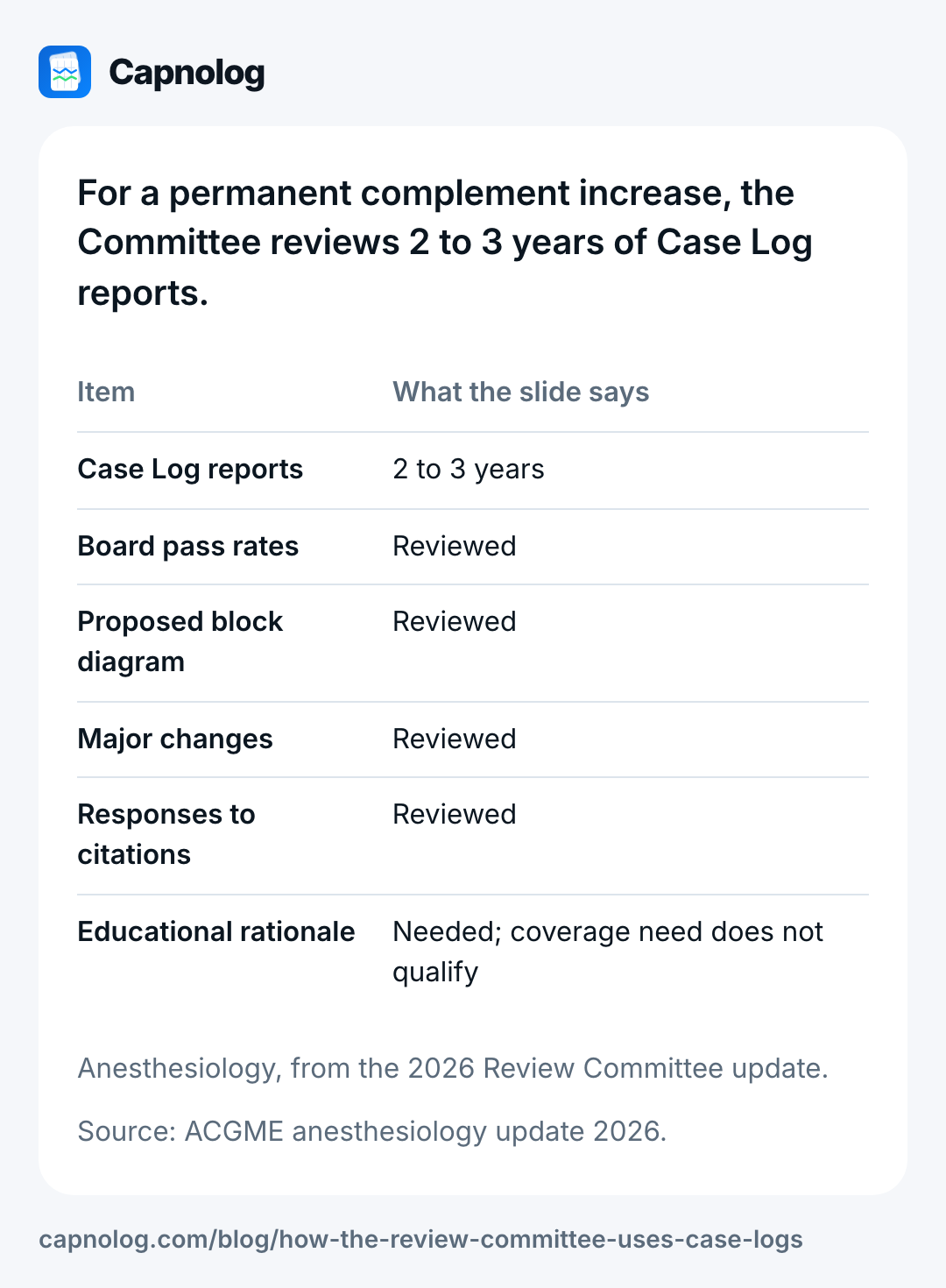
For a permanent complement increase, the anesthesiology Review Committee reviews Case Log reports from 2 to 3 years (ACGME anesthesiology update 2026). It also reviews board pass rates, the proposed block diagram, major changes, and responses to citations (ACGME anesthesiology update 2026).
The same slide asks for a solid educational rationale (ACGME anesthesiology update 2026). An increased need for coverage does not qualify as that rationale (ACGME anesthesiology update 2026).
| Item | What the slide says |
|---|---|
| Case Log reports | 2 to 3 years |
| Board pass rates | Reviewed |
| Proposed block diagram | Reviewed |
| Major changes | Reviewed |
| Responses to citations | Reviewed |
| Educational rationale | Needed; coverage need does not qualify |
Anesthesiology, from the 2026 Review Committee update.
Source: ACGME anesthesiology update 2026.
Anesthesiology programs have grown. Approved resident positions in core programs rose from 7,640 in 2020-21 to 8,890 in 2024-25, a 16.4% increase (ACGME anesthesiology update 2026). Core programs rose from 161 to 182, or 13.0%, over the same years (ACGME anesthesiology update 2026).
These counts cover core programs, not subspecialty fellowships. A program planning its own increase needs 2 to 3 years of Case Log reports it trusts.
Neurosurgery count from the 2024-25 report. The 16.4% compares 2020-21 with 2024-25. Read each number on its own.
Sources: ACGME neurosurgery update 2026; ACGME anesthesiology update 2026.
What under-logging could do to a program's numbers
Residents do not always log every case. At one institution, residents logged 11,713 cases against 16,342 anesthetics performed in 2018-19 (Pregnall 2021). That is 71.7% by simple division, and the authors describe the gap as under-reporting (Pregnall 2021). A single institution gives 1 example, not a national rate.
The next step is an inference, not an ACGME statement. If residents under-log, Case Log reports show fewer cases than the program provided. A complement request that relies on those reports could then understate the program's volume.
No source cited here shows that outcome for any program. Treat it as a reason to check the logs, not as a finding.
To check your own program, compare 1 month of Case Log reports with the OR schedule for the same month. The post on what improves case-log completion covers what programs have tested. The case-log gap page collects the research on how much residents leave out of their logs. The same review is published as a citable preprint.
Close graduate logs before the archive date
The urology deck tells programs, at the start of the academic year, to ensure graduate Case Logs are complete before the archive date (Kielb 2026). The radiology Case Log FAQ says that after graduation, Case Log data goes into an archive and no one may edit the data (ACGME radiology FAQ).
The ACGME help center says the year-end deadline applies to specialties that require Case Logs, and in most cases falls on August 1 (ACGME Help 2024). After the deadline, the ACGME archives the graduates' Case Log data, and no one can add or edit cases (ACGME Help 2024). Not every specialty has a deadline.
Check the date for your specialty in the Specialty Case Log Information report on the ADS public site before you set a program deadline.
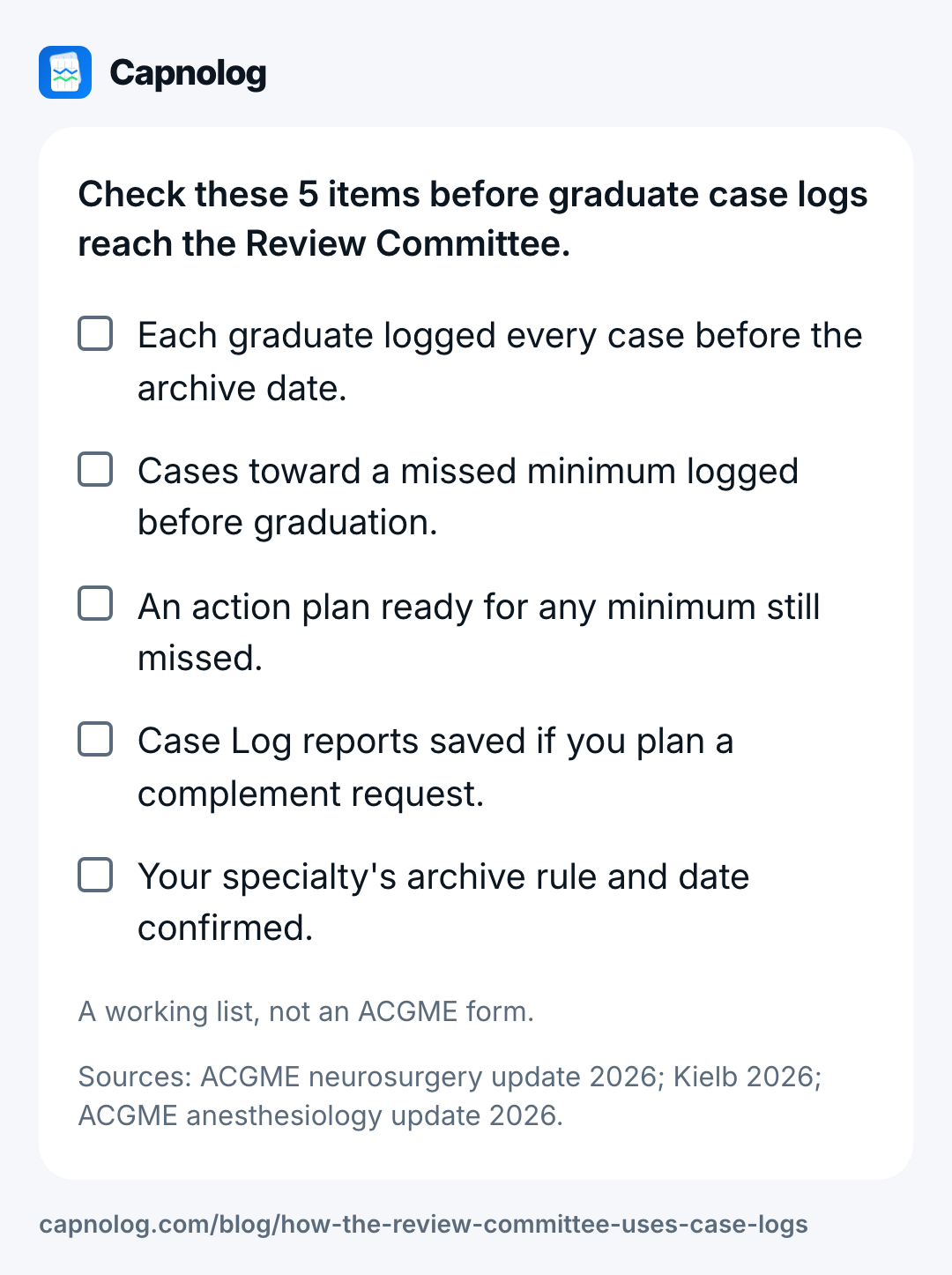
The checklist below is plain guidance built on the neurosurgery, urology, and anesthesiology slides (ACGME neurosurgery update 2026; Kielb 2026; ACGME anesthesiology update 2026). Run the list in the spring, before graduation.
- Each graduate logged every case before the archive date.
- Cases toward a missed minimum logged before graduation.
- An action plan ready for any minimum still missed.
- Case Log reports saved if you plan a complement request.
- Your specialty's archive rule and date confirmed.
A working list, not an ACGME form.
Sources: ACGME neurosurgery update 2026; Kielb 2026; ACGME anesthesiology update 2026.
Coordinators preparing for the mid-year committee can use the case-log checks before the mid-year CCC. The post on coordinator FTE in anesthesiology covers the staffing side. The ACGME case minimums pages list the minimums by specialty.
Plan for the next review.
Explore Capnolog's program schedule publishing; the official ACGME record remains separate.
What the Program Console doesFor what Capnolog offers programs, see the programs page. Capnolog has no affiliation with the ACGME.
What this post does not cover
- The annual months come from the anesthesiology deck. Other Review Committees can use different months.
- The effect of under-logging on a complement request is an inference. No source here shows it happening to a program.
- The archive wording comes from radiology and urology material and a general ACGME help article. Confirm the date for your specialty.
- The logging figures come from a single institution in 2018-19.
- Conference slides summarize Committee practice. The program requirements and the Review Committee decide what applies.
Sources
- ACGME. Anesthesiology Review Committee Update, 2026 Annual Educational Conference ('Annual Timeline', 'Annual Review Elements', 'Permanent Complement Increases' and 'Trends in Core Anesthesiology Programs' slides).
- ACGME. Neurological Surgery Review Committee Update, 2026 Annual Educational Conference ('2025 Annual Program Review' and 'Advice to PDs and PCs' slides).
- Kielb S, Huth L, Bardgett S. Specialty Update: Urology. ACGME 2026 Annual Educational Conference.
- ACGME. e-Communication, June 22, 2026: ADS Annual Update collection window.
- ACGME Review Committee for Radiology. Case Log FAQs: Diagnostic and Interventional Radiology. July 2026.
- ACGME. Year-End Case Logs Verification Process for Program Leadership. ACGME Help Center, updated May 23, 2024.
- Pregnall AM, Gruss CL, Ramanujan KS, Gelfand BJ, McEvoy MD, Wanderer JP. ACGME Case Log Reminder Does Not Improve Resident Accuracy in Logging Cases. J Med Syst. 2021;46(1):1 (PMID 34786618).