
Anesthesiology program coordinator FTE: what the ACGME requires
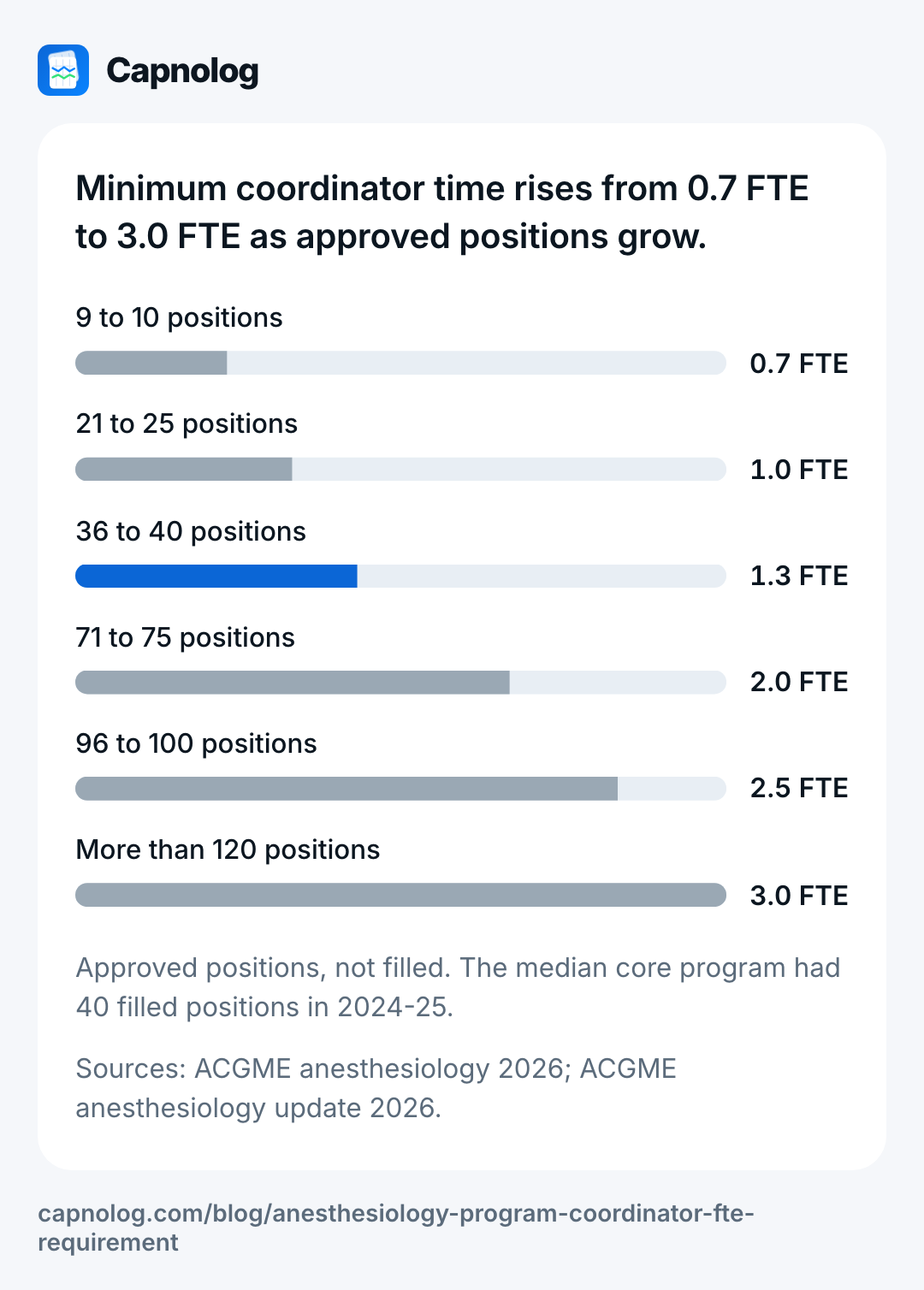
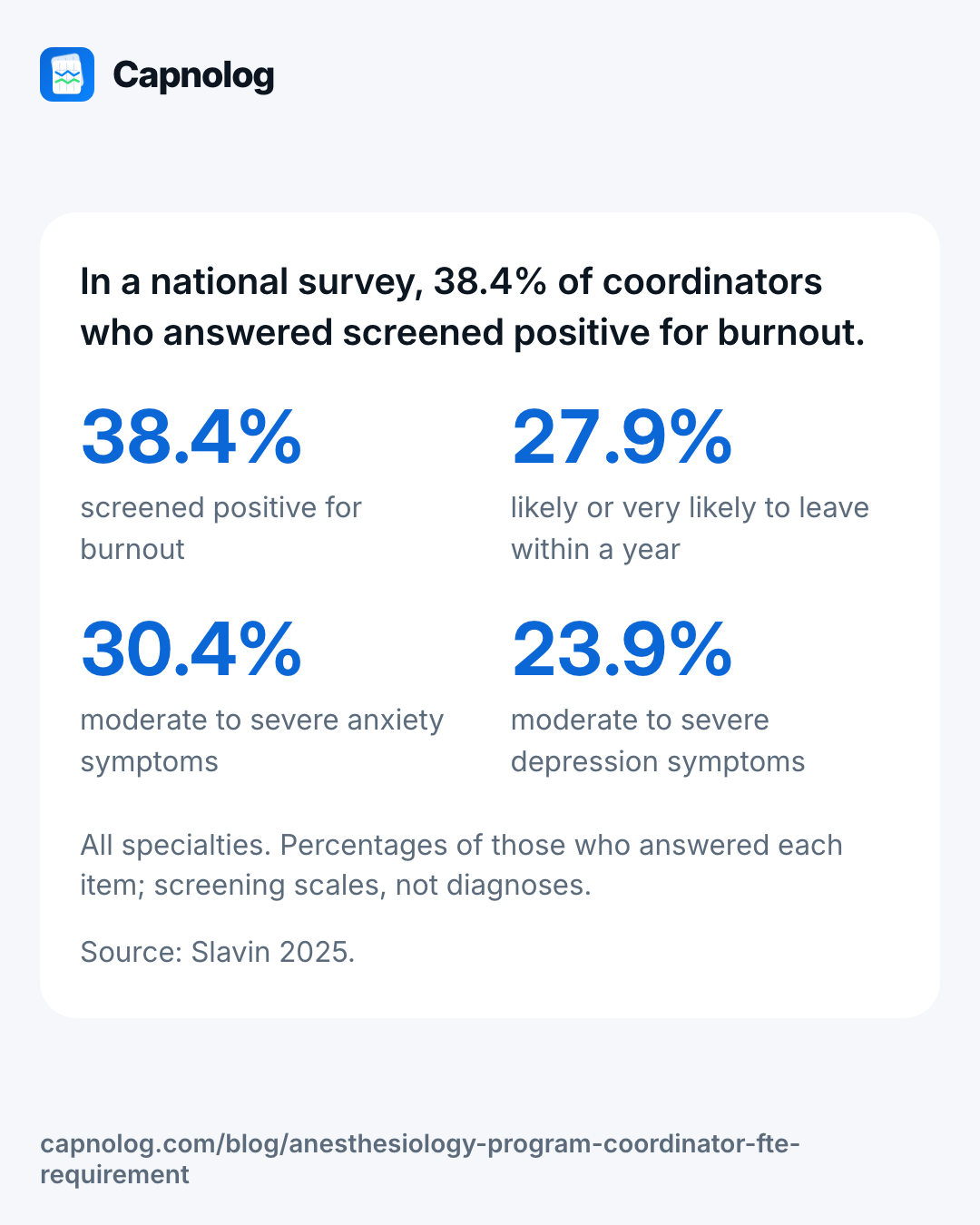
For an anesthesiology residency, ACGME requirement 2.12.b sets minimum coordinator time by the number of approved resident positions. A program with 36 to 40 positions needs at least 1.3 full-time equivalents (FTE), and one with more than 120 needs 3.0. In a national survey, 38.4% of coordinators who answered screened positive for burnout.
A resident who builds Capnolog ·
This post is for program directors, department administrators, and coordinators who need the coordinator-time number with a citation. The number comes from the 2026 anesthesiology program requirements. The workload findings come from studies of coordinators across specialties, not anesthesiology alone.
What requirement 2.12.b says
Requirement 2.12.b sets the minimum coordinator support for an anesthesiology program by the number of approved resident positions (ACGME anesthesiology 2026). The table starts at 0.7 FTE for 9 to 10 positions, then adds 0.1 FTE for every 5 positions (ACGME anesthesiology 2026). A program with more than 120 approved positions needs at least 3.0 FTE (ACGME anesthesiology 2026).
The Background and Intent text explains what the minimum covers. The minimum time includes activities directly related to administration of the accredited program (ACGME anesthesiology 2026). The same passage notes that coordinators often carry duties beyond that minimum (ACGME anesthesiology 2026).
The passage says that assigning these other responsibilities "will necessitate consideration of allocation of additional support" (ACGME anesthesiology 2026). The added support protects the coordinator's time for the accredited program. Quote that sentence when a coordinator also works outside the program.
Approved positions, not filled. The median core program had 40 filled positions in 2024-25.
Sources: ACGME anesthesiology 2026; ACGME anesthesiology update 2026.
The table, read for a typical program
In 2024-25, core anesthesiology programs had a median of 40 and a mean of 43 filled positions, with a range from 0 to 128 (ACGME anesthesiology update 2026). A program with 40 approved positions sits in the 36 to 40 row, at 1.3 FTE (ACGME anesthesiology 2026).
The 2 counts differ. The table in 2.12.b uses approved resident positions, while the conference slide counts filled positions (ACGME anesthesiology 2026; ACGME anesthesiology update 2026). Use your program's approved number, not this year's head count, when you read the table.
To read the table, find the row for your approved positions. Then compare that row's FTE with the FTE assigned to the program today. If a coordinator divides time across more than one program, count only the share spent on this program.
Elsewhere in the table, a program approved for 21 to 25 positions needs at least 1.0 FTE. A program approved for 96 to 100 positions needs at least 2.5 FTE (ACGME anesthesiology 2026).
The table sets a minimum, not a target. A coordinator who also supports the department or other programs may need more time than the minimum allows.
What the national coordinator survey found
A national survey of 6,372 program and institutional coordinators measured well-being across graduate medical education (Slavin 2025). Of those who answered, 38.4% screened positive for burnout (Slavin 2025). In the same survey, 27.9% were likely or very likely to leave their job within a year (Slavin 2025).
The survey also found 23.9% with moderate to severe depression symptoms and 30.4% with moderate to severe anxiety symptoms (Slavin 2025). These come from screening scales, not diagnoses.
The survey did not limit itself to anesthesiology coordinators. Respondents chose to answer an emailed survey, so the sample may not match all coordinators. For a staffing request, the requirement sets the number, and the survey adds context about the people who hold the role.
All specialties. Percentages of those who answered each item; screening scales, not diagnoses.
Source: Slavin 2025.
Tracking down residents
The survey abstract lists drivers of dissatisfaction, and tracking down residents, fellows, and faculty to complete required tasks is among them (Slavin 2025). The abstract lists that item first, but does not call the item the top driver (Slavin 2025).
A case log is a required task a coordinator may chase before a deadline. The post on what improves case-log completion covers what programs have tested to get residents to log. Coordinators preparing for the committee meeting can use the case-log checks before the mid-year CCC.
Each task that needs a reminder from the coordinator adds time the 2.12.b minimum may not cover. Counting those reminders for 1 month gives a staffing request a number to point to.
What coordinator job descriptions cover
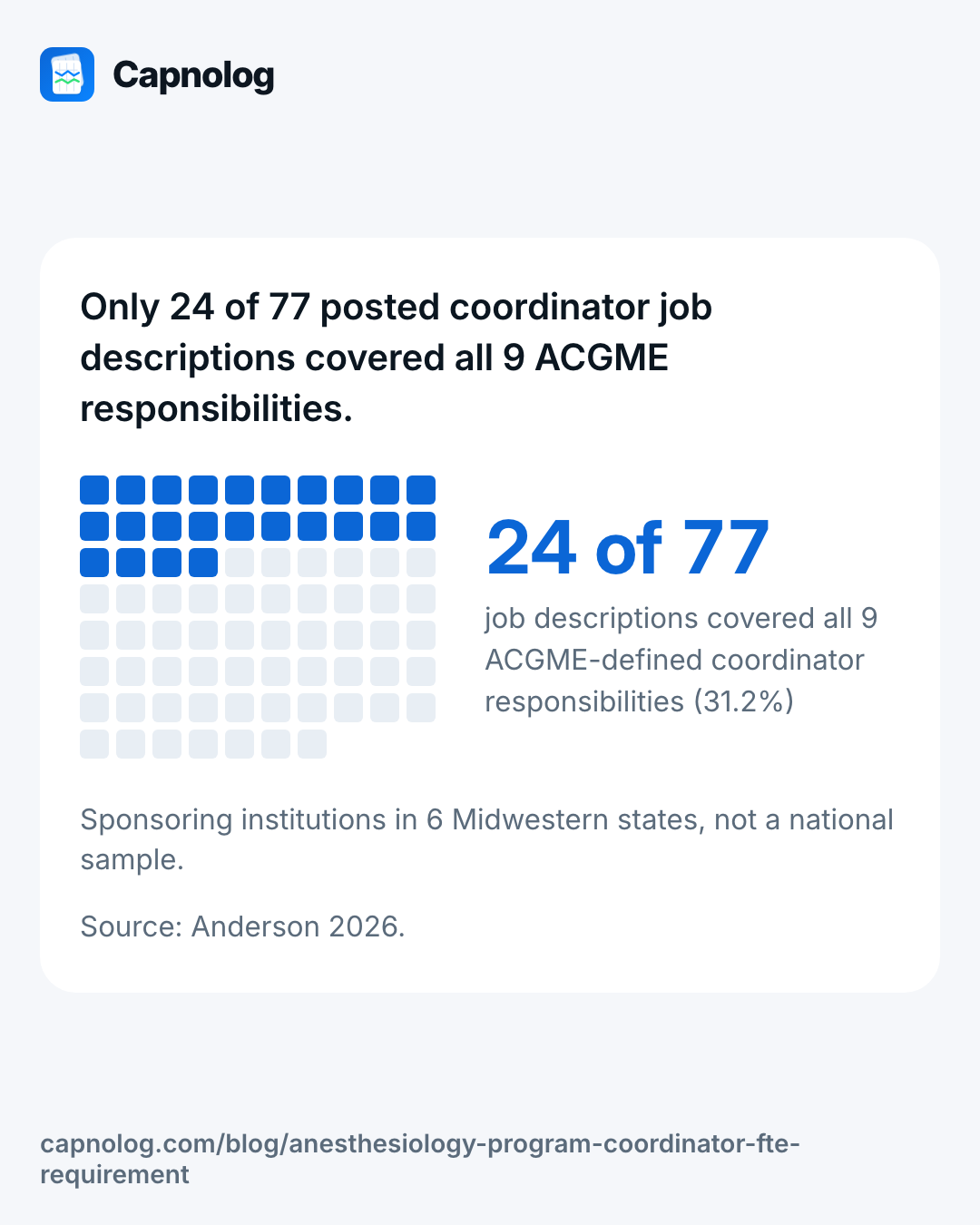
A 2026 study read 77 publicly posted coordinator job descriptions from sponsoring institutions in 6 Midwestern states (Anderson 2026). Only 31.2%, or 24 of 77, covered all 9 responsibilities the ACGME defines for coordinators (Anderson 2026).
A job description that leaves out ACGME duties makes the gap between the minimum and the real workload hard to see. Compare your own description with the 9 responsibilities before you write a staffing request.
Sponsoring institutions in 6 Midwestern states, not a national sample.
Source: Anderson 2026.
Using the table in a staffing request
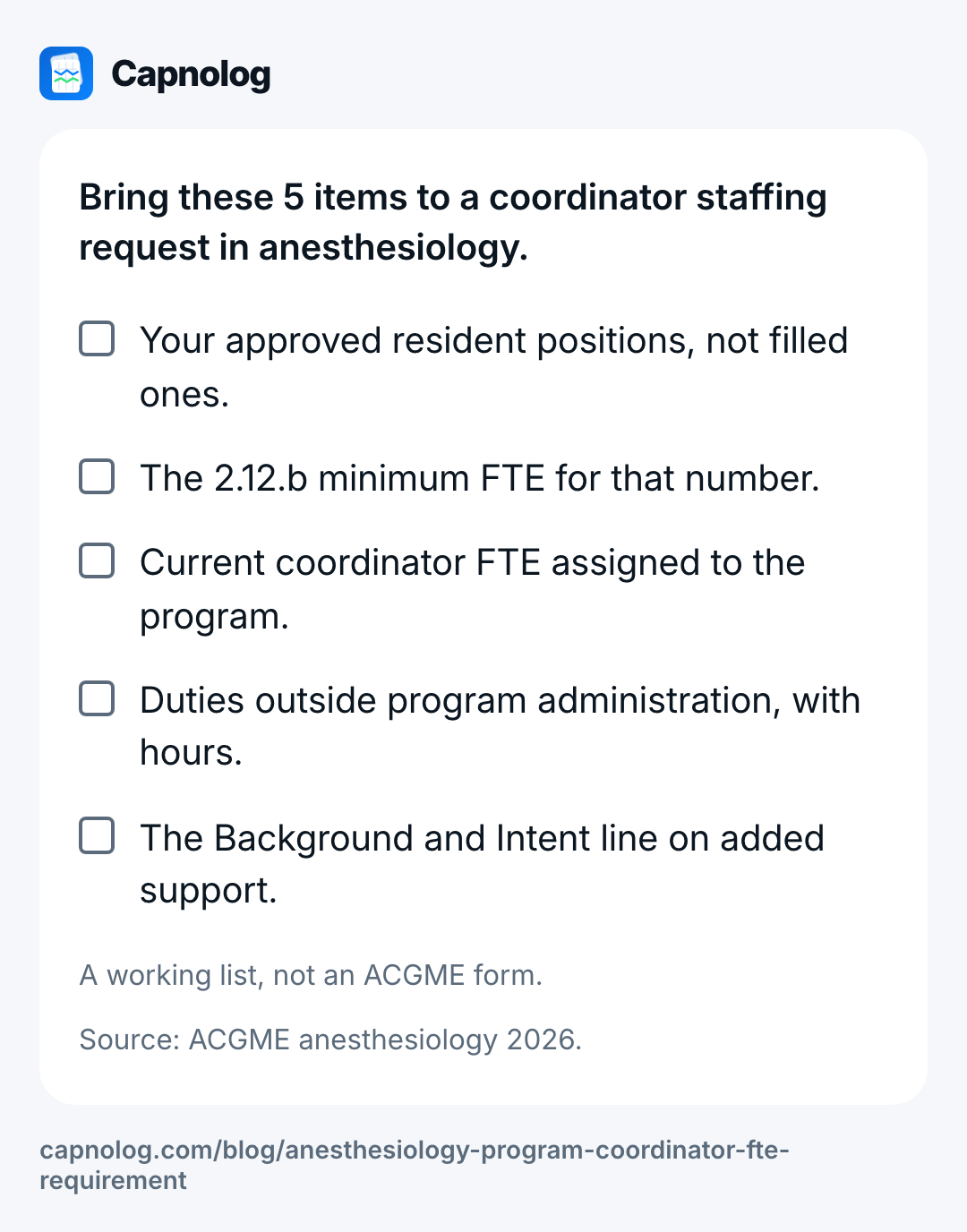
A staffing request carries more weight when the numbers come from the requirement itself. The checklist below is plain guidance built on 2.12.b and the Background and Intent text (ACGME anesthesiology 2026).
- Your approved resident positions, not filled ones.
- The 2.12.b minimum FTE for that number.
- Current coordinator FTE assigned to the program.
- Duties outside program administration, with hours.
- The Background and Intent line on added support.
A working list, not an ACGME form.
Source: ACGME anesthesiology 2026.
Write the request around the gap between the minimum and the hours the role takes now. Track 1 month of hours in 2 groups: program administration and everything else. The 2 totals make that gap visible.
Check the current requirements before each request, because the numbers here come from the 2026 anesthesiology version. A separate post covers the proposed changes to anesthesiology case minimums. For what Capnolog offers programs, see the programs page.
Publish the OR week from a program console.
Ask how Capnolog can fit the program's existing scheduling workflow.
What the Program Console doesWhat this post does not cover
- The FTE table is from the 2026 anesthesiology requirements. Other specialties set different numbers, and a future revision can change this table.
- The median of 40 counts filled positions. The 2.12.b table counts approved positions.
- The well-being survey covered coordinators across specialties, and respondents chose to answer. The results do not describe anesthesiology coordinators alone.
- The job-description study read postings from 6 Midwestern states, not a national sample.
- None of the studies cited here measured how many hours case-log follow-up takes a coordinator.
Program staff: see how programs use Capnolog.
Sources
- ACGME. Program Requirements for Graduate Medical Education in Anesthesiology, including FAQs. 2026 (requirement 2.12.b with the Background and Intent).
- ACGME. Anesthesiology Review Committee Update, 2026 Annual Educational Conference ('Core Anesthesiology Program Size: 2024-2025' slide).
- Slavin S, Yaghmour N, Baez-Martinez A, O'Donovan C, Panda M, Carpenter P, Burt C, McLeod KK. Program and Institutional Coordinator Well-Being: Results From a National Survey. Acad Med. 2025;100(5):572-577 (PMID 39705400).
- Anderson L, Wright K, Keffler K, Eaton J, Twiss M, Rowland K. An Analysis of Graduate Medical Education Program Coordinator Job Descriptions. J Grad Med Educ. 2026:26-35 (PMID 41694770).