
Proposed anesthesiology case minimums: what the 2026 Delphi study found
A 60-member national panel recommended adding anesthesiology residency minimums for arterial lines (40), central lines (20), fiberoptic intubation (10), and several other experiences. The panel also recommended increasing peripheral nerve blocks from 40 to 60 and cardiac cases from 20 to 25. These are proposals, not changes to current ACGME requirements.
A resident who builds Capnolog ·
The study appeared online in Anesthesiology on October 8, 2026 (Saddawi-Konefka 2026). The difference between a recommendation and a requirement matters, because residents could mistake the numbers for new graduation targets.
If you review a resident's log today, use the current ACGME requirements (ACGME Anesthesiology 2026). Treat the study as an informed proposal for what might change.
What the study actually did
The authors ran a 3-round modified Delphi process with a national panel of 60 stakeholders (Saddawi-Konefka 2026). Panelists rated procedural categories and minimum numbers, reviewed the group's feedback, and rated the proposals again. Consensus required agreement from at least two-thirds of the panel (Saddawi-Konefka 2026).
The panel had 30 residency program directors, 15 academic anesthesiologists, and 15 anesthesiologists in private practice (Saddawi-Konefka 2026).
A Delphi study measures where experts can agree. The study is not an ACGME rule-making vote, and consensus does not show that each proposed minimum predicts clinical competence.
Where the panel recommended new minimums
The panel recommended new minimums in areas that have no separate minimum today (Saddawi-Konefka 2026). The proposals are not changes to a number already required.
| Area | Proposed minimum, not required |
|---|---|
| Arterial lines | 40 |
| Central lines | 20 |
| Fiberoptic intubation | 10 |
| One-lung ventilation | 10 |
| Neuromonitoring | 10 |
| Point-of-care ultrasound (POCUS) | 10 cardiac, 10 lung |
| Non-operating-room anesthesia (NORA) | 20 cases |
Proposed by a Delphi panel of 60. Not ACGME requirements.
Source: Saddawi-Konefka 2026.
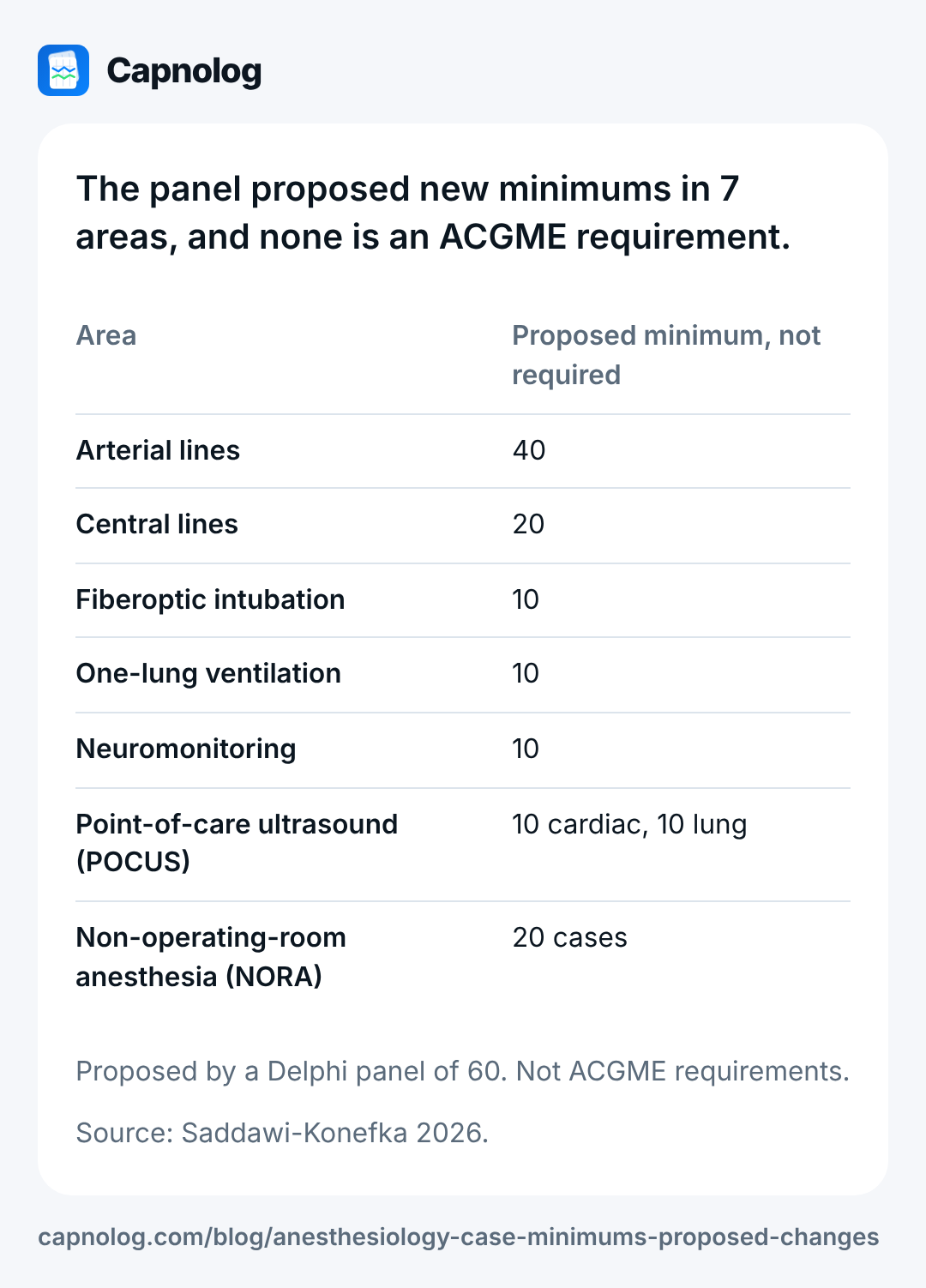
The table does not establish how a new category would be entered in the ACGME Case Log System. The form, the definitions, and the counting rules would come from a later requirements process.
A resident may already place arterial lines, perform POCUS, or give anesthesia outside the operating room. A new minimum would make each of those experiences count against a defined target. No such target from this study is in effect today.
Existing targets the panel would raise
The panel also reached consensus on raising 2 existing requirements. Total peripheral nerve blocks would rise from 40 to 60, with added requirements for anatomic detail (Saddawi-Konefka 2026). The cardiac minimum would rise from 20 to 25 cases (Saddawi-Konefka 2026).
Required numbers count patients (Program Requirement 4.4). Proposed numbers count blocks or cases and are not requirements.
Sources: ACGME Anesthesiology 2026; Saddawi-Konefka 2026.
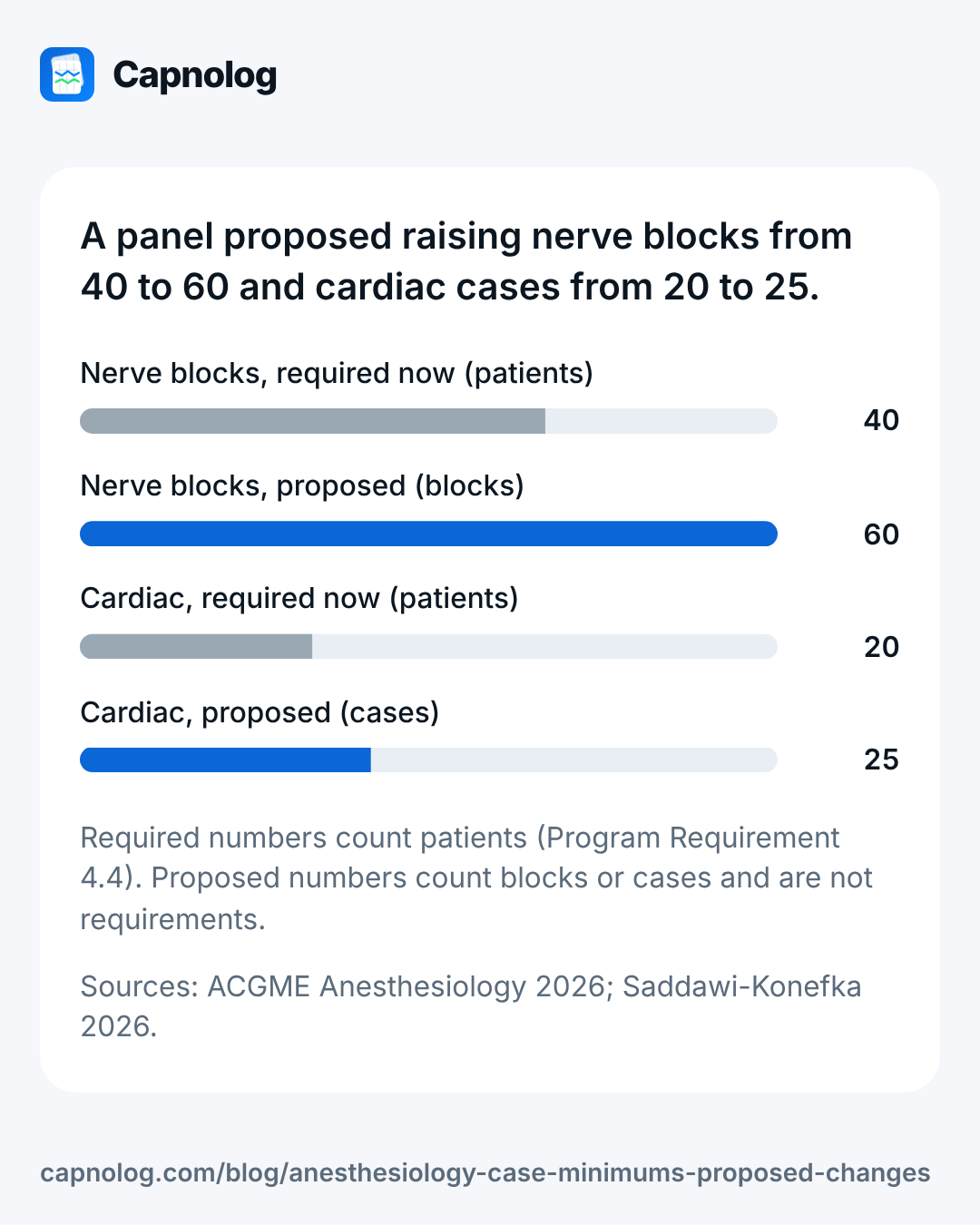
The current numbers come from the ACGME's 2026 anesthesiology requirements (ACGME Anesthesiology 2026), and the proposed numbers come from the Delphi paper (Saddawi-Konefka 2026).
The 2 columns do not count the same thing. The current requirements count patients, while the study describes some proposals as blocks, procedures, or cases. A revised requirement would have to define the unit before the number could apply.
The panel did not agree on every proposal. The panel reached no consensus on whether to keep the existing minimum for patients younger than 3 months (Saddawi-Konefka 2026). The study reports uncertainty alongside consensus, not one uncontested replacement rule.
Which anesthesiology minimums still apply now
The 2026 ACGME anesthesiology requirements remain the source for residency minimums in effect today. The numbers sit inside Program Requirement 4.4, and each one counts patients (ACGME Anesthesiology 2026). The list below gives 4 examples.
- Peripheral nerve blocks: 40 patients (4.4.c.10.a) (ACGME Anesthesiology 2026).
- Cardiac surgery: 20 patients, with a cardiopulmonary bypass sub-requirement of 10 of the 20 (4.4.c.3) (ACGME Anesthesiology 2026).
- Epidurals: 40 patients (4.4.c.7.a) (ACGME Anesthesiology 2026).
- Spinals: 40 patients (4.4.c.9.a) (ACGME Anesthesiology 2026).
These are examples, not the full table. Totals and nested categories count differently, so use the exact current ACGME definition when you assess a resident. The anesthesiology case minimums page lists the full set, with links to the ACGME document.
When would the ACGME change the requirements?
The authors describe the paper as preparation for ACGME revisions they expect in 2027 (Saddawi-Konefka 2026). The ACGME's 2026 anesthesiology update lists 2027 as the tentative start of a core revision process (ACGME anesthesiology update 2026). That date starts a process, and is not an effective date for new case-log minimums.
The ACGME says Review Committees periodically review and adjust minimum requirements (ACGME 2024). The anesthesiology slides describe surveys during a revision, calls for writing groups, and a stakeholder summit (ACGME anesthesiology update 2026). Even a formal change could leave separate dates for when a new category appears and when enforcement starts.
A separate revision, to the Regional Anesthesiology and Acute Pain Medicine fellowship requirements, takes effect July 1, 2027 (ACGME July 6, 2026). That fellowship action does not adopt the panel's proposed numbers for core anesthesiology residency.
- July 2016Last major revision of core requirements
- July 2026Current requirementsMinimums inside Program Requirement 4.4.
- October 2026Delphi recommendations publishedAnesthesiology, online ahead of print October 8, 2026.
- 2027Tentative start of core revision processNot a start date for new minimums.
A start date for a revision process, not an effective date for new minimums.
Sources: ACGME anesthesiology update 2026; ACGME Anesthesiology 2026; Saddawi-Konefka 2026.
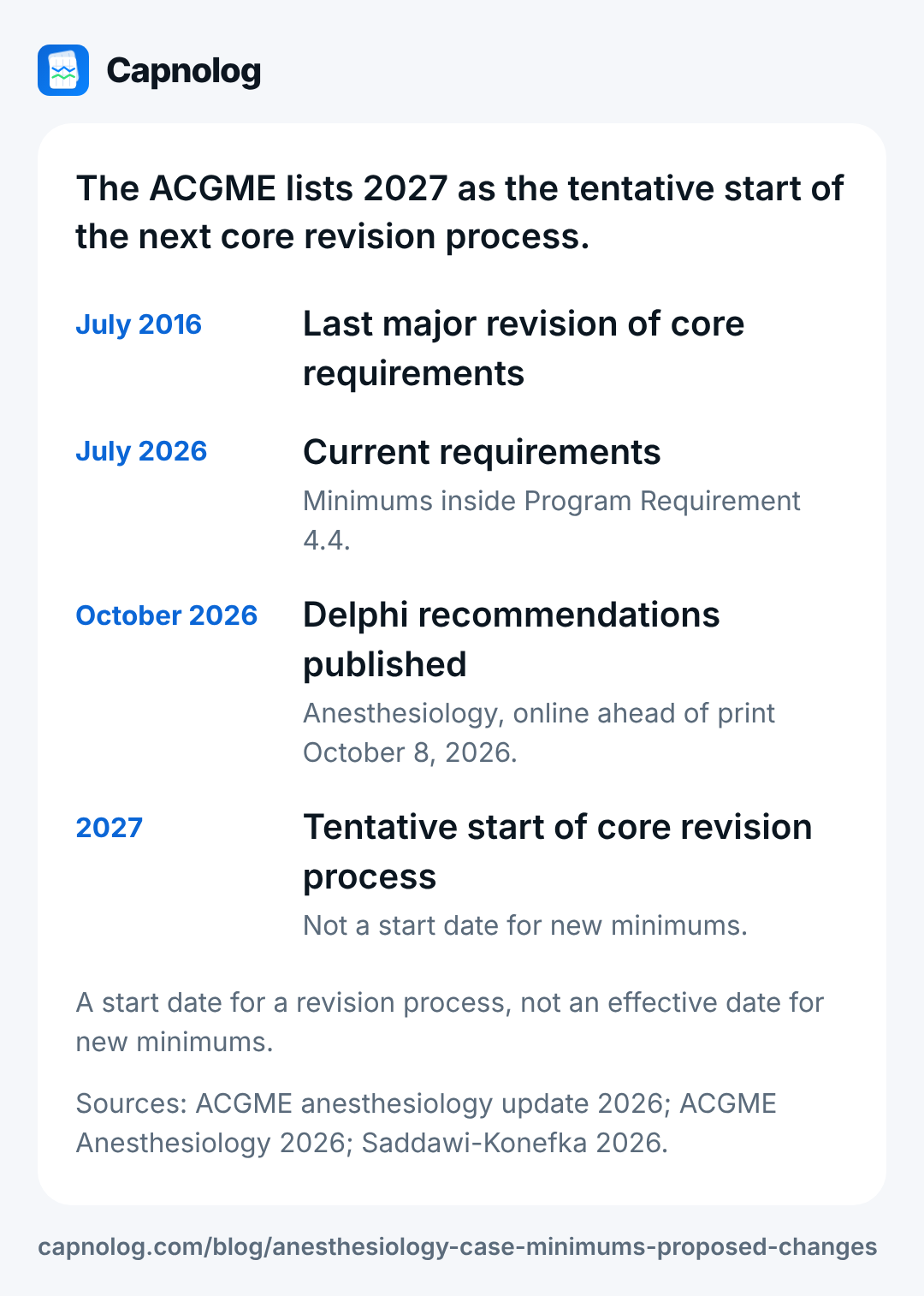
The practical answer is simple: keep following the ACGME minimums in effect today. A published study is no reason to move a program's graduation checklist to these numbers. The 2026 case-log changes post shows how other specialties phased in recent changes.
What residents and programs can do before rules change
For residents, keep recording the cases and procedures you perform. If your log has a place for line placement, POCUS, NORA, or other experiences the study names, record them accurately. Do not create a false entry to anticipate a future category. Ask your program which system counts for current evaluations.
For program directors and coordinators, the proposals show where experience may already exist and where a future tracking change could add work. The study does not require programs to redesign rotations or change graduation thresholds.
- Keep the current ACGME minimums as the required targets.
- Identify which rotations provide the experiences the study discusses.
- Check whether current records capture those experiences accurately.
- Watch the ACGME specialty page and e-Communication for a formal proposal.
- Tell residents the study's numbers are recommendations, not adopted minimums.
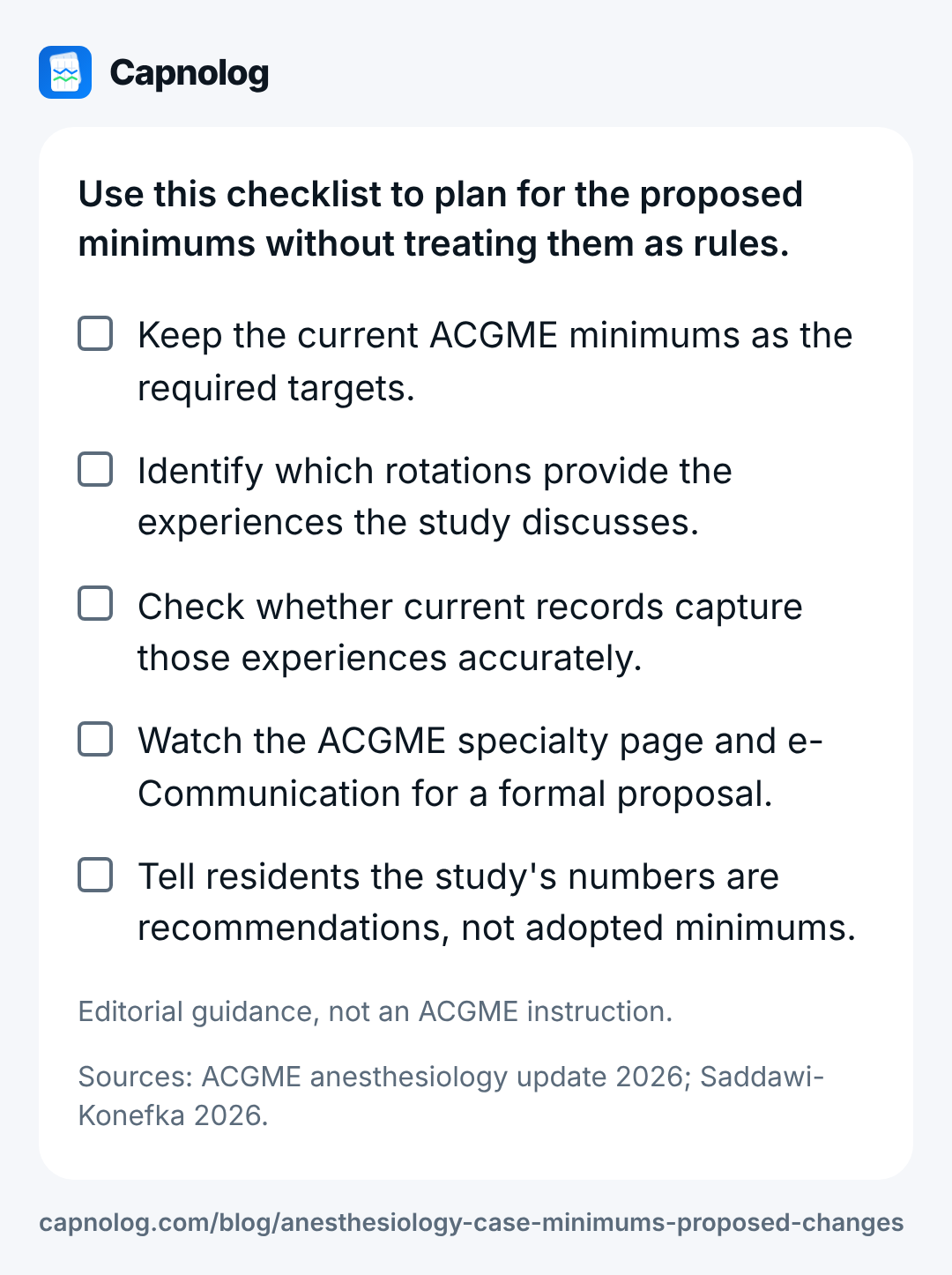
Editorial guidance, not an ACGME instruction.
Sources: ACGME anesthesiology update 2026; Saddawi-Konefka 2026.
Track the minimums in effect today
Capnolog shows anesthesiology case-log progress against the current ACGME requirements, not the panel's proposed changes. The official record stays in the ACGME Case Log System.
Capnolog for anesthesiologyWhat the research cannot show
- The Delphi panel reports expert consensus. The paper does not show whether graduates with these numbers are safer, more competent, or better prepared.
- The authors name their own limits. No residents or recent graduates sat on the panel, and program directors made up half of the 60 members (Saddawi-Konefka 2026).
- No source here says which proposals the ACGME will adopt, when approved changes would start, or how logging categories would change.
- Sources were checked on October 17, 2026. Check the ACGME anesthesiology page and e-Communication for newer notices before you act.
- Capnolog did not conduct the study and has no affiliation with the ACGME.
Sources
- Saddawi-Konefka D, Kacmar RM, Long TR, Mitchell JD, Ang L, Ambardekar AP. A National Delphi Study to Inform Modernization of Anesthesiology Residency Case Log Requirements. Anesthesiology. 2026.
- ACGME. Program Requirements for Graduate Medical Education in Anesthesiology including FAQs (2026), sections 4.4.c.3, 4.4.c.7, 4.4.c.9, and 4.4.c.10.
- ACGME. Anesthesiology Review Committee Update, 2026 Annual Educational Conference, Major Revisions: Core Anesthesiology slide.
- ACGME. ACGME Answers: A Look at Case Log Minimums. ACGME blog, September 26, 2024.
- ACGME. e-Communication, July 6, 2026: major revision to the Regional Anesthesiology and Acute Pain Medicine Program Requirements, effective July 1, 2027.