
How to help your residents keep better case logs
Write down how soon residents must log. Run the Case Log activity report on a schedule. Give residents protected time to catch up, and check a sample against the OR schedule. A reminder alone did not improve logging in one anesthesiology program. A weekly protected hour was followed by more on-time logging in one surgical program, though that study had no control group.
A resident who builds Capnolog ·
Residents fall behind on case logs for ordinary reasons: long days, a slow form, and no one asking until the semiannual review. The fix is a routine. This post lays out one for a program director or coordinator. The research behind it is in what improves case-log completion.
Put the deadline in writing
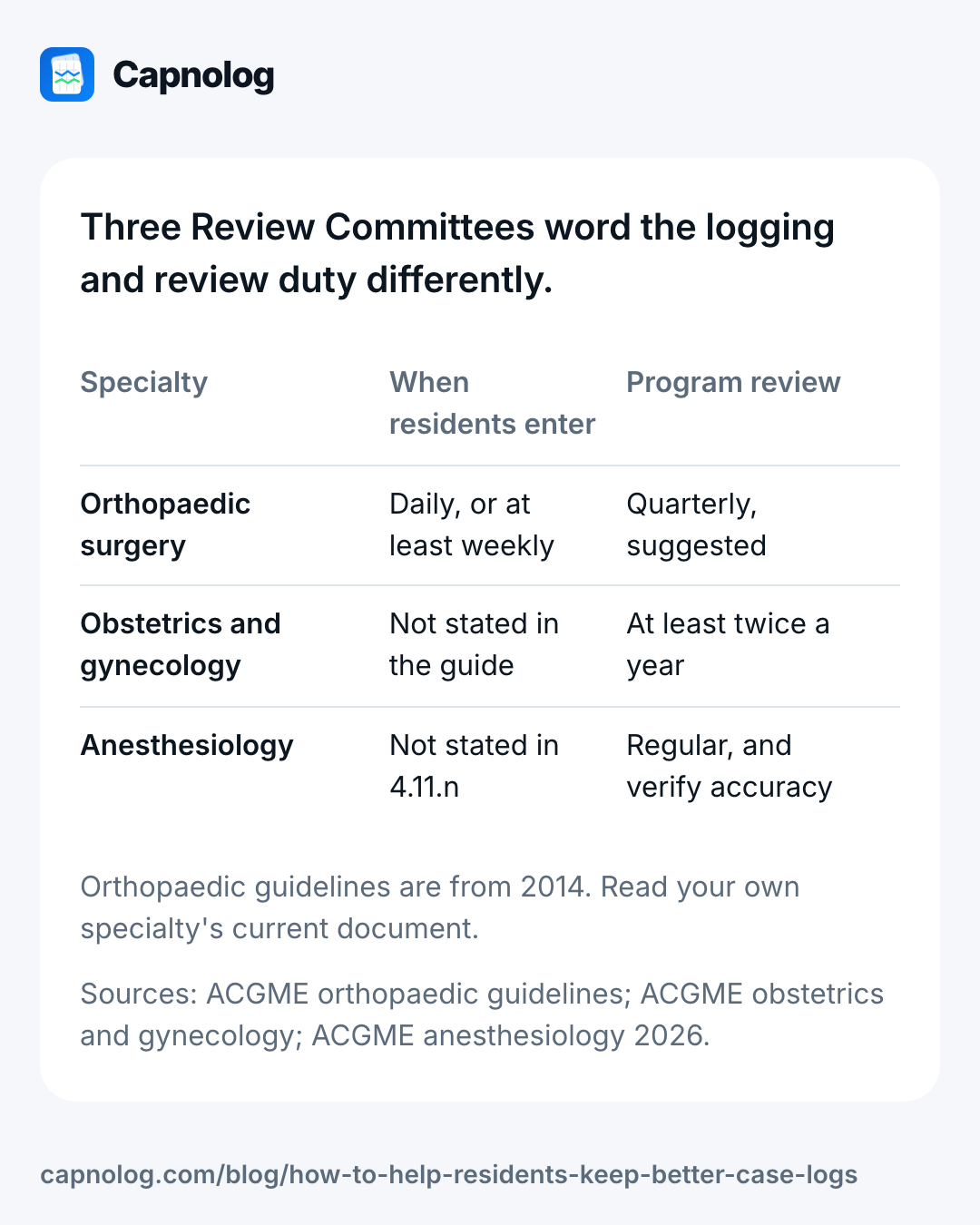
A resident cannot meet a rule that no one stated. In its case-log guidelines, the Review Committee for Orthopaedic Surgery says residents should enter cases as soon as possible, daily or at least weekly (ACGME orthopaedic guidelines). Those guidelines date from 2014. In a survey of 82 surgical residents at one medical center, half logged monthly or less often. Of the backlogs they reported, 51.4% lasted 3 months or longer (Cadish 2016).
Choose a deadline for your program, put the deadline in the resident handbook, and name who checks. Each Review Committee words the duty differently, so check yours first.
| Specialty | When residents enter | Program review |
|---|---|---|
| Orthopaedic surgery | Daily, or at least weekly | Quarterly, suggested |
| Obstetrics and gynecology | Not stated in the guide | At least twice a year |
| Anesthesiology | Not stated in 4.11.n | Regular, and verify accuracy |
Orthopaedic guidelines are from 2014. Read your own specialty's current document.
Sources: ACGME orthopaedic guidelines; ACGME obstetrics and gynecology; ACGME anesthesiology 2026.
Run the activity report on a schedule
In obstetrics and gynecology, the Review Committee describes a Log Activity report. The report shows each resident's total cases, last procedure date, and last update date. The Committee calls the report a quick way to see how often residents enter cases (ACGME obstetrics and gynecology). In radiology, the Committee's FAQ says program directors and coordinators can open the Case Log reports. Coordinators can also view the case entry screens with their own ADS login (ACGME radiology FAQ). Look at the reports for your own specialty, because each document covers one specialty.
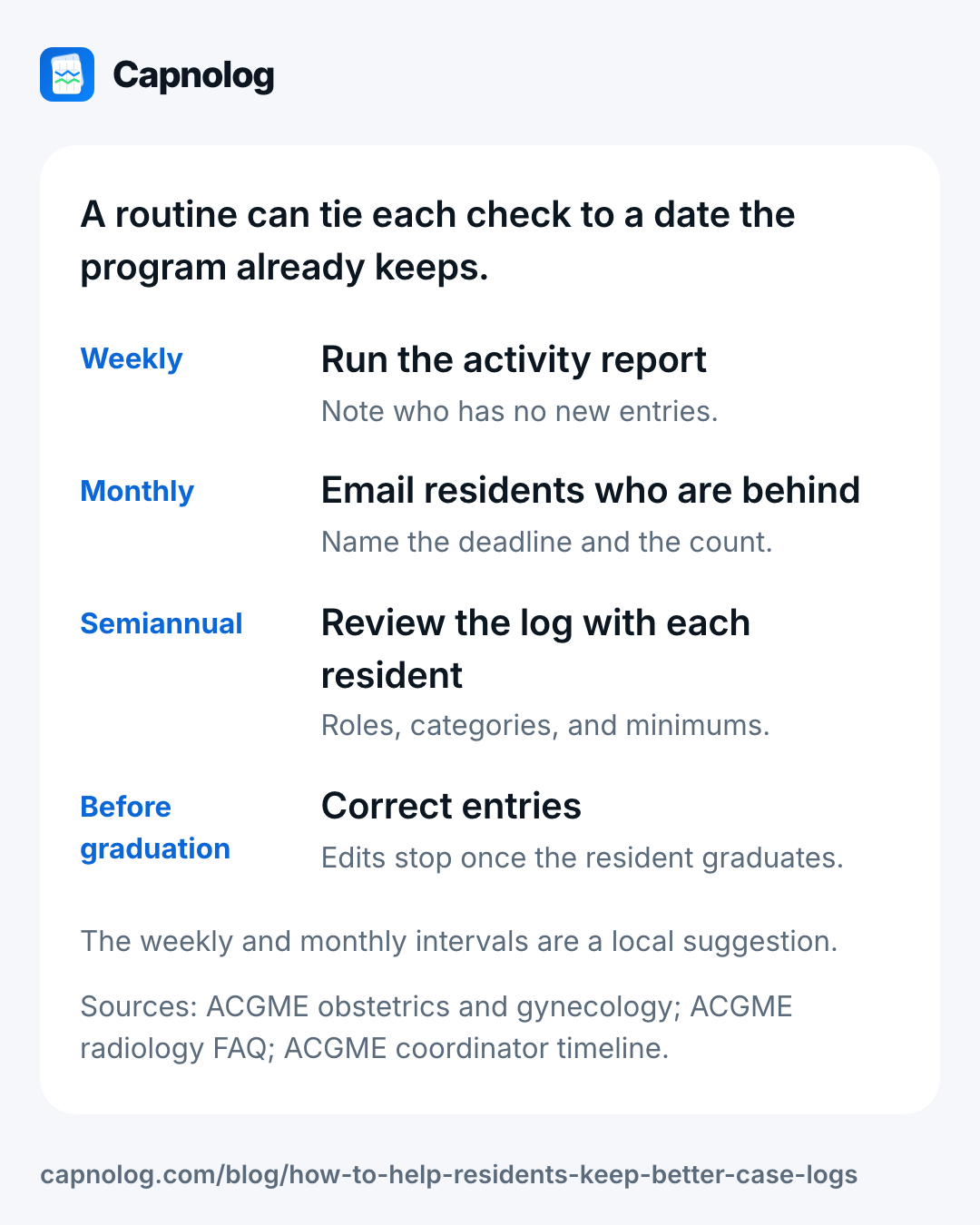
The ACGME's coordinator timeline lists "Remind residents (via email) to log procedures" among its monthly or as-needed tasks, with a second task to verify procedure logs with the program director (ACGME coordinator timeline). The timeline is a general template, so adjust the interval to your deadline.
- WeeklyRun the activity reportNote who has no new entries.
- MonthlyEmail residents who are behindName the deadline and the count.
- SemiannualReview the log with each residentRoles, categories, and minimums.
- Before graduationCorrect entriesEdits stop once the resident graduates.
The weekly and monthly intervals are a local suggestion.
Sources: ACGME obstetrics and gynecology; ACGME radiology FAQ; ACGME coordinator timeline.
Give time, not only reminders
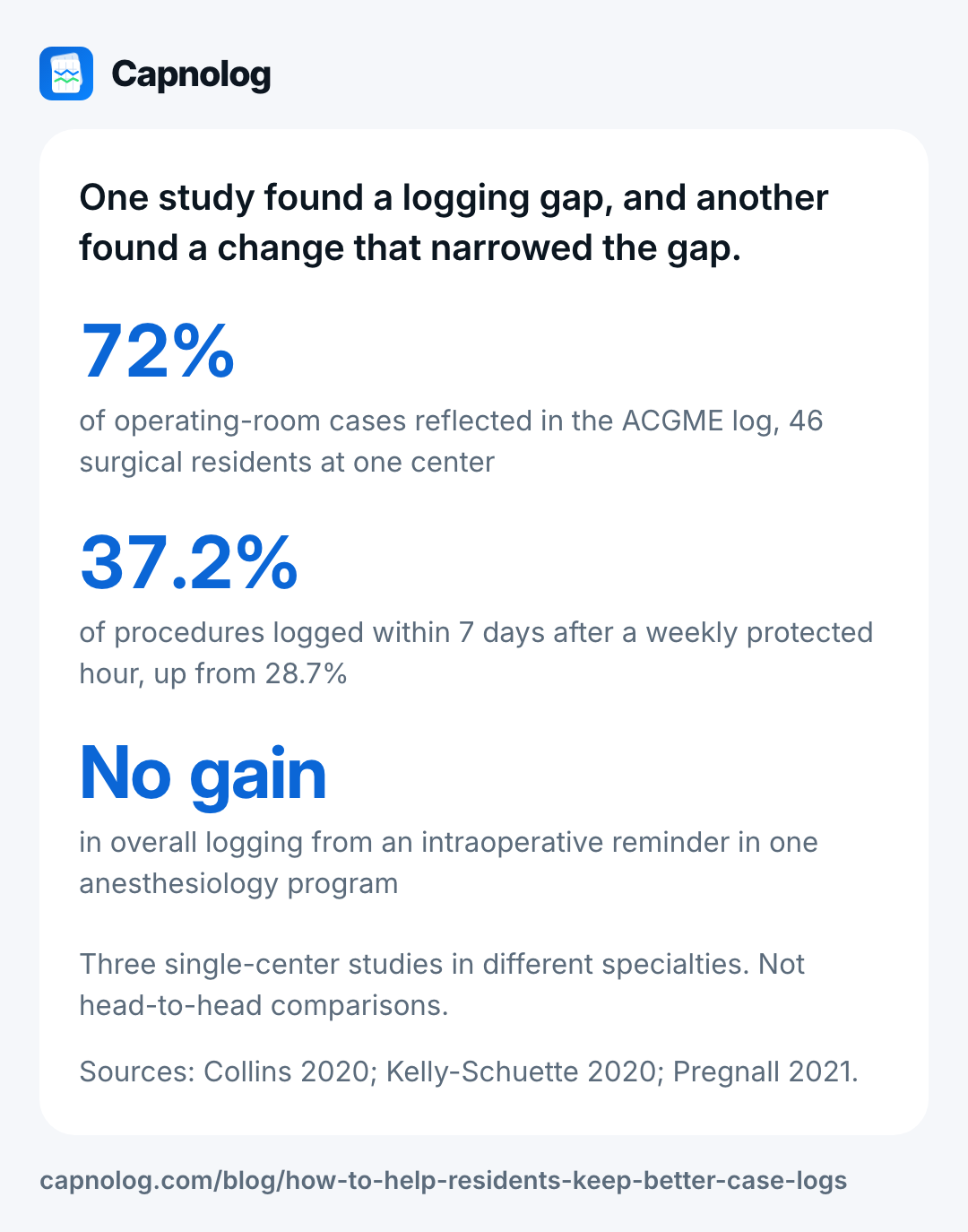
An intraoperative reminder at one anesthesiology program did not improve overall logging, and the delay between case and entry grew (Pregnall 2021). A surgical residency that protected one administrative hour a week saw logging within 7 days rise from 28.7% to 37.2%, and within 30 days from 52.7% to 69.9% (Kelly-Schuette 2020). That comparison covered 79 residents at one hospital and had no control group.
In the multispecialty survey, departmental training and reminders were associated with better logging habits (Cadish 2016). A survey cannot show cause. Try training, and measure the result.
Three single-center studies in different specialties. Not head-to-head comparisons.
Sources: Collins 2020; Kelly-Schuette 2020; Pregnall 2021.
Check a sample against the OR schedule
A log can look full and still be missing cases. Anesthesiology requirement 4.11.n makes the program director responsible for regular review of residents' logs. The director also verifies their accuracy and completeness when the logs go to the Review Committee (ACGME anesthesiology 2026). At one center, only 72% of cases in the operating room records appeared in the ACGME logs of 3 surgical programs. Accuracy rose with a resident's case volume (Collins 2020).
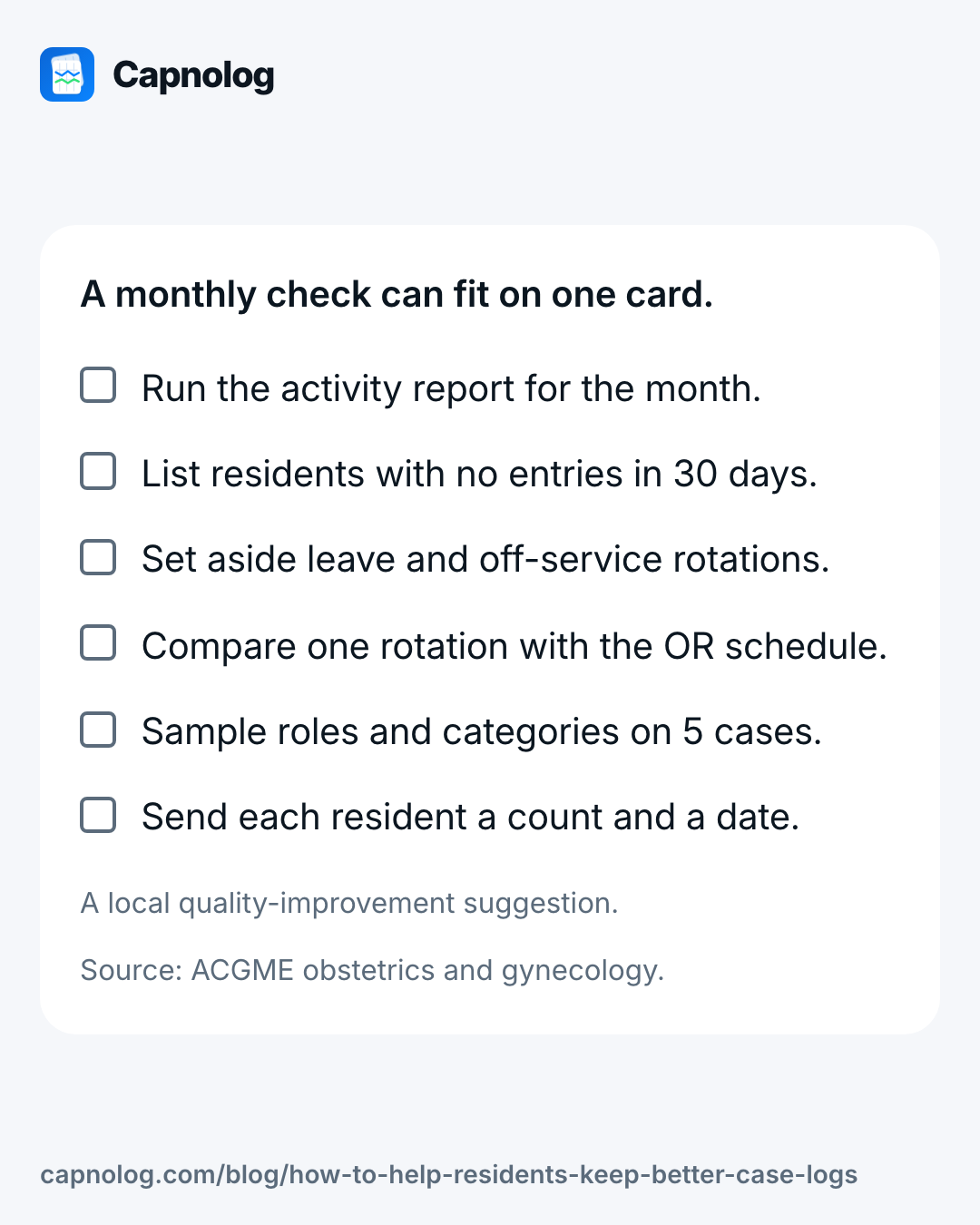
- Run the activity report for the month.
- List residents with no entries in 30 days.
- Set aside leave and off-service rotations.
- Compare one rotation with the OR schedule.
- Sample roles and categories on 5 cases.
- Send each resident a count and a date.
A local quality-improvement suggestion.
Source: ACGME obstetrics and gynecology.
Use records your institution authorizes, and do not export patient-identifiable data into personal spreadsheets.
Fix entries while the resident is active
The radiology FAQ says Case Log data can be edited while the resident is active in the program. After graduation, the data is archived and cannot be edited (ACGME radiology FAQ). A wrong category found at a semiannual review is therefore a quick fix, and the same error found after graduation is not.
What Capnolog does for programs
Capnolog gives residents a phone case log and shows each resident their own progress toward minimums. The official record stays in the ACGME Case Log System. The Capnolog program console publishes the OR schedule to residents. The console does not show a resident's private case log.
See what the program console does.
The program console publishes your OR schedule to residents. It does not open their case logs.
What the program console doesWhat this post does not establish
- The orthopaedic timing guidance is from 2014, the radiology FAQ covers radiology, and the obstetrics and gynecology guide covers that specialty. Your Review Committee may say something different.
- The 72%, 28.7% to 37.2%, and reminder findings each come from one center and different specialties. None proves the same result at another program. The 72% figure uses cases from 2009 to 2010.
- The weekly and monthly intervals, the 5-case sample, and the monthly card are local suggestions.
- Whether any change pays for itself is a question for your program and institution.
Program staff: see how programs use Capnolog.
Sources
- ACGME Review Committee for Orthopaedic Surgery. Case Log Guidelines. April 2014 (timeliness and quarterly review questions).
- ACGME Review Committee for Obstetrics and Gynecology. Case Log Information: Obstetrics and Gynecology. March 2025.
- ACGME Review Committee for Radiology. Case Log Frequently Asked Questions: Diagnostic and Interventional Radiology. July 2026.
- ACGME. Program Requirements for Graduate Medical Education in Anesthesiology, including FAQs. 2026 (requirement 4.11.n).
- ACGME. Residency Program Coordinator Timeline. November 2020 (copy hosted by Kaiser Permanente Northern California).
- Cadish LA, Fung V, Lane FL, Campbell EG. Surgical Case Logging Habits and Attitudes: A Multispecialty Survey of Residents. J Surg Educ. 2016;73(3):474-481 (PMID 27049679).
- Pregnall AM, Gruss CL, Ramanujan KS, Gelfand BJ, McEvoy MD, Wanderer JP. ACGME Case Log Reminder Does Not Improve Resident Accuracy in Logging Cases. J Med Syst. 2021;46(1):1 (PMID 34786618).
- Kelly-Schuette K, Osantowski B, Chung MH, Wright GP. Implementation of a Weekly Administrative Hour and the Impact on Case Logging and Duty Hour Reporting in Surgical Residents. J Surg Educ. 2020;77(4):765-771 (PMID 32147467).
- Collins C, Dudas L, Johnson M, Davenport D, Bernard A, Beck S, Muchow R, Pittman T, Talley C. ACGME Operative Case Log Accuracy Varies Among Surgical Programs. J Surg Educ. 2020;77(6):e78-e85 (PMID 32950429).