
How many hours a day do residents spend in the EHR? The studies side by side
Published studies range from 94 minutes a day for plastic surgery residents to 5.38 hours a day for medicine residents. Time-motion studies found about half the workday at a computer. The spread comes from what each study counts, the specialty, the training year, and the single hospital behind each number.
A resident who builds Capnolog ·
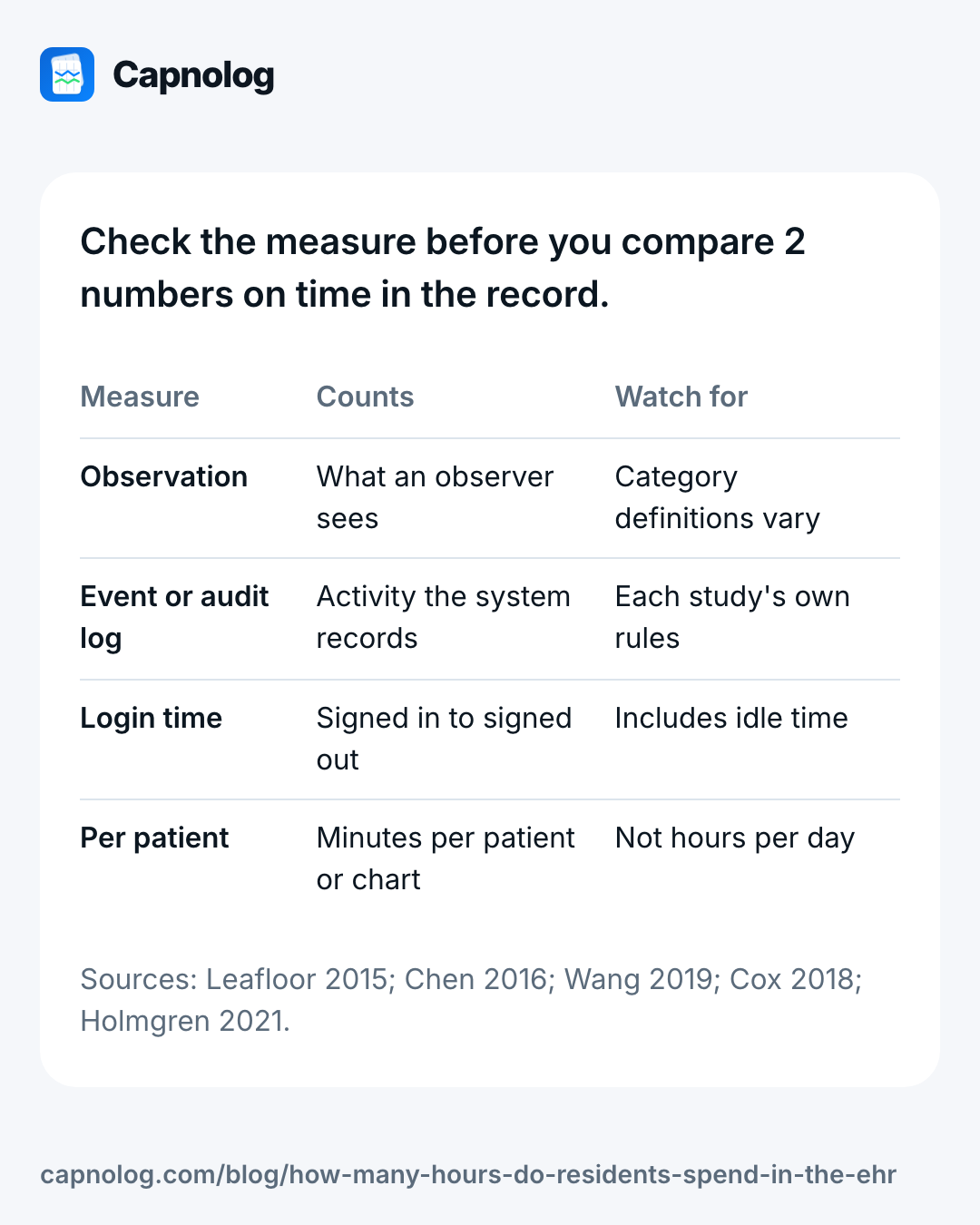
These numbers come from different measures, so treat them as a range and not as one figure. A study that watched residents, a study that counted clicks, and a study that counted login time can each be right and still disagree.
How each study measured time
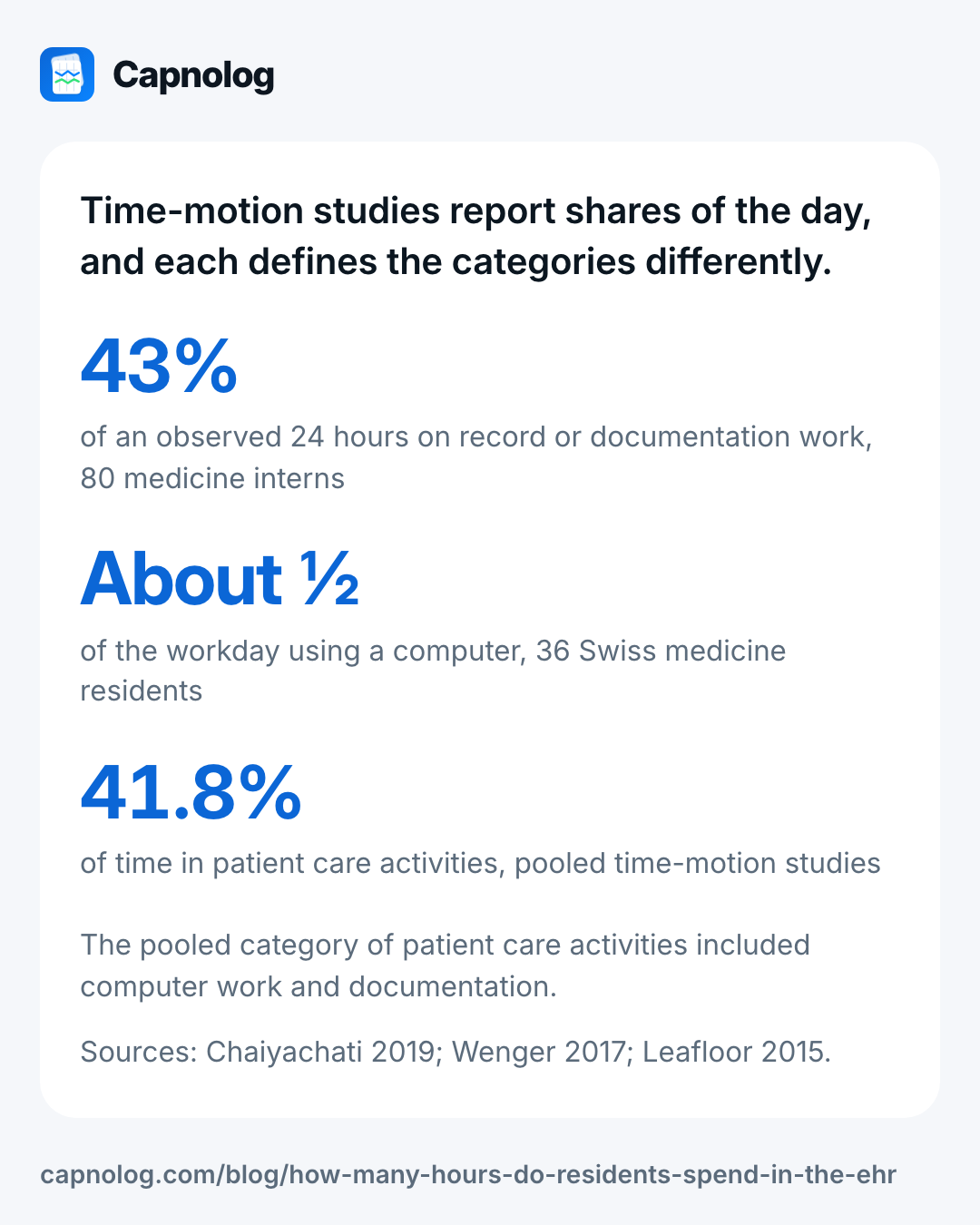
Time-motion studies put an observer beside residents to record each activity. In a pooled analysis of these studies, internal medicine residents spent 41.8% of their time in patient care activities (Leafloor 2015). That category included clinical computer work and documentation, which explains part of the spread between published shares (Leafloor 2015). The analysis pooled 8 studies of residents on general medicine services, and the authors noted wide variation in how studies defined each category (Leafloor 2015).
Event logs and audit logs count what the system records. One study counted active use by thresholds of keystrokes and clicks (Chen 2016). By that rule, each intern averaged 112 hours a month in the record over 206 patient encounters (Chen 2016). Another left out user-days with less than one hour of activity (Wang 2019).
Login studies count the time a resident stays signed in. That number includes idle time, and the number does not measure active typing (Cox 2018). Some studies also report minutes per patient instead of hours per day.
| Measure | Counts | Watch for |
|---|---|---|
| Observation | What an observer sees | Category definitions vary |
| Event or audit log | Activity the system records | Each study's own rules |
| Login time | Signed in to signed out | Includes idle time |
| Per patient | Minutes per patient or chart | Not hours per day |
Sources: Leafloor 2015; Chen 2016; Wang 2019; Cox 2018; Holmgren 2021.
The numbers side by side
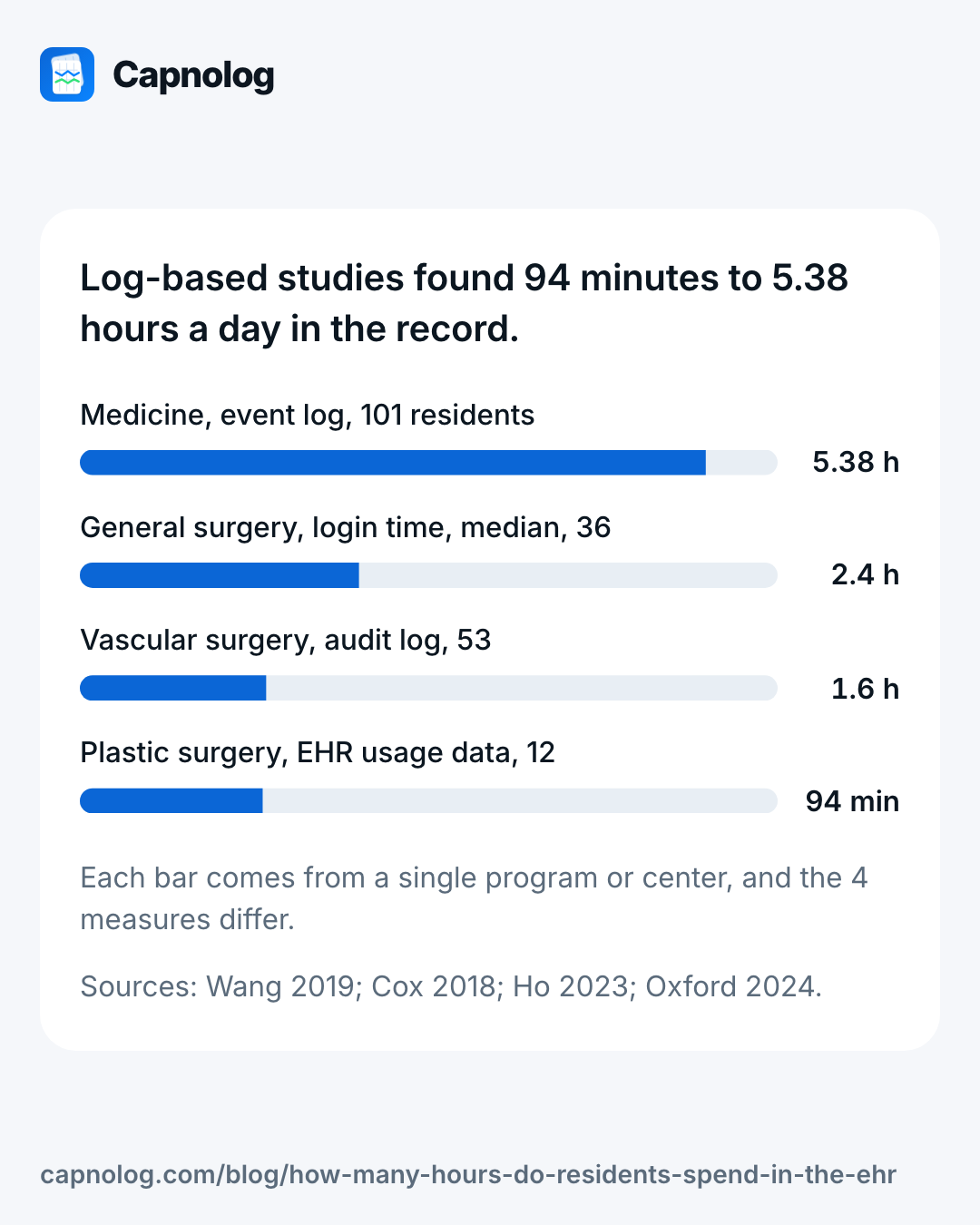
In event logs, 101 inpatient medicine residents averaged 5.38 hours a day using the record (Wang 2019). Interns averaged 5.47 hours, and residents in their second year or later averaged 5.21 (Wang 2019).
Audit logs of 36 general surgery residents at Duke showed a median of 2.4 hours a day and 23.7 hours a week logged in (Cox 2018). The authors put the weekly figure at about 38% of logged duty hours (Cox 2018).
Twelve plastic surgery residents averaged 94 minutes a day (Oxford 2024). Chart review took 42% of that time, patient discovery 22%, orders 14%, and documentation 12% (Oxford 2024). At Stanford, 53 vascular surgery residents averaged 1.6 hours a day in the record (Ho 2023).
Each bar comes from a single program or center, and the 4 measures differ.
Sources: Wang 2019; Cox 2018; Ho 2023; Oxford 2024.
Time-motion studies report shares of the day instead. Over 194 observed shifts, 80 internal medicine interns spent 10.3 of 24 hours, or 43%, on record or documentation work (Chaiyachati 2019). Direct patient care took 3.0 hours, or 13% (Chaiyachati 2019). The authors present these shares as a baseline and make no judgment on how the time should be split (Chaiyachati 2019).
In a Swiss hospital, 36 internal medicine residents spent about half the workday using a computer (Wenger 2017). On day shifts, activities indirectly related to patients took 52.4% of the time, and direct care took 28.0% (Wenger 2017).
The pooled category of patient care activities included computer work and documentation.
Sources: Chaiyachati 2019; Wenger 2017; Leafloor 2015.
Junior residents spend more time than seniors
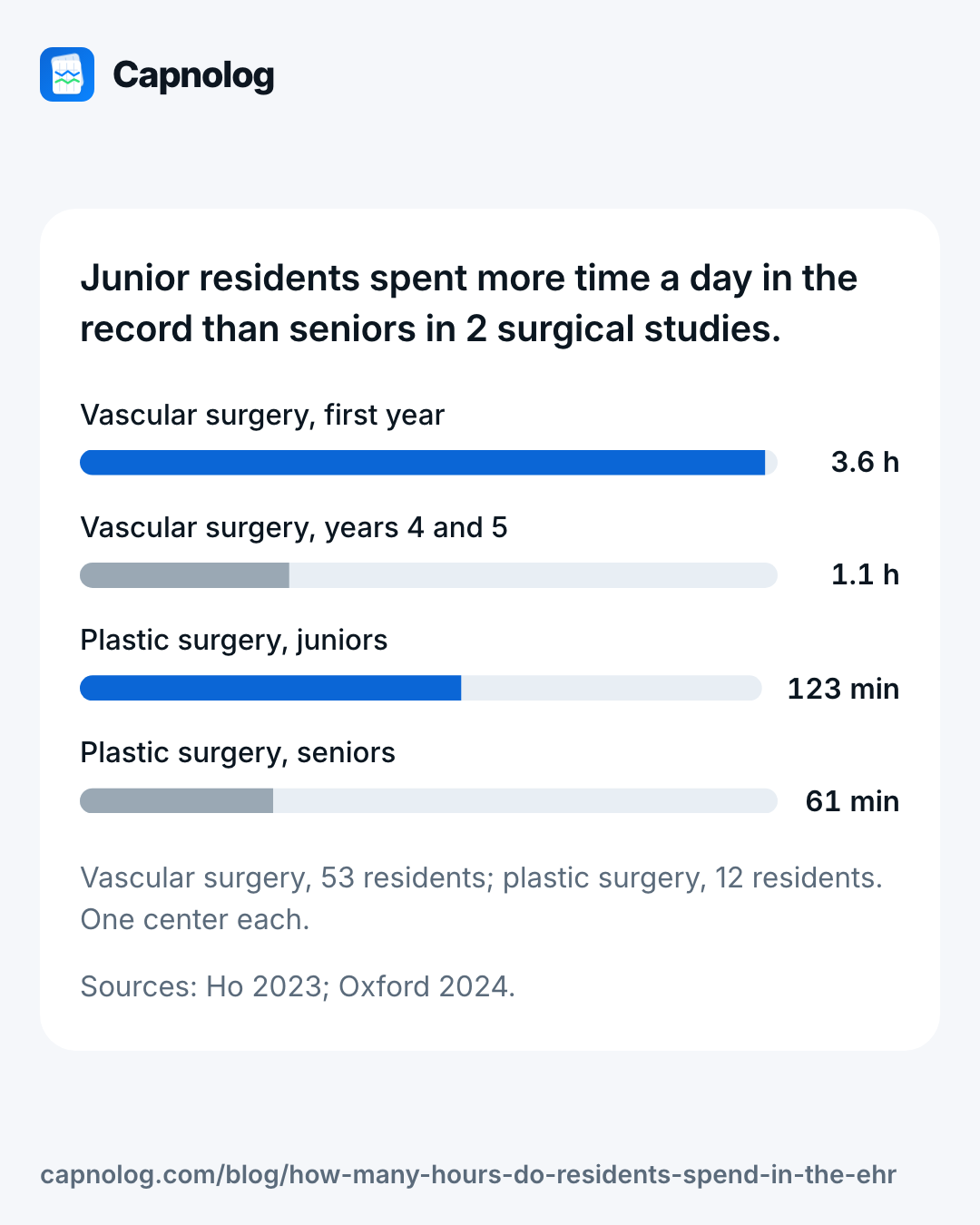
Time in the record dropped with seniority in several studies. Plastic surgery juniors averaged 123 minutes a day, against 61 minutes for seniors (Oxford 2024). Juniors spent 48% of their record time on chart review and seniors 36%, a difference that did not reach significance (Oxford 2024). In vascular surgery, daily time ranged from 3.6 hours in first-year residents to 1.1 hours in residents in years 4 and 5 (Ho 2023). Across that program, average daily use also fell from 2.4 hours in the 2015-16 year to 1.78 hours in 2018-19 (Ho 2023).
The same drop appears within a single year. Internal medicine interns spent 41 minutes per patient-chart encounter in July and 30 minutes in January (Chen 2016). In 622 ambulatory residents, time in the record per patient fell with experience (Holmgren 2021).
Vascular surgery, 53 residents; plastic surgery, 12 residents. One center each.
Sources: Ho 2023; Oxford 2024.
How much happens after hours
Some of this time falls outside the shift. In the Swiss study, computer use was heaviest after 6 p.m. (Wenger 2017) About one-third of the plastic surgery residents' time in the record happened off duty (Oxford 2024).
In 622 ambulatory residents, 13.5% of time in the record came after hours (Holmgren 2021). That share did not fall with experience, even as time per patient did (Holmgren 2021). A later post covers whether charting from home counts toward the 80-hour limit.
What changes the time
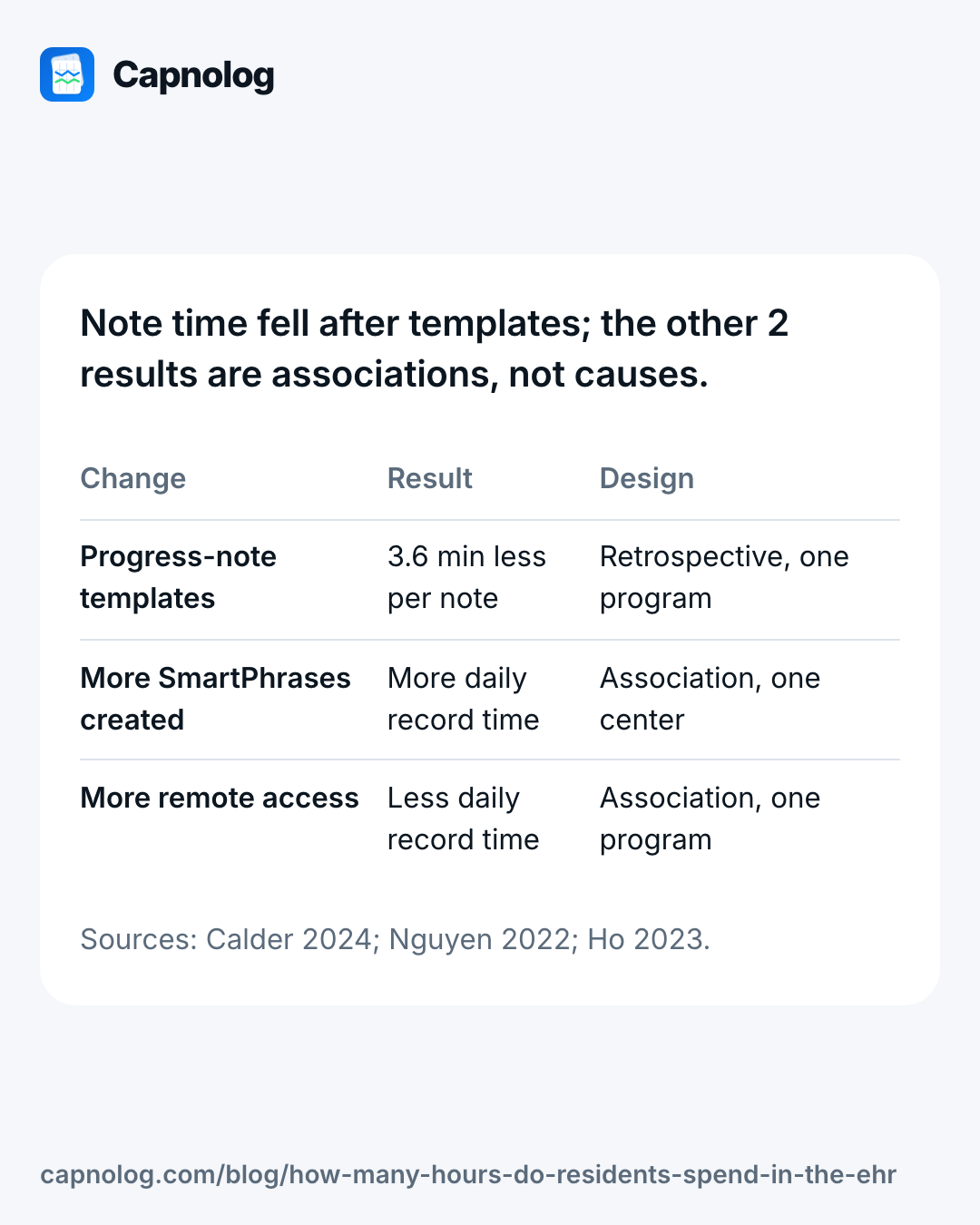
Note time fell after templates in one program. In a 94-resident internal medicine program, residents who could use new templates spent 3.6 minutes less per progress note (Calder 2024). The analysis looked back at notes from that single program.
More SmartPhrases did not mean less time. Among 441 primary care physicians, those who had created more SmartPhrases spent more time in the record each day (Nguyen 2022). The authors suggest that heavier users may simply create more of them (Nguyen 2022).
Remote access showed the opposite pattern. Vascular surgery residents who used more remote access spent less time in the record each day, an association rather than proof (Ho 2023).
| Change | Result | Design |
|---|---|---|
| Progress-note templates | 3.6 min less per note | Retrospective, one program |
| More SmartPhrases created | More daily record time | Association, one center |
| More remote access | Less daily record time | Association, one program |
Sources: Calder 2024; Nguyen 2022; Ho 2023.
How to read a number someone quotes
A single figure on resident time in the record is easy to repeat and hard to interpret. Before you repeat one, ask these questions.
- What was counted: observed activity, logged activity, or time signed in?
- Which residents: specialty, inpatient or clinic, and which training year?
- When: interns spent more time per chart in July than in January.
- Where: one program, one center, and which vendor's record system?
- Per what: hours per day, minutes per patient, or a share of the shift?
Program leaders who want a local number can measure their own residents with one definition, then compare like with like. Capnolog's page for programs covers the program console, and a separate post covers what improves case-log completion.
Make case logging a separate, shorter task.
Record cases in Capnolog when they're fresh and review progress later.
The resident case log, end to endWhat these studies do not show
- No study found for this post measured anesthesiology, neurosurgery, or urology residents.
- Each study comes from a single program or center, and several have small samples.
- The plastic surgery study and the July-to-January intern study used another vendor's records, not Epic.
- The measures differ, so no single number answers the question for every resident.
Sources
- Leafloor CW, Lochnan HA, Code C, et al. Time-motion studies of internal medicine residents' duty hours: a systematic review and meta-analysis. Advances in Medical Education and Practice, 2015.
- Chen L, Guo U, Illipparambil LC, et al. Racing against the clock: internal medicine residents' time spent on electronic health records. Journal of Graduate Medical Education, 2016.
- Wang JK, Ouyang D, Hom J, Chi J, Chen JH. Characterizing electronic health record usage patterns of inpatient medicine residents using event log data. PLoS One, 2019.
- Cox ML, Farjat AE, Risoli TJ, et al. Documenting or operating: where is time spent in general surgery residency? Journal of Surgical Education, 2018.
- Holmgren AJ, Lindeman B, Ford EW. Resident physician experience and duration of electronic health record use. Applied Clinical Informatics, 2021.
- Oxford MA, McLaughlin CM, McLaughlin CJ, et al. Replacing the scalpel with a computer mouse: an evaluation of time spent on electronic health record for plastic surgery residents and its impact on resident training. Ann Plast Surg. 2024;92(4S Suppl 2):S271-S274.
- Ho VT, Sgroi MD, Chandra V, et al. Utilizing remote access for electronic medical records reduces overall electronic medical record time for vascular surgery residents. Journal of Vascular Surgery, 2023.
- Chaiyachati KH, Shea JA, Asch DA, et al. Assessment of inpatient time allocation among first-year internal medicine residents using time-motion observations. JAMA Internal Medicine, 2019.
- Wenger N, Méan M, Castioni J, et al. Allocation of internal medicine resident time in a Swiss hospital: a time and motion study of day and evening shifts. Annals of Internal Medicine, 2017.
- Calder MB, Hanson M, Jost M, Kelley KD. Time and note characteristic effects of an electronic health record template for internal medicine resident notes. Journal of Graduate Medical Education, 2024.
- Nguyen OT, Turner K, Apathy NC, et al. Primary care physicians' EHR proficiency and efficiency behaviors and time interacting with EHRs: a quantile regression analysis. Journal of the American Medical Informatics Association, 2022.