
Does charting at home count toward the 80 hours? What the ACGME requirements say
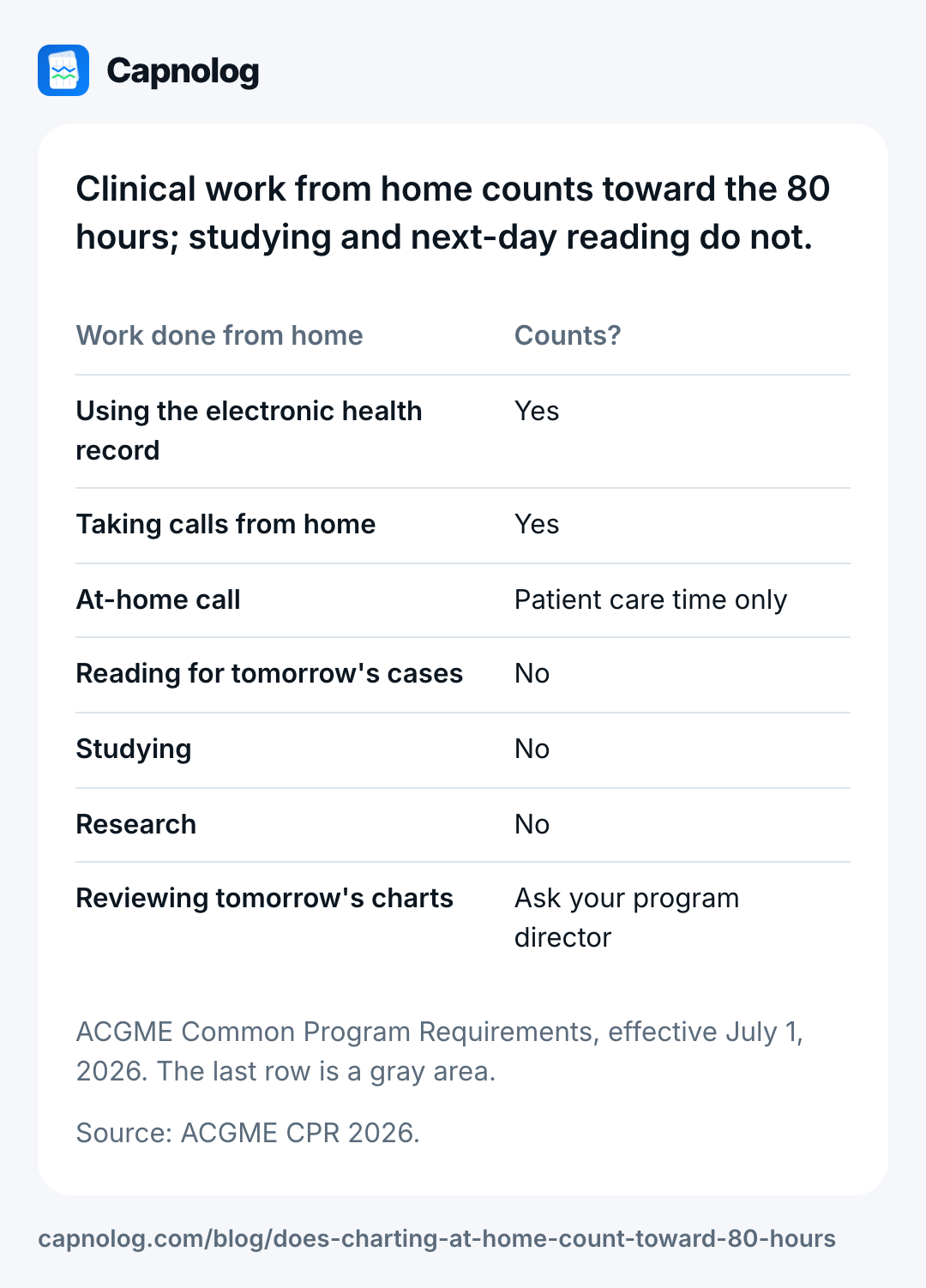
Yes. ACGME requirements count clinical work from home, including electronic health record use, toward the 80-hour weekly limit averaged over 4 weeks. Reading for the next day's cases, studying, and research done from home do not count.
A resident who builds Capnolog ·
This post covers residents in any ACGME specialty, plus program directors and coordinators. The quoted rules come from the ACGME Common Program Requirements (Residency), effective July 1, 2026 (ACGME CPR 2026). Check acgme.org for the current version before you rely on the wording.
What the requirement says
Requirement 6.20 limits clinical and educational work to 80 hours a week, averaged over 4 weeks (ACGME CPR 2026). The limit includes all in-house clinical and educational activities, clinical work done from home, and all moonlighting (ACGME CPR 2026).
The Background and Intent under that section explains the thinking. The ACGME expects schedules that let residents finish most work on site during scheduled hours (ACGME CPR 2026). Clinical work you still do from home goes into the same 80-hour total as your hours in the hospital.
The averaging matters. A heavy week can sit inside the limit when the 4-week average stays at 80 hours or below. Home time that nobody records drops out of that average, and the schedule then looks lighter than the work.
What counts and what does not
The Background and Intent names 2 types of work from home that must be counted: using an electronic health record and taking calls from home (ACGME CPR 2026). Notes, orders, and chart work you do in the record from home all involve using the record.
The same passage names 3 kinds of home time that do not count. Those are reading in preparation for the following day's cases, studying, and research done from home (ACGME CPR 2026). The line runs between clinical work for patients and work for your own learning.
| Work done from home | Counts? |
|---|---|
| Using the electronic health record | Yes |
| Taking calls from home | Yes |
| At-home call | Patient care time only |
| Reading for tomorrow's cases | No |
| Studying | No |
| Research | No |
| Reviewing tomorrow's charts | Ask your program director |
ACGME Common Program Requirements, effective July 1, 2026. The last row is a gray area.
Source: ACGME CPR 2026.
At-home call
At-home call raises a narrower question: does the whole call period count? Requirement 6.28 answers no. Only time spent on patient care activities counts toward the 80 hours (ACGME CPR 2026).
The Background and Intent under 6.28 names what counts. Responding to phone calls and other messages counts, and so does documentation, such as entering notes in the record (ACGME CPR 2026). Time in the hospital after a call brings you in counts too (ACGME CPR 2026). Hours on call at home without patient care do not add to the total.
Who tracks the time
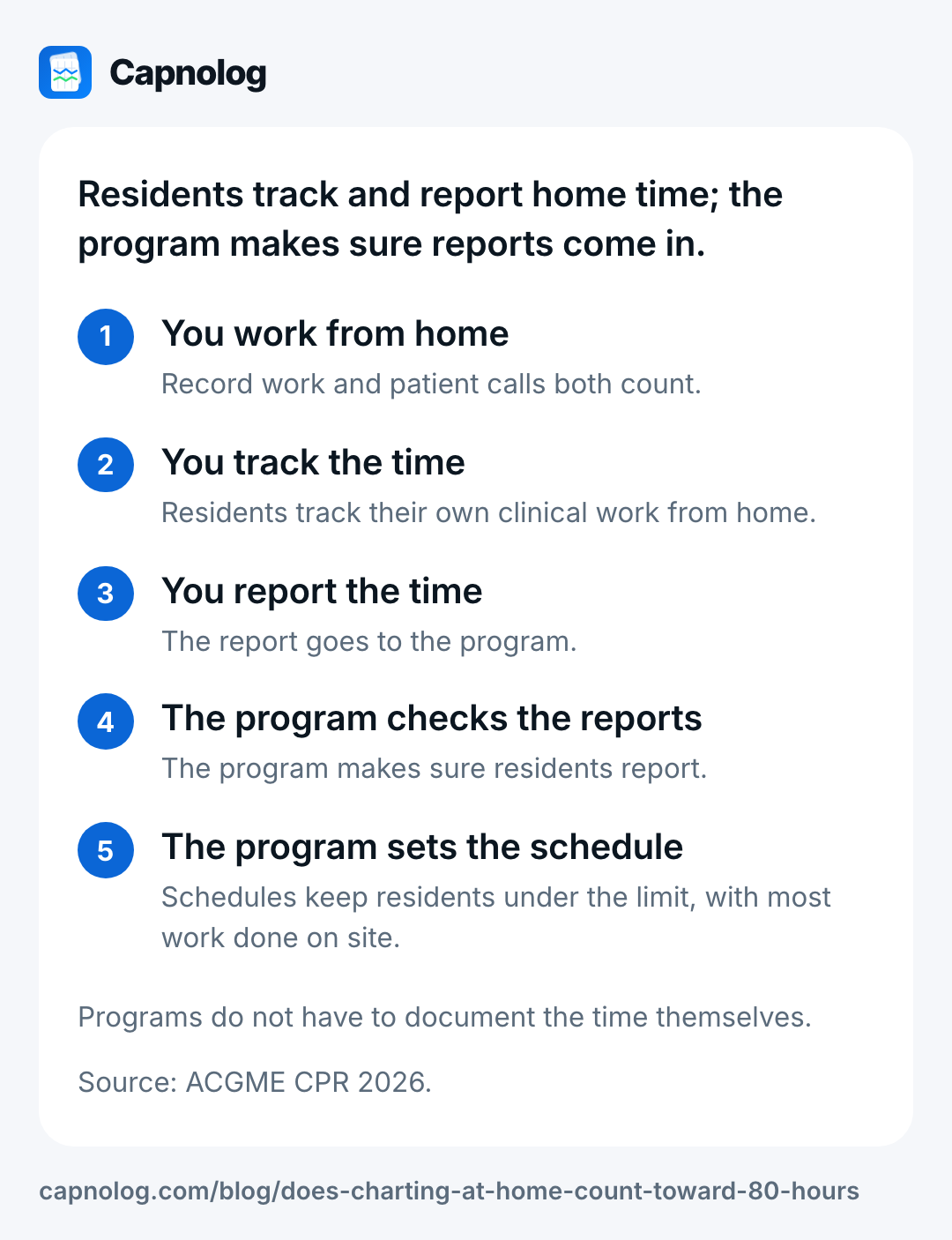
The requirement puts tracking on the resident. Residents are to track the time they spend on clinical work from home and report that time to the program (ACGME CPR 2026). Infrequent, short phone calls may be left to your discretion to report (ACGME CPR 2026).
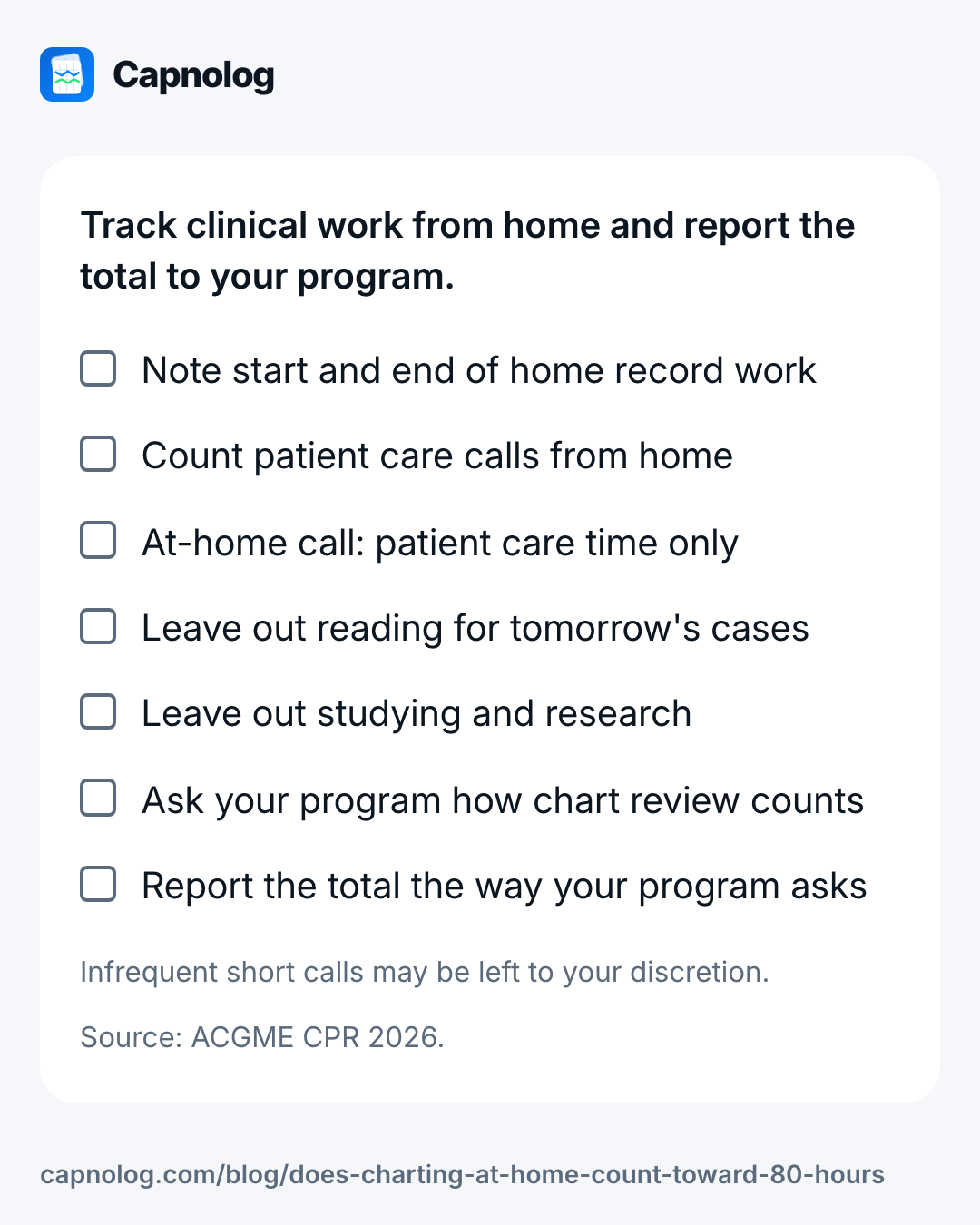
A plain habit makes the tracking easier. Write down the time when you open the record at home and when you close the record. Add the minutes at the end of the week.
Here is a worked example with made-up numbers. Suppose you finish notes from home for 45 minutes on 4 evenings in one week. That week gains 3 hours of clinical work, and the 3 hours belong in your report.
- Note start and end of home record work
- Count patient care calls from home
- At-home call: patient care time only
- Leave out reading for tomorrow's cases
- Leave out studying and research
- Ask your program how chart review counts
- Report the total the way your program asks
Infrequent short calls may be left to your discretion.
Source: ACGME CPR 2026.
Faster record work in the hospital leaves less record work for home.
For program directors and coordinators
The program has 2 jobs under the same passage. The program makes sure residents report the time, and structures schedules that keep residents under the limit (ACGME CPR 2026). Programs do not have to document the time themselves (ACGME CPR 2026).
Residents need 2 answers from the program: where to report home time, and what to include. Point residents to the place your program already collects work hours. Quote the requirement's examples of work that counts and work that does not.
Say how your program handles the gray area below, so residents in the same program count the same way. A short line in the handbook or the orientation slides covers the question once for everyone.
- You work from homeRecord work and patient calls both count.
- You track the timeResidents track their own clinical work from home.
- You report the timeThe report goes to the program.
- The program checks the reportsThe program makes sure residents report.
- The program sets the scheduleSchedules keep residents under the limit, with most work done on site.
Programs do not have to document the time themselves.
Source: ACGME CPR 2026.
Capnolog's program console publishes the OR week to residents and never opens a resident's case log. The programs page has the details.
How much record time falls outside duty hours
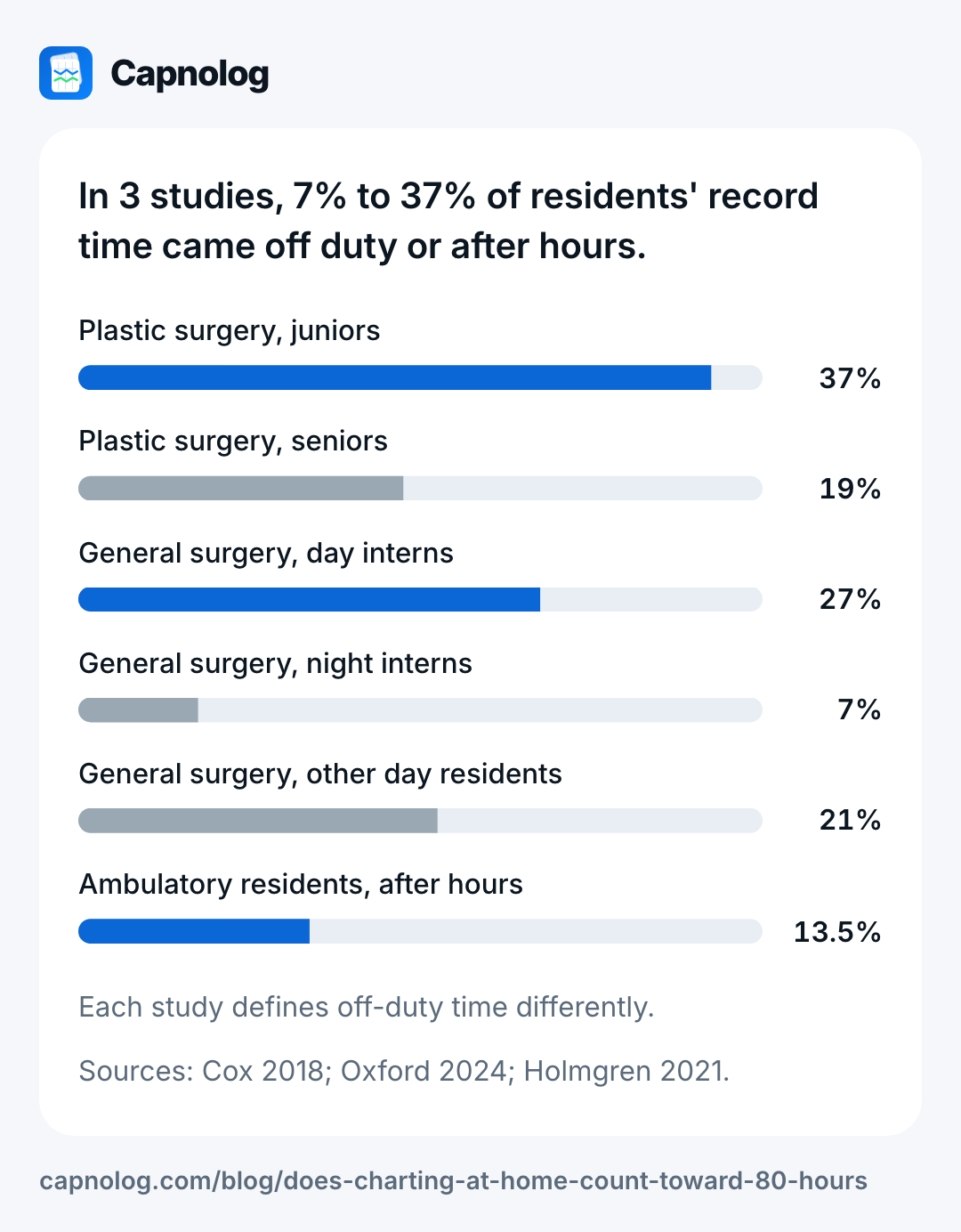
Several studies measured how much resident time in the record falls outside scheduled or duty hours. Audit logs of 36 general surgery residents at Duke showed that day-rotation interns averaged 27% of record time outside scheduled duty hours (Cox 2018). Night-rotation interns averaged 7%, and day-rotation residents past the intern year averaged 21% (Cox 2018).
Twelve plastic surgery residents averaged 94 minutes a day in the record, about one-third of the time off duty (Oxford 2024). Juniors in years 1 to 3 averaged 123 minutes a day, with 37% off duty. Seniors averaged 61 minutes, with 19% off duty (Oxford 2024).
In 622 ambulatory residents, 13.5% of record time came after hours (Holmgren 2021). That share did not fall with experience, even as time per patient did (Holmgren 2021).
Each study defines off-duty time differently.
Sources: Cox 2018; Oxford 2024; Holmgren 2021.
These studies measured when residents used the record, not where. Some off-duty time may have come in the hospital after a shift. The post on hours in the EHR puts each study's daily total side by side.
The gray area: reviewing tomorrow's patients
The requirement counts time spent in an electronic health record. The same requirement leaves out reading in preparation for the following day's cases (ACGME CPR 2026). Reviewing tomorrow's patients in the record from home fits both descriptions.
The requirement text does not settle which description applies. Ask your program director how your program counts that time. Keep the answer with your hour records, so you count the same way each week.
A second passage raises a related question. Program objectives must be met without excessive reliance on residents to fulfill non-physician obligations (ACGME CPR 2026). The examples in that passage do not name documentation, so this post takes no side on charting.
Keep case logging manageable.
Capnolog lets supported residents log cases from their phones. Duty-hour rules still come from ACGME and the program.
The resident case log, end to endWhat this post does not cover
- The quoted text comes from the Common Program Requirements effective July 1, 2026. Check acgme.org for the current version (ACGME CPR 2026).
- Specialty requirements and institutional policy can be stricter than the common requirements.
- This post is not your program's policy. Your program director decides how your program applies the rule.
- The after-hours studies measured when residents used the record, not where. None studied anesthesiology, neurosurgery, or urology residents.
Sources
- ACGME. Common Program Requirements (Residency) including FAQs, effective July 1, 2026, requirements 6.12.a, 6.20, and 6.28.
- Cox ML, Farjat AE, Risoli TJ, et al. Documenting or operating: where is time spent in general surgery residency? Journal of Surgical Education, 2018.
- Oxford MA, McLaughlin CM, McLaughlin CJ, et al. Replacing the scalpel with a computer mouse: an evaluation of time spent on electronic health record for plastic surgery residents and its impact on resident training. Ann Plast Surg. 2024;92(4S Suppl 2):S271-S274.
- Holmgren AJ, Lindeman B, Ford EW. Resident physician experience and duration of electronic health record use. Applied Clinical Informatics, 2021.