
The brief op note: what goes in the note, when the note is due, and Epic setup
A brief op note gives the next team the key facts of an operation before the full operative report reaches the chart. Under a Joint Commission FAQ, the note goes in before the patient moves to the next level of care. Your hospital's policy sets the details.
A resident who builds Capnolog ·
This post covers the brief op note for surgical residents and students. Federal rules, the Joint Commission, and your hospital's policy each set part of the answer, and the hospital's policy decides the exact window.
What the federal rule requires
Medicare's Conditions of Participation for hospitals cover the full operative report, not the brief note. The report must describe techniques, findings, and tissues removed or altered (42 CFR 482.51). The rule requires the report immediately following surgery, written or dictated, with the surgeon's signature (42 CFR 482.51).
The federal text says nothing about residents or about brief op notes. Who drafts the note on your service comes down to hospital policy and your attending's practice. The brief note exists because the full report can take longer to reach the chart, while the next team needs the facts now.
When the brief note is due
The Joint Commission answers the timing question in a standards FAQ (Joint Commission FAQ). The FAQ defines immediately after as on completion of the procedure, before the patient moves to the next level of care (Joint Commission FAQ). When the full operative report is not yet in the record, an immediate progress note has to stand in for the report (Joint Commission FAQ).
The FAQ treats pre-op, the operating room, and the PACU as one level of care (Joint Commission FAQ). A surgeon who goes with the patient to the next unit may write the note there (Joint Commission FAQ). The FAQ appears under the ambulatory, critical access hospital, office-based surgery, and hospital manuals (Joint Commission FAQ).
Hospitals add windows of their own. One health system's 2019 tip sheet called for a brief op note right after surgery when the full note would come later. In that tip sheet, the surgeon had 24 hours to write or dictate the full note (Salem Health 2019).
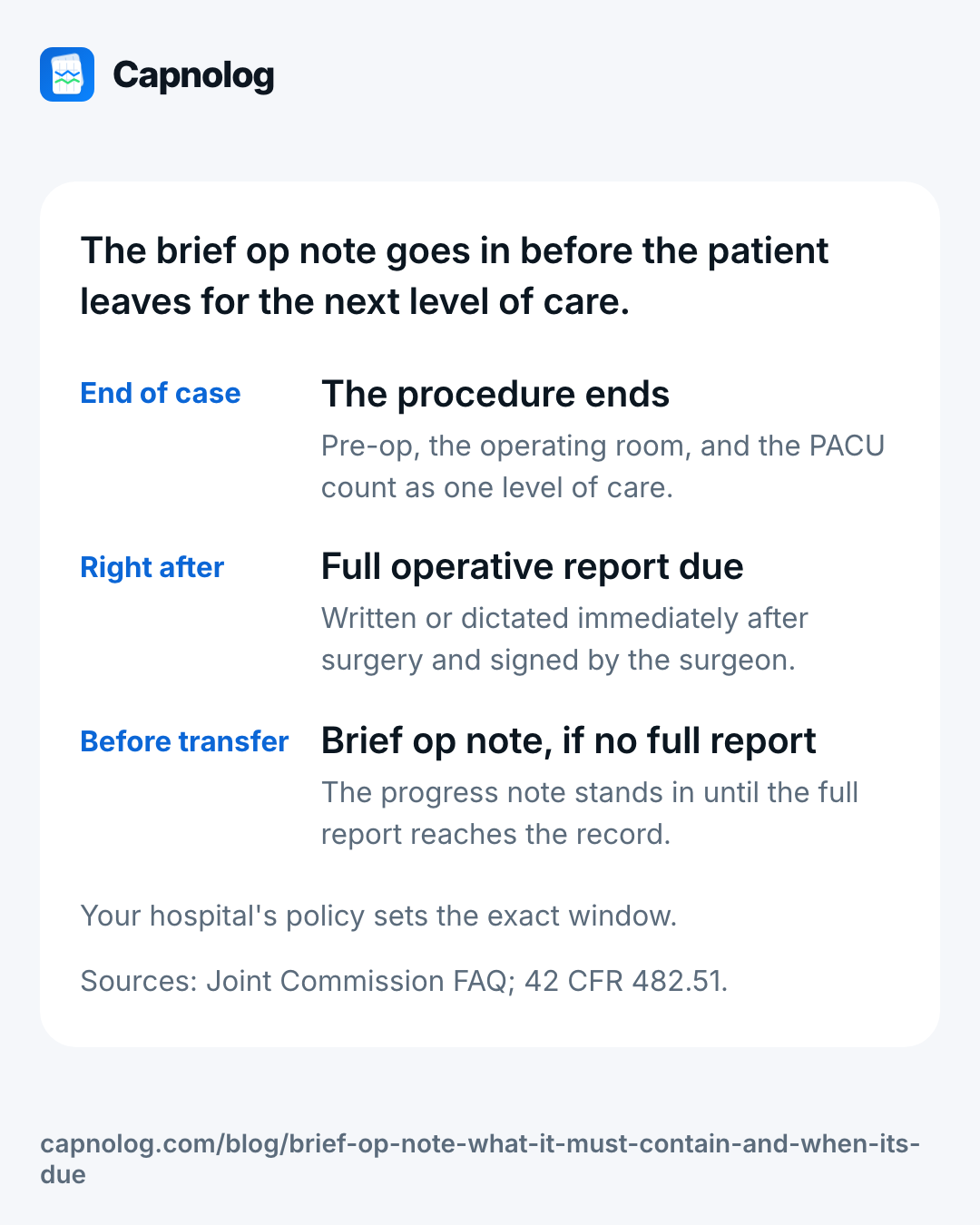
- End of caseThe procedure endsPre-op, the operating room, and the PACU count as one level of care.
- Right afterFull operative report dueWritten or dictated immediately after surgery and signed by the surgeon.
- Before transferBrief op note, if no full reportThe progress note stands in until the full report reaches the record.
Your hospital's policy sets the exact window.
Sources: Joint Commission FAQ; 42 CFR 482.51.
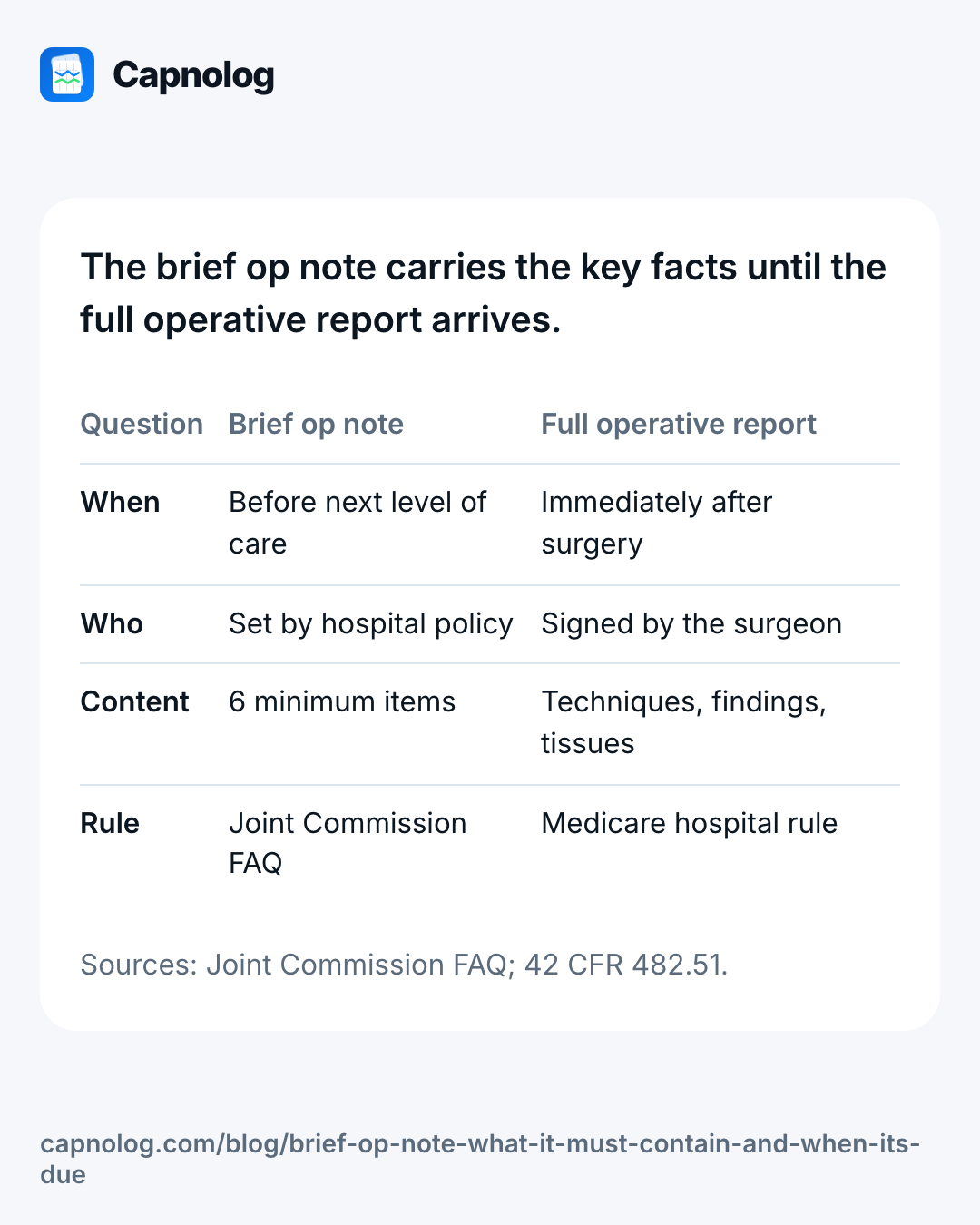
| Question | Brief op note | Full operative report |
|---|---|---|
| When | Before next level of care | Immediately after surgery |
| Who | Set by hospital policy | Signed by the surgeon |
| Content | 6 minimum items | Techniques, findings, tissues |
| Rule | Joint Commission FAQ | Medicare hospital rule |
Sources: Joint Commission FAQ; 42 CFR 482.51.
What goes in the note
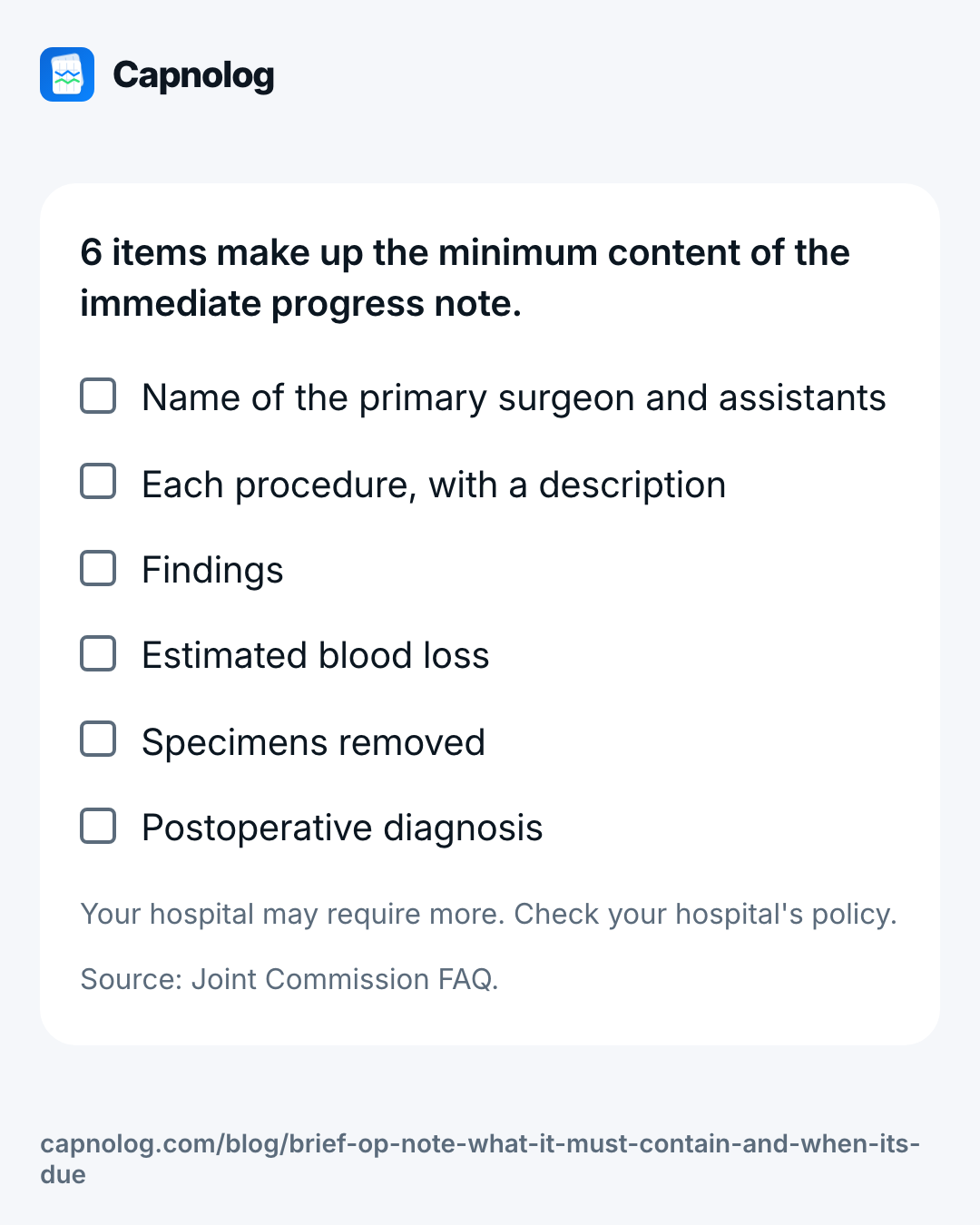
The same FAQ lists the minimum content of the immediate progress note (Joint Commission FAQ). The list has 6 items: the primary surgeon and assistants, each procedure with a description, findings, estimated blood loss, specimens removed, and the postoperative diagnosis (Joint Commission FAQ).
- Name of the primary surgeon and assistants
- Each procedure, with a description
- Findings
- Estimated blood loss
- Specimens removed
- Postoperative diagnosis
Your hospital may require more. Check your hospital's policy.
Source: Joint Commission FAQ.
Your hospital may ask for more than these 6. Write each item so the next team can act on the note without calling you, and keep the wording plain.
- Surgeons: the primary surgeon and each assistant, by name.
- Procedures: each procedure performed, with a one-line description.
- Findings: what the next team needs to know, in plain words.
- Blood loss and specimens: the estimate, and each specimen removed.
- Postoperative diagnosis: the diagnosis at the end of the case, which may differ from the diagnosis you started with.
Setting up the note in Epic
Where the note lives depends on your hospital's build. In one health system's 2019 tip sheet, selecting the Brief Op Notes section in the surgeon's workspace filled in a SmartText with the required fields (Salem Health 2019).
The University of Iowa describes OpTime as Epic's operating room application, with 3 jobs: surgery scheduling, preference card management, and perioperative documentation (UI Health Care). The same page calls for a brief op note immediately after surgery, for patient safety and regulatory reasons (UI Health Care).
Read every field that fills in without you before you sign, because a template cannot know what you found. Build one SmartPhrase per common case, with headings only and a blank for each finding.
Order sets save steps around the case as well. An otolaryngology guide gives separate preoperative order sets for different thyroidectomy types, each placed in one click (Resser 2025).
Keep screens from your hospital's tip sheets out of anything you share. In one tip sheet, 4 of 5 pages carried a footer calling the content confidential and copyrighted information of Epic Systems Corporation (Salem Health 2019).
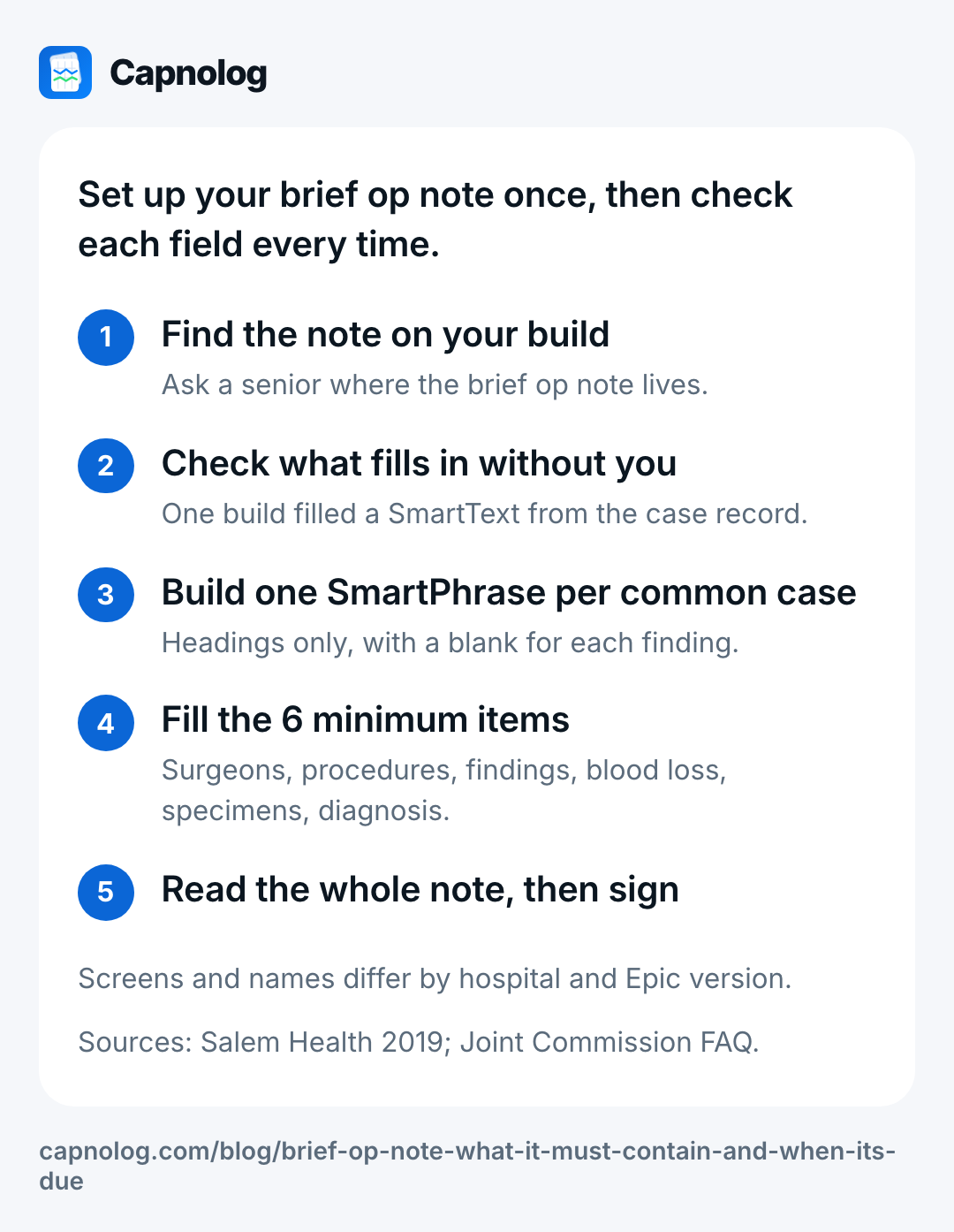
- Find the note on your buildAsk a senior where the brief op note lives.
- Check what fills in without youOne build filled a SmartText from the case record.
- Build one SmartPhrase per common caseHeadings only, with a blank for each finding.
- Fill the 6 minimum itemsSurgeons, procedures, findings, blood loss, specimens, diagnosis.
- Read the whole note, then sign
Screens and names differ by hospital and Epic version.
Sources: Salem Health 2019; Joint Commission FAQ.
Why the note is worth practicing
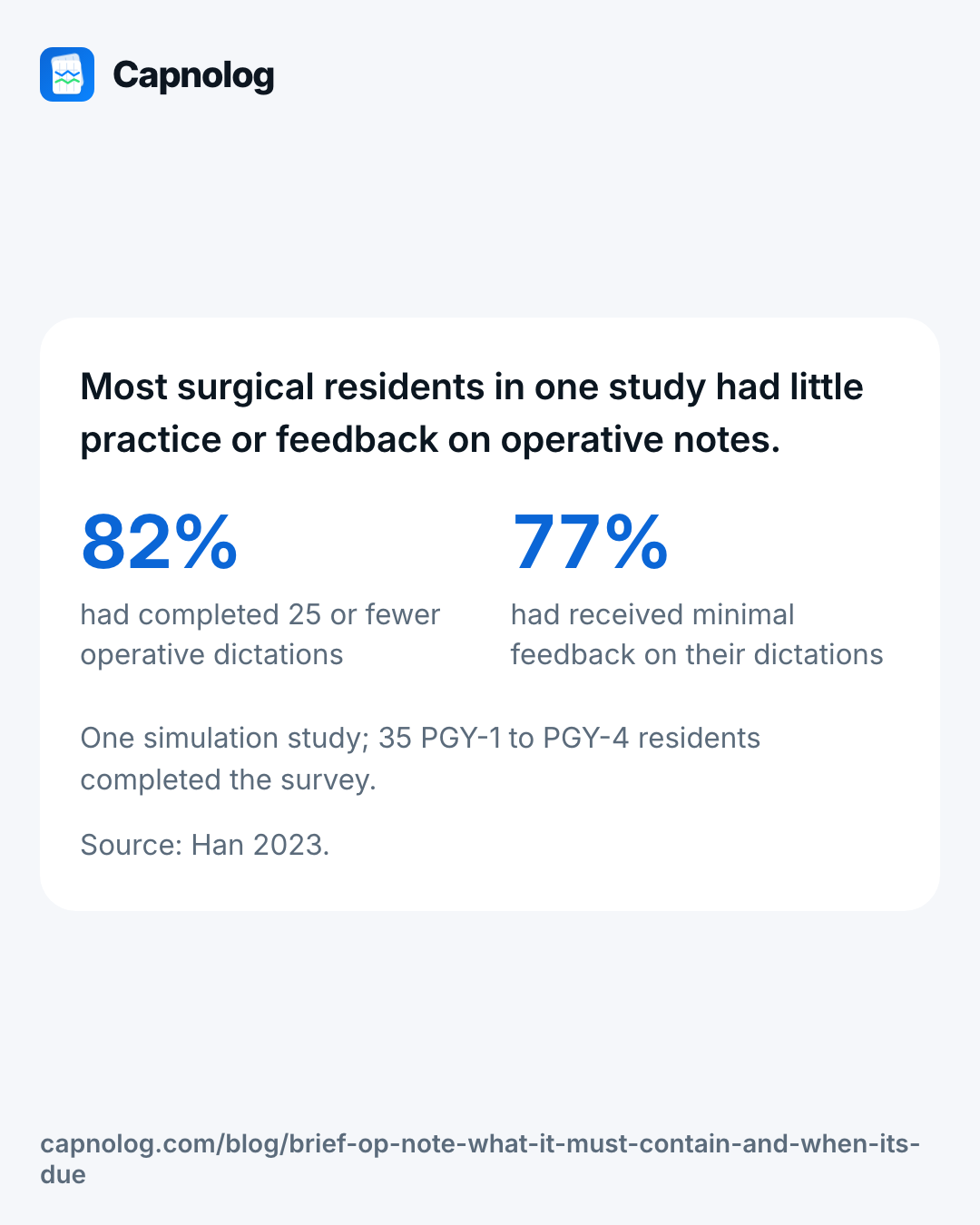
Operative notes get little teaching. In a simulation-based needs assessment of PGY-1 to PGY-4 surgical residents, 82% had completed 25 or fewer operative dictations (Han 2023). In the same group, 77% had received minimal feedback on their dictations (Han 2023). The authors concluded that training may not give enough teaching and feedback on operative notes (Han 2023).
One simulation study; 35 PGY-1 to PGY-4 residents completed the survey.
Source: Han 2023.
A brief note is short, which makes feedback easy to ask for. Ask your attending to review your first 5 brief notes and name what is missing. The same habit of writing the case down while the details are fresh helps with surgical case notes and with your case log.
After the note, log the case
The brief op note records the case for the hospital, and your case log records the case for your training. Log the case the same day, with your role. Case-log roles in urology covers how the role you log relates to what you did.
Capnolog is live for neurosurgery today. Urology is coming, and the urology page has a list you can join.
Keep a separate learning note.
Capnolog's surgical case-note template is for preparation and learning, not a replacement for the clinical operative note.
How to keep surgical case notesWhat this post does not cover
- This post is not legal or accreditation advice. Your hospital's policy and the accreditation manual decide the details.
- The FAQ quoted here sits in more than one Joint Commission manual, and the standard numbering may differ between manuals.
- The Epic examples come from single hospitals, one from 2019, and builds change between versions.
- The feedback figures come from one simulation study with 35 respondents.
- Capnolog has no affiliation with Epic or the Joint Commission, and every picture here is a drawing.
Sources
- 42 CFR 482.51(b)(6), Condition of participation: surgical services. Legal Information Institute, Cornell Law School.
- The Joint Commission. Standards FAQ: Operative and high risk procedure reports, timeframe of dictation or written. First published April 11, 2016; last updated October 14, 2023.
- Clinical Informatics, Salem Health. Changes to surgeon's workspaces in Epic (preprocedure and postprocedure buttons). Tip sheet, January 2019.
- University of Iowa Health Care. PostOp. UI Health Care Epic Education.
- Resser JR, Giliberto JP, Ruiz JW. EHR efficiency tips for otolaryngologists. AAO-HNS Bulletin, 2025.
- Han B, Clanahan J, Casson C, et al. Operative dictations in surgical trainees: an underutilized educational resource? Surgical Endoscopy, 2023.